10 Proven Ways to Manage Money Better in 2026
10 Proven Ways to Manage Money Better in 2026
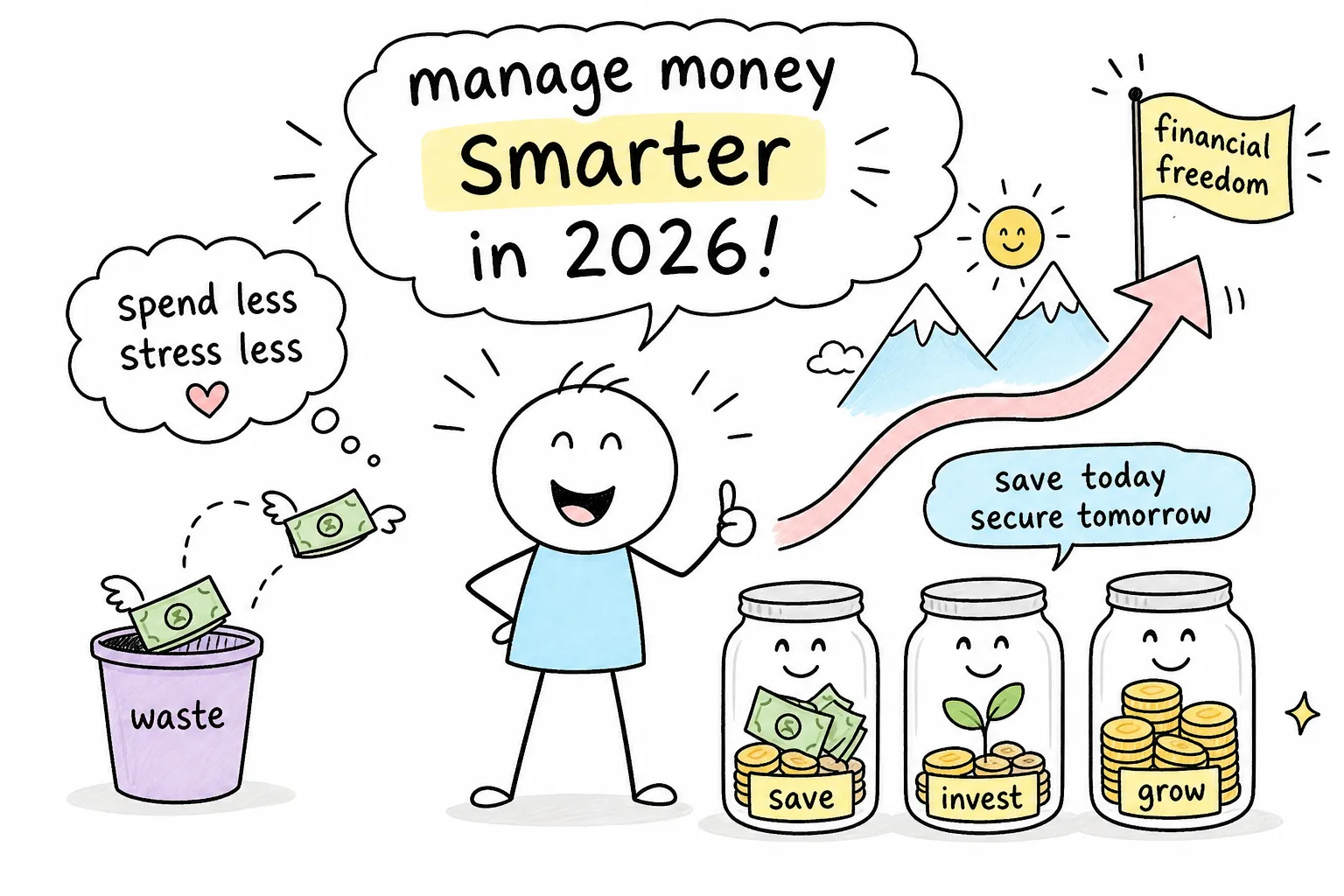
Here's a number worth sitting with: according to Bankrate, 53% of U.S. adults cannot cover a $1,000 emergency from liquid savings, and 33% say they'd take on debt to do so. That means more than half the country is one car repair, one medical bill, or one broken appliance away from a credit card balance. If that statistic hits close to home, you're not broken, and you're not bad with money. You just haven't had the right system yet, and the good news is that you can manage money better starting with a single diagnostic: how many months of expenses can you cover today?
Managing money better is a skill, not a personality trait. It's built through the right sequence of decisions: the budgeting method that fits your actual life, the savings target that's within reach, and the behavioral habits that make it stick past week three. This guide covers 10 concrete, proven strategies organized in the order most people should tackle them, from choosing a budget to protecting your progress against the habits that quietly erode it.
This is the kind of foundational material The Growth Engine is built on: the specific tactics and the behavioral systems underneath them that determine whether financial progress actually lasts. By the end of this article, you'll have a sequenced action plan you can start this week, not "someday."
How to manage money better: pick a budgeting method that fits where you are right now
A common reason people abandon budgets is choosing a method that doesn't fit their life. The system wasn't wrong; it just wasn't the right fit. The three methods below cover the full spectrum from simple to precise, and the right starting point depends on your income, your habits, and your goal.
Way 1: Use the 50/30/20 rule if you're new to budgeting
This method splits your take-home pay into three buckets: 50% for needs (rent, utilities, groceries, insurance, minimum debt payments), 30% for wants (dining out, subscriptions, entertainment), and 20% for savings and extra debt payoff. It's the easiest starting point for beginners because it requires almost no financial analysis to implement. You categorize your spending broadly, check whether you're in the right ballpark, and adjust from there.
The 50/30/20 rule works best for households with steady income and relatively uncomplicated expenses. One important caveat: in high-cost cities like New York, San Francisco, or Boston, housing can consume a much larger share of take-home pay, often making the standard split unrealistic. The fix is simple, adjust the percentages to reflect your actual costs. The framework still works even if your "needs" bucket is 60%. The goal is awareness and proportionality, not perfect adherence to the original ratios.
Way 2: Switch to zero-based budgeting when you want full control
Zero-based budgeting means every dollar of income gets assigned to a category before the month begins, so income minus all planned spending and saving equals zero. Nothing floats. Nothing is "leftover." This method takes more upfront effort than 50/30/20, but it produces the tightest financial control of any approach and works especially well if you have irregular income, an aggressive debt payoff goal, or a spending leak you can't seem to track down.
Apps like YNAB are built specifically for zero-based budgeting and reduce the spreadsheet work significantly. If you're serious about accelerating your financial progress and ready to invest a focused block of time in setup, this is the method that tends to produce the fastest measurable results for motivated savers and debt payers.
Way 3: Try the cash envelope method for problem spending categories
You don't have to use the envelope system for your entire budget. The smarter use is to apply it surgically to the one or two categories where you consistently overspend, typically dining out, groceries, or entertainment. At the start of the month, you put a fixed amount of cash (or a digital equivalent in an app) into that category. When it's gone, the spending stops. No exceptions.
The hard-stop mechanic is what makes this work. Other budgeting methods let you see that you've overspent after the fact. The envelope system creates a physical or psychological barrier before you overspend. Use it as a targeted tool alongside your main budgeting method, not as an all-or-nothing replacement.
Track your spending before you try to fix it
Budgeting without tracking is just guessing with formatting. Studies on consumer spending behavior consistently find that people substantially underestimate their discretionary spending because they're working from memory, not data. The tracking step isn't glamorous, but it's the diagnostic layer that makes every other money management tip in this article actually work.
Way 4: Audit a full month of transactions first
Before you set a single budget number, pull up the last 30 days of your bank and credit card statements and categorize every charge. Every coffee, every subscription, every Amazon order. This is a one-time exercise, and it will likely surface at least two or three spending patterns you didn't realize existed. The psychological impact of seeing real numbers instead of estimated ones is the entire point: it replaces the comfortable vague story you've been telling yourself with an accurate picture you can actually work with.
Don't adjust anything yet during this step. Just categorize and observe, and add one concrete note next to any category that surprises you. The goal is a clear baseline, because without one, your budget is fiction.
Way 5: Use one budgeting app consistently
For U.S. users in 2026, the top-rated options each serve a slightly different need. Monarch Money (App Store 4.9) is the strongest all-in-one financial dashboard, covering budgeting, net worth tracking, savings goals, and investment syncing in one place, with a 7-day free trial. YNAB is the go-to for zero-based budgeting specifically and pairs exceptionally well with Way 2. Rocket Money offers strong automation, passive savings tools, and subscription cleanup features. Quicken Simplifi is a solid option if savings goals are your primary focus. PocketGuard is the most approachable choice if you want a simple "safe to spend" view without extensive configuration.
The specific app matters less than the habit of using one consistently. Pick one based on your primary goal, give it at least 60 days, and resist the urge to app-hop when the novelty wears off. Consistency with an imperfect tool beats frequent switching between better ones.
Build an emergency fund before you do anything else
An emergency fund isn't a bonus feature of a healthy financial life. It's the foundation that keeps every other financial system from collapsing when something goes wrong. Without one, every unexpected expense lands on a credit card, and credit card debt undoes months of budgeting progress in a single bill. Bankrate research confirms that 33% of U.S. adults would take on debt to cover a $1,000 emergency. Building that cushion is the single most effective first step to improve your finances and break that cycle for good.
Way 6: Hit a $1,000 starter fund as your first milestone
The starter fund handles the most common financial emergencies without requiring you to carry a balance: a car repair, a medical copay, a broken appliance. Before you accelerate debt payments or pursue any other financial goal, get this $1,000 set aside in a separate account. The timeline will vary by household depending on income and current expenses, but many people find it achievable within a few weeks by temporarily redirecting discretionary spending. It's a near-term, achievable target that immediately reduces your financial vulnerability.
Keep this money in a high-yield savings account, completely separate from your checking account. Marcus by Goldman Sachs (4.40% APY, no minimum, no fees) and Ally Bank (4.20% APY with Savings Buckets for goal organization) are strong options for this. Separation matters because money sitting in your checking account gets spent.
Way 7: Automate to manage money better, grow to 3-6 months of essential expenses at 10% of income
Once the starter fund is in place, your ongoing savings target is 10% of monthly take-home pay directed toward the emergency fund until you reach 3-6 months of essential expenses. Essential expenses for this calculation include rent or mortgage, utilities, groceries, minimum debt payments, and insurance. That's it, not subscriptions, not dining out, not clothing.
Saving 10% of income creates a predictable path toward a fully funded emergency fund, typically reaching the three-month mark within 2-3 years from scratch. If your current income allows for more than 10%, push it. If 10% isn't possible right now, start with whatever you can automate consistently. Consistency beats amount in the early stages. For higher savings, CIT Bank Platinum Savings offers 4.50% APY, though it requires a $5,000 minimum balance.
Automate your savings so willpower isn't involved
Willpower is a finite resource, and any financial system that depends on you manually moving money from checking to savings every month is already compromised. Every dollar that requires a deliberate human decision to save is a dollar that's vulnerable to rationalization, distraction, or a rough Tuesday. Automation removes the decision entirely.
Way 8: Set up automatic transfers on payday using the pay-yourself-first system
Schedule a transfer to your savings account for the same day or the day after every paycheck hits. Most U.S. banks and credit unions support automatic transfers through online banking with just a few steps. The mechanics are simple: your paycheck lands, savings move automatically, and you spend from what's left. You never see the savings as available spending money, so you don't miss it.
A 2023 Vanguard behavioral research report identified automatic saving as one of the most reliable levers for building long-term savings, precisely because it removes the human decision point from the equation. To reinforce the habit further, give your savings accounts specific names: "Emergency Fund," "Car Fund," "Vacation Fund." Behavioral finance research shows that named, earmarked accounts reduce the psychological temptation to raid balances because the money feels mentally assigned rather than available.
Choose a debt payoff strategy and commit to it
Debt payoff isn't a motivation problem for most people. It's a strategy problem. The wrong method for your psychology leads to early abandonment, and abandonment is more expensive than choosing the "less optimal" method and sticking with it for three years. Here are the two dominant approaches with clear criteria for choosing between them.
Way 9: Use the debt snowball for motivation and early momentum
The snowball method works like this: pay the minimum on every debt, then throw every extra dollar at your smallest balance first. When that debt is paid off, roll that entire payment into the next smallest balance. You'll eliminate individual accounts faster than any other method, which produces real, visible wins on your statement within months rather than years.
The psychological payoff is the point. Eliminating one debt account, even a small one, delivers a measurable sense of progress that keeps people on the plan long enough to see it work. A widely cited study from Northwestern University's Kellogg School of Management found that focusing on paying off smaller accounts first increases the likelihood of eliminating overall debt, because visible early wins sustain the commitment. If that sounds like you, snowball is your method.
Way 10: Use the debt avalanche to pay the least interest overall
The avalanche method targets the debt with the highest interest rate first, regardless of balance size. Mathematically, this is the most efficient approach: it minimizes total interest paid and produces the fastest overall payoff timeline. If you have a credit card at 24% APR sitting next to a personal loan at 9%, the avalanche puts every extra dollar at the 24% card until it's gone.
The tradeoff is that visible progress can feel slower, especially if the highest-rate debt also carries the largest balance. This method works best for analytically motivated people who are comfortable tracking total interest saved as their primary progress metric rather than the number of accounts eliminated. Run your numbers in a debt payoff calculator and see which approach shaves the most off your total timeline and interest cost.
Guard your financial progress against lifestyle inflation
Lifestyle inflation is the most common reason people with rising incomes still feel financially stuck. As income grows, spending tends to grow proportionally, leaving the savings rate unchanged at zero no matter how many raises come through. It's not dramatic. It happens gradually, one small upgrade at a time.
What lifestyle inflation actually looks like in practice
You get a $6,000 raise and upgrade to a slightly nicer apartment because you can "afford it now." You add two new streaming subscriptions. You start going out to dinner on Thursdays because the extra income loosened the mental budget. You lease a newer car before the old one is paid off. Each individual decision feels entirely reasonable. Collectively, they absorb 100% of the income increase and leave your savings rate exactly where it was before the raise.
According to Bureau of Labor Statistics CPI data from mid-2026, inflation has been running near 3%, which means a portion of any raise is already offset before you spend a dollar of it. Spending patterns frequently expand to match or exceed the full nominal increase, leaving real purchasing power gains on the table.
The "bank your raise" rule before adjusting your lifestyle
When income increases, treat this as a rule of thumb: direct at least 50% of the increase to savings or debt payoff before adjusting any spending. If you receive a $5,000 annual raise, that's $416 per month. Banking half of it means $208 per month goes to your emergency fund or debt payoff automatically. Over 12 months, that's $2,496 in accelerated progress without touching your existing lifestyle at all.
This isn't deprivation. You still get to enjoy the raise. You just claim half of it for your financial future before lifestyle creep claims all of it. The best time to improve your savings rate is the moment your income increases, because you haven't yet adjusted your spending upward to match.
The daily habits and mindset shifts that make all of this sustainable
Most people know the basics of what they should do with money. The gap isn't knowledge; it's consistent execution. That gap is behavioral, and it's where most financial plans collapse after two or three weeks. The habits below are the layer that determines whether someone actually follows through on the previous six sections long-term.
Behavioral routines with real evidence behind them
Four habits, used together, form one of the most evidence-backed starting stacks for how to manage finances sustainably:
- Automatic transfers on payday, removes the savings decision entirely so the money moves before you can spend it
- A 24-to-48-hour purchase delay on non-essential buys, introduces friction between impulse and purchase; behavioral research supports that even a brief pause disrupts the automatic response driving most non-essential spending
- A weekly 10-minute money review, keeps spending aligned with your actual budget before small overages compound
- Named savings accounts, reduces the psychological pull to raid balances because earmarked money feels assigned, not available
Each of these habits works by reducing friction in one direction or increasing it in the other. Automation makes saving frictionless. A purchase delay makes impulse spending slower. A weekly review makes overspending visible before it compounds. Named accounts make raiding savings feel like a rule violation instead of a neutral financial transfer. Used together, they form a system that doesn't depend on motivation to function.
Why The Growth Engine connects money management to habits and mindset
Most personal finance content focuses exclusively on tactics: which app to use, which debt method to pick, which savings account pays the highest rate. That information is useful, but it's incomplete. At The Growth Engine, the premise is that sustainable financial improvement requires both the right tactics and the habit systems and mindset shifts that support them, because one without the other rarely produces lasting results. The site covers how daily routines, identity-based change, and realistic goal-setting intersect with budgeting and debt reduction, recognizing that the person who builds better financial habits is also building a better relationship with money itself.
Your 30-to-90-day action plan to manage money better starting now
The 10 ways above are most effective when implemented in sequence, not all at once. Here's the roadmap by month, designed so each step builds on the one before it.
Month 1: Set up the foundation
- Choose your budgeting method (Ways 1-3) based on your income type, current habits, and primary financial goal
- Audit the last 30 days of all bank and credit card transactions and categorize every charge (Way 4)
- Download and configure one tracking app, Monarch Money, YNAB, Rocket Money, Simplifi, or PocketGuard, and commit to it for at least 60 days (Way 5)
- Open a separate high-yield savings account, name it "Emergency Fund," and set up an automatic transfer for the same day as your paycheck (Ways 6 and 8)
- Target for Month 1: $1,000 starter emergency fund in place
Months 2-3: Add layers and accelerate
- List every debt with its balance, interest rate, and minimum payment, then choose the snowball or avalanche method based on your psychology (Ways 9-10)
- Review your spending categories and identify at least one lifestyle inflation pattern to reduce or eliminate
- Apply the "bank your raise" rule to any upcoming income increase before adjusting lifestyle spending
- Implement the 24-hour purchase delay for non-essential buys and schedule a weekly 10-minute money review
- Target for Months 2-3: Consistent budget in place, first extra debt payment made, emergency fund growing toward one month of essential expenses
Financial resilience is built one system at a time
Building a stronger financial foundation isn't a single decision you make in January. It's a sequence of small systems, each built on the one before it, each compounding over time. The 10 ways in this article aren't meant to be implemented simultaneously. They're meant to be stacked in the order that matches where you are right now, starting with the one or two that close your most immediate financial gaps.
The combination of smart tactics and sustainable habits is what separates people who see lasting financial improvement from those who hit a strong three-week streak and slide back to old patterns. The tactics tell you what to do. The habits are what keep you doing it when motivation runs low, and it will. Every automatic transfer, every purchase delay, every weekly money review compounds into a financial life that's less reactive and more resilient.
Every step you take now builds on itself. A $1,000 emergency fund becomes three months of expenses. One debt paid off frees up cash flow for the next. A budgeting habit formed this month is one you won't have to think about in six months. For more on the habit systems and financial strategies that make this sustainable long-term, explore the full library of budgeting and personal finance guides at The Growth Engine. The next step is closer than it looks from where you're standing.
Frequently asked questions about managing money better
What is the fastest way to start managing money better?
The fastest starting point is a one-time audit of your last 30 days of transactions. Categorize every charge before you build any budget. Most people discover two or three spending patterns they didn't know existed, which makes every subsequent step more effective. Once you have that baseline, choose a budgeting method and set up one automatic savings transfer.
How many months of expenses should an emergency fund cover?
Financial guidance from sources including the Consumer Financial Protection Bureau recommends 3-6 months of essential expenses. Essential expenses include rent or mortgage, utilities, groceries, minimum debt payments, and insurance. Start with a $1,000 milestone first, then build toward the three-month target at a consistent savings rate.
What is the difference between the debt snowball and the debt avalanche?
The snowball method pays off your smallest balance first to build early momentum and motivation. The avalanche method targets the highest interest rate first to minimize total interest paid. The best choice depends on your psychology: if you need visible wins to stay motivated, use snowball. If you're driven by optimizing the math, use avalanche.
What are the best money management tips for beginners?
For beginners, the highest-impact money management tips are: (1) track your actual spending for one full month before budgeting, (2) start with the 50/30/20 rule to build the habit without overcomplicating it, (3) build a $1,000 emergency fund before tackling anything else, and (4) automate at least one savings transfer so the decision is removed from the equation entirely.
How do I improve my finances without a big income?
You improve your finances by controlling what you can: tracking every dollar, eliminating one or two spending leaks, and automating even a small transfer on payday. A $25 automatic transfer is more effective than a $200 manual one you skip half the time. The behavioral habits, automation, purchase delays, weekly reviews, matter more than income level in the early stages.


Comments
Post a Comment