How to Monetize a Low-Traffic Blog in 2026 (12 Strategies)
How to Monetize a Low-Traffic Blog in 2026 (12 Strategies)
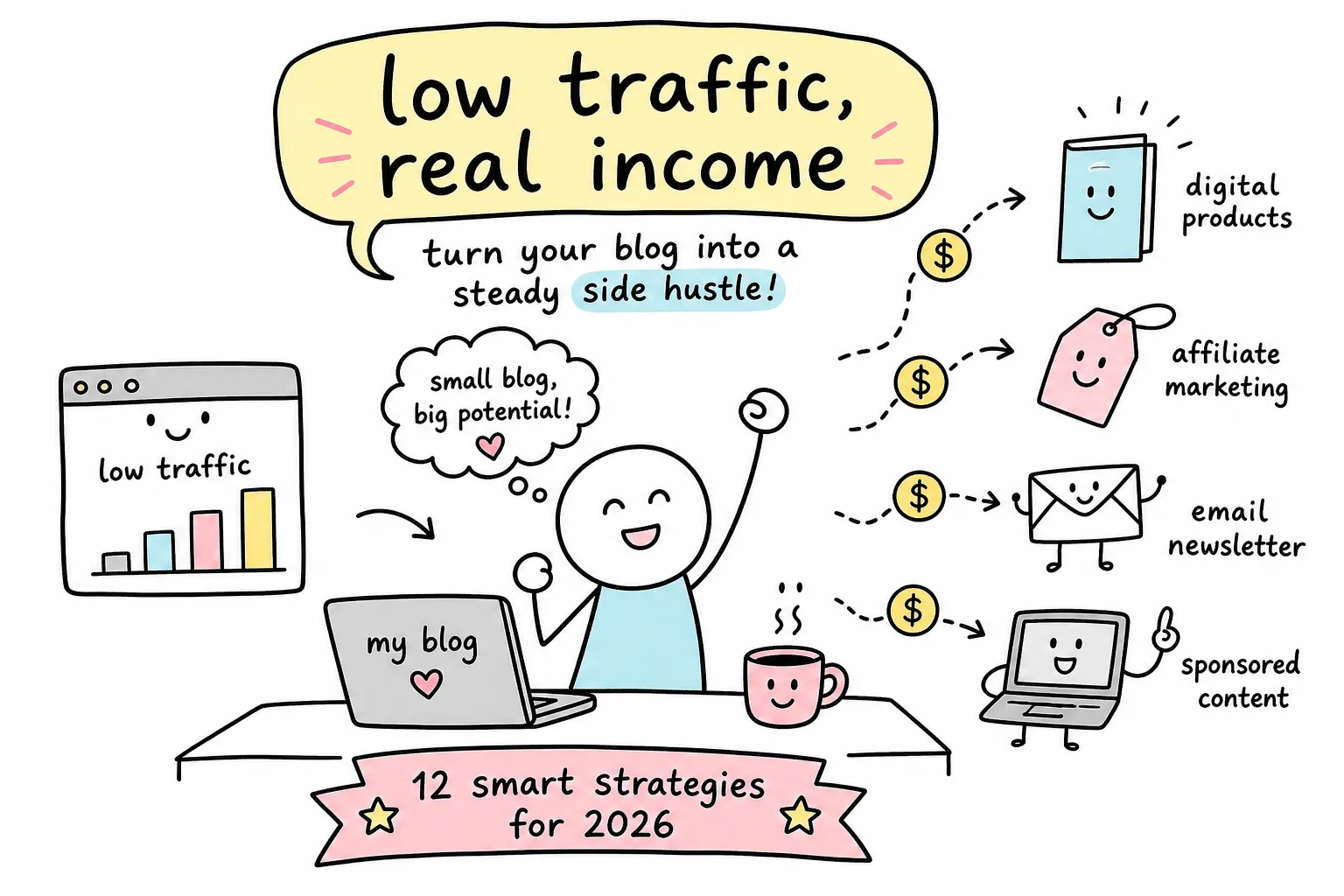
Most beginner bloggers wait. They tell themselves they'll figure out monetization once they hit 10,000 monthly visitors, then 20,000, and somehow the goalposts keep moving. Meanwhile, months pass without a single dollar earned, and that waiting strategy isn't just unnecessary, it's costing real money.
A small, loyal audience in a tight niche is more valuable than a flood of uninterested readers who click away in eight seconds. A personal finance blogger made her first affiliate commission at 1,200 monthly visitors. Stock Millionaires, a niche site with roughly 8,500 monthly readers, cleared $10,000 per month through high-ticket affiliate offers. These aren't outliers. They're what happens when the right monetization method meets the right audience, regardless of traffic volume.
At The Growth Engine, we cover blogging, personal finance, and personal development from exactly this angle: you don't need to go viral to build real income. This article breaks down 12 practical strategies for how to monetize a blog with low traffic in 2026, organized by category, paired with a simple framework for picking the two or three methods that fit your blog, and followed by a 90-day action plan to turn your existing readers into your first revenue source.
Why low traffic doesn't mean low income
The biggest misconception in blogging is that income scales linearly with traffic. It doesn't. What actually determines whether a blog makes money is revenue per visitor, not total visitors. A niche blog sending 500 visitors per month to a high-converting affiliate offer can outperform a general blog with 5,000 visitors running display ads, and the math behind that isn't complicated.
The case studies prove it. A blog with fewer than 100 daily visitors generated $12,000 on a single ebook launch day and $35,000 in its first two months after building an email list and releasing a digital product. What those blogs had wasn't a massive audience, they had the right offer in front of the right people.
The metric that actually matters: revenue per visitor
Revenue per visitor (RPV) is the number that tells you how efficiently your blog is turning attention into income. To calculate it, divide total monthly earnings by total monthly visitors. A blog earning $300 from 600 visitors has an RPV of $0.50. A blog earning $100 from 5,000 visitors has an RPV of $0.02. The second blog has more traffic and less money, RPV is the lens that reveals which blog is actually winning.
Bloggers who obsess over session counts while ignoring RPV are optimizing the wrong thing. Focus on higher-converting offers and content that attracts buyers, not just browsers.
Why display ads are the wrong starting point
Display ad networks typically require 10,000 or more monthly sessions before they generate meaningful revenue, hundreds to low thousands of dollars per month. At under 5,000 monthly visitors, most ad placements pay a few dollars per month at most. That's not a revenue strategy; it's a distraction that clutters your site and degrades the reader experience you need to build trust.
Skip display ads for now. The methods covered below produce real income at a fraction of the traffic ad networks require, and they don't depend on someone accidentally clicking a banner while reading your content.
How to monetize a blog with low traffic in 2026: affiliate marketing built for small audiences
Affiliate marketing is the most reliable income channel for blogs under 5,000 monthly visitors, but only when it's matched to buyer-intent content. A review or comparison post targeting someone who's already decided to buy converts far better than an informational post written for someone just browsing. Small blogs should concentrate affiliate effort on comparison posts, tutorials with embedded tool recommendations, and problem-solution articles tied to specific offers.
For personal finance blogs, programs like NerdWallet, SoFi, Acorns, Credit Karma, and Empower are strong starting points. For blogging education content, Kit (formerly ConvertKit), Semrush, and Teachable map cleanly to "how to start a blog" and "best tools for creators" style content. The common thread is audience fit: the affiliate offer should solve the exact problem the post is addressing.
How to pick affiliate offers that convert at low traffic
Focus on offers that pay recurring commissions, have tight niche alignment, and connect directly to the problem your post solves. A personal finance blog recommending a budgeting app to someone searching for the best budgeting tools is far more effective than a generic product mention dropped into an unrelated article. The reader's purchase intent is already high, your job is to make the right recommendation at the right moment.
When you're just starting out, prioritize programs with low-friction user actions like free account signups or app downloads. These convert more easily than high-ticket purchases, which helps you build early momentum and track what's working.
Realistic earnings benchmarks for beginner blogs
Set honest expectations: $0 to $500 per month is a common starting range, with well-positioned niche review posts capable of generating $50 to $500 per month from a single URL. In one illustrative example, a personal finance blogger with 700 targeted monthly readers reported consistent affiliate commissions by pairing buyer-intent content with tightly matched offers. Your first three to five affiliate posts won't all be winners, but the ones that connect a specific search intent to the right offer will compound over time.
To estimate what you can realistically earn, calculate the monthly clicks your top posts send to affiliate links, multiply by a conservative 1% to three% conversion rate, and multiply by the commission per sale. That gives you a working baseline to improve from.
Where to place affiliate links for maximum clicks
Commonly high-converting placements include in-content links, resource pages, and email sequences. Sidebar widgets and banners often underperform compared with in-content links and email placements, where readers' attention is focused on solving a specific problem. Put your links inside the content itself, near the point where the reader's problem becomes most clear. US bloggers are also required to disclose affiliate relationships under FTC Endorsement Guides; keep your disclosure visible and specific, not buried in fine print.
Digital micro-products that sell without big traffic
Digital products are the highest-leverage income method for blogs with loyal but small audiences. A tightly focused product that solves one specific problem can generate $15 to $97 per sale with no inventory, no shipping, and no ongoing delivery cost. The operative word is "tightly focused", broad digital products aimed at everyone appeal to no one. One promise, one audience, one clear price point.
The five formats that work best for small blogs are checklists ($15 to $35), templates ($25 to $47), mini email courses ($47 to $97), resource libraries ($25 to $45 per month), and short PDF guides ($17 to $37). Start with the format that's fastest for you to create and most directly tied to a problem your readers already ask you about.
How to price your first product without undercharging
Price based on the outcome your product delivers, not the hours it took to create. A budgeting template that helps someone redirect $200 per month toward savings is worth considerably more than $12. Run this pricing check: identify the concrete result the buyer gets, estimate what that result is worth in dollars or time saved, then price the product at a fraction of that value, somewhere between 5% and 20%, and make sure it feels like an obvious trade.
Most beginners undercharge because they're thinking about their effort rather than the buyer's outcome. Start where you can confidently defend the price, sell your first few copies, and raise the price once demand validates it.
Where to sell and how to deliver without tech headaches
Payhip, Lemon Squeezy, and Gumroad are all low-barrier starting points for small blogs. Payhip is a solid default choice for low-volume testing because its free plan charges only 5% per transaction with no monthly fee. Lemon Squeezy handles VAT and sales tax automatically, which matters if you're selling to customers outside the US. Gumroad is the fastest to set up but becomes less economical as you scale and margins matter more.
A blog doesn't need a complex funnel to launch its first product. A focused sales page, a checkout link, and an automated delivery email are enough to get started. Build more sophisticated infrastructure only after the product has proven it sells.
Turning your email list into a real revenue channel
Email is the most underrated asset a small blog can build. Social media platforms change their algorithms. Search rankings shift. Your email list belongs to you, and it compounds over time in a way that neither traffic source does. Small lists can absolutely generate income, even lists in the 200- to 300-subscriber range can promote digital products and warm readers up for coaching or service offers when the content and sequence are well matched to the audience.
The opt-in rate benchmark to aim for is 2% to 5% of blog visitors. A targeted lead magnet that solves a specific problem will consistently outperform a generic "subscribe for updates" prompt. A personal finance blog offering a free debt payoff tracker will convert better than the same blog with no lead magnet, even at identical traffic levels. Build the lead magnet before you focus on growing traffic, not after.
Building an email list even when traffic is thin
Three lead magnet formats work reliably for beginner blogs: a single-topic checklist, a fill-in-the-blank template, and a short email course delivered over five to seven days. The email course is particularly effective because it creates multiple touchpoints with new subscribers before you ever make an offer. Readers who open four to five emails in a sequence are significantly more likely to buy than someone who signed up and received a single PDF.
Place your opt-in form inside posts, not just in the sidebar. A contextually relevant opt-in embedded within the body of a post converts at a higher rate than a generic widget that appears on every page regardless of topic.
How to monetize your list without feeling pushy
The 80/20 rule works: deliver value 80% of the time and make offers 20% of the time. A welcome sequence of five emails can introduce one affiliate recommendation or product offer naturally within that window without burning trust. For example, the fourth email in the sequence might offer a relevant template or tool with a brief explanation of why you use it, that context makes the offer feel like a resource, not a pitch. Automated sequences convert at 3% to 6% for well-targeted niche audiences, which runs significantly above the average for broadcast emails. Build the automation once and let it work for every new subscriber who joins.
Micro-sponsorships and niche brand deals
Sponsorships aren't reserved for blogs with 50,000 monthly visitors. Brands in tight niches actively look for small, engaged audiences where their product fits precisely. A blog with 2,000 highly qualified readers in a specific vertical is often more attractive to the right brand than a general blog with 20,000 disengaged visitors. The pitch shifts from "here's our traffic" to "here's our audience, and here's why they need your product."
For niche blogs with under 5,000 monthly visitors, sponsorship rates generally start at $50 to $150 per sponsored post. Newsletter placements for particularly engaged, niche-aligned lists can range from $100 to $300, though $30 to $100 is more typical for general small lists. These aren't headline-grabbing numbers, but they're real income that stacks when combined with other methods.
When a small blog is actually ready to pitch sponsors
As a practical guideline, aim for a defined niche, 500 or more email subscribers (or 2,000 or more monthly readers), and at least three months of consistent publishing history before outreach. These signals tell brands the blog is an ongoing property with an established audience, not a side project that might disappear in 60 days. You don't need to hit all three perfectly, but meeting two of them makes outreach considerably more credible.
Writing a sponsorship pitch that gets a reply
Keep the first email under 200 words. A structure that works: a personalized opening that references something specific about the brand, two or three audience metrics (monthly readers, email open rate, or subscriber count), the specific placement you're offering, a starting price or package range, and a single low-friction ask such as "Would you be open to a quick call to see if this is a fit?"
Here's a short, adaptable template you can use immediately:
Subject: Partnership idea: [Blog Name] and [Brand Name]
Hi [First Name], I run [Blog Name], a blog for [specific niche audience]. I noticed [Brand Name] serves people who care about [relevant topic], and I think there's a strong audience fit. My site reaches [monthly readers] readers and [email subscribers] subscribers, with a [open rate]% email open rate. I'd love to offer a [sponsored post / newsletter mention] to get your brand in front of this audience. Would you be open to a quick conversation?
Personalize heavily. Generic pitches get deleted. A pitch that mentions a specific product, a recent campaign, or a genuine alignment between your audience and their customer base stands out in any inbox.
Productized services: the fastest path to first-dollar income
Services require zero product creation time and can generate $300 to $5,000 per month from a blog with only a few hundred monthly readers. A blog positions the writer as the expert. Readers who trust the content are already warmed up to hire the person behind it, that trust shortens the sales cycle dramatically compared to cold outreach.
A personal finance blogger can offer budget audits. A blogging education blogger can offer content strategy sessions, blog setup packages, or SEO audits. A self-improvement blogger can offer accountability coaching. The key is making the offer outcome-based and scope-limited so delivery stays consistent and you're not reinventing the service for every client.
How to package and price a beginner service offer
A three-tier structure works well: a Starter tier for first-time buyers with low friction and a clearly scoped deliverable, a Core tier that becomes the default choice most clients select, and a Premium tier with faster turnaround or more personalized support. For floor pricing, estimate your fully loaded delivery time including revisions and communication, multiply by your target hourly rate, then add 20 to 25% for overhead and a 20 to 30% profit margin on top. That number is your minimum, price the Core tier at or above it.
Name your tiers around outcomes, not deliverables. "Blog Launch Package" converts better than "3 Blog Posts + Setup." The buyer wants the result, not a description of your process.
How to monetize a blog with low traffic in 2026: picking the right 2 to 3 methods
Not every method fits every blog. A high-intent review blog in a software niche will convert differently than a personal finance blog with 800 monthly readers and a strong email list. The decision filter is straightforward: match your content type to the monetization method it naturally leads to, then choose the combination that creates the least friction for your reader to take the next step.
Reviews and comparison posts are natural affiliate vehicles. How-to guides are natural product and service upsells. Personal stories build the trust that converts readers into email subscribers and email subscribers into buyers. Identify which format makes up most of your existing content and start there.
The combinations that tend to work best together
Affiliate marketing paired with one digital product is the highest-leverage starting combination for most beginner blogs. Email capture supports both. Services work best as a standalone add-on for bloggers with a demonstrable skill they can deliver in a structured format. Here's how that plays out across three common blogger profiles:
- Personal finance blogger (800 monthly readers): Affiliate marketing tied to budgeting apps and investing platforms, plus a $37 budget template as a digital product. Email list with a debt payoff tracker lead magnet.
- Blogging education blogger (1,500 monthly readers): Affiliate marketing for hosting, email tools, and SEO software, plus a $97 mini course on launching a first blog post. Blog setup service as a Premium offer.
- Self-improvement blogger (600 monthly readers): Affiliate marketing for productivity apps and books, plus a $25 habit tracker template. Accountability coaching as a service for the most engaged readers.
Your 90-day plan to turn a small blog into a revenue source
The 90-day frame works because it's long enough to see real results but short enough to stay focused. Trying to implement all 12 strategies at once is how bloggers end up with nothing fully built and nothing earning. Each month has a single clear priority.
Month 1: Foundation and first offers
Set up an email opt-in with a targeted lead magnet. Publish three to five high-intent posts with embedded affiliate links pointed at programs you've already joined. Choose one digital product idea and validate it by asking three to five existing readers if they'd pay for it before you build it. No revenue is expected this month. Month one is infrastructure, you're building the systems that will generate income in months two and three.
Month 2: Optimization and first income
Launch the digital product to your email list, even if the list is small. Send your first affiliate-focused email sequence using the 80/20 rule. Apply to two to three affiliate programs that match your niche content. Begin tracking RPV on your top posts by connecting traffic data with any affiliate earnings those posts are generating. This month should produce your first dollars, not necessarily your first hundreds, but proof that the system works.
Month 3: Stack and scale
Identify the one method generating the most income and double down on it. Begin sponsor outreach if your email list has crossed 500 subscribers. Raise the price on your digital product if early sales validated demand. Revisit your top 10 posts and add monetization touchpoints you missed in month one: in-content affiliate links, calls to action for your product, or opt-in prompts for your email list. This is the compounding month where the foundation starts to pay off.
Start now, not when traffic arrives
Waiting for traffic is the wrong strategy. Bloggers who start earning early treat monetization as part of the blog's design from day one, not an afterthought they'll figure out later. If you've been searching for how to monetize a blog with low traffic in 2026, the answer is already in front of you: pick two of the five core methods covered here, affiliate marketing, digital products, email monetization, micro-sponsorships, or productized services, execute the 90-day plan, and track your RPV instead of your session count.
Month one builds the infrastructure. Month two generates the first proof of income. Month three reveals which method to scale. You don't need a viral post or a media feature to get there, you need a clear offer, a targeted audience, and the discipline to ship something before you feel ready.
To keep building on this foundation, The Growth Engine covers blog monetization, content strategy, email list building, and personal finance in practical depth. Bookmark it, return often, and take one action from this article in the next 24 hours. Try one method from this list to start monetizing your blog with low traffic in 2026, set a 30-day goal, build your email opt-in today, and start.
#BlogMonetization,#PassiveIncome,#CreatorEconomy,#AffiliateMarketing,#DigitalProducts,#BloggingTips


Comments
Post a Comment