Blog Monetization Strategies That Work at Any Traffic Level
Blog Monetization Strategies That Work at Any Traffic Level
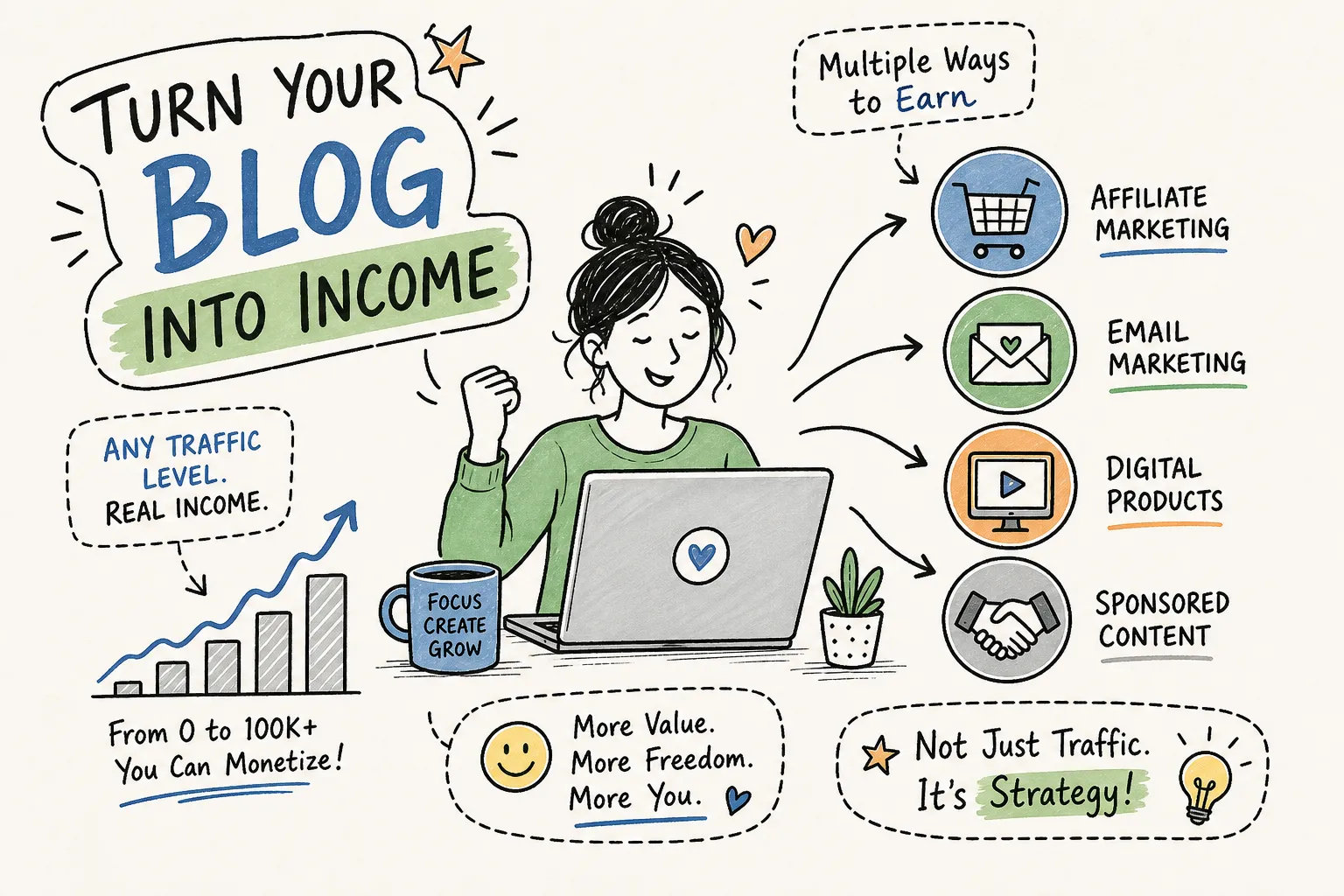
Blog monetization strategies are everywhere online, but most of them share the same flaw: they're written for a generic blogger who doesn't exist. The advice assumes you already have traffic, an email list, and a niche that happens to align with whatever revenue method the writer is promoting. For the blogger with 2,000 monthly visitors trying to make money blogging, that advice is nearly useless.
The real problem isn't a lack of strategy. It's a mismatch between where you are and what you're trying to do. At The Growth Engine, we operate at the intersection of blogging education, personal finance, and self-improvement, three niches that naturally build multiple blog revenue streams because the audience has high-value problems worth solving. Audience intent matters here: finance and blogging education readers consistently show higher commercial intent, which translates directly into stronger ad RPMs and affiliate conversion rates compared to general lifestyle content. That positioning matters, and your niche will shape your income ceiling just as much as your traffic numbers.
This guide breaks down every major blog monetization method by traffic tier, gives you realistic income ranges based on current data, and closes with a prioritized 90-day action plan you can follow starting today.
Why Your Traffic Tier Changes Everything About Blog Income
Most bloggers fail at monetization not because they picked the wrong strategy, but because they picked the right strategy for the wrong stage. Running display ads at 2,000 monthly visitors earns you $4 to $20 a month. Building an affiliate content system at that same traffic level can realistically earn $200 to $500 a month. The content creation effort required is essentially the same. The income isn't.
The Three Stages of Blog Monetization
Traffic tiers create a natural monetization roadmap. Under 10,000 monthly visitors is your early stage, where affiliate marketing and digital products generate the most income per visitor. From 10,000 to 50,000 visitors is your growth stage, where stacking revenue streams, ads alongside affiliates and a simple product, starts to compound. Above 50,000 visitors is your scale stage, where premium ad networks, sponsorships, and flagship products turn your blog into a full business.
Why Mismatching Strategy to Stage Kills Momentum
The stage mismatch is the most common reason bloggers quit before monetization has a chance to build. A blogger applying AdSense to a 2,000-visitor site spends the same content creation effort they could channel into a single affiliate review post that earns 10 to 20 times more per month. Niche plays a major role here, too: a finance blog at 10,000 visitors routinely outperforms a general lifestyle blog at 50,000 visitors in ad RPM, because finance audiences carry higher commercial intent and brands pay a premium to reach them.
Blog Monetization Strategies for Display Ads: Use Them at the Right Stage
Display ads feel like the obvious starting point because they're passive. You install a plugin and revenue appears automatically. That logic holds at scale, but the numbers at early stages will disappoint you if you're not prepared for them, and setting up ads before you're ready creates a real page-speed tradeoff that can hurt the organic rankings driving your traffic in the first place.
The Ad Network Ladder and What Each Tier Pays
Ad networks in 2026 fall into clear tiers based on traffic minimums and RPM potential. Entry-tier options include Google AdSense (no traffic minimum, $4, $12 RPM for U.S. traffic), Ezoic (minimal traffic required, $8, $18 RPM with AI-based optimization), and Monumetric (10,000 pageviews required, $6, $12 RPM). RPM figures for entry-tier networks vary by niche, seasonality, and audience geography, so treat these as directional benchmarks rather than guarantees.
Premium-tier networks require higher volume but pay significantly more. Mediavine Journey lowered its entry point to 1,000 monthly sessions; reported RPMs vary by niche and optimization level, with publishers commonly citing $8, $25 RPM depending on content category and time of year. Mediavine's main network now requires roughly $5,000 in annual ad revenue (approximately 25,000 monthly pageviews for an average site) and delivers $25, $45 RPM. Raptive sits at the top, requiring 25,000 monthly pageviews and delivering $30, $50 RPM for U.S. audiences. Always verify current eligibility requirements directly with each network, as thresholds are updated periodically. For a concise summary of current Mediavine requirements and thresholds, consult recent third-party write-ups that track network changes.
When Display Ads Make Sense (and When They Don't)
Below 10,000 monthly visitors, display ads typically generate between $10 and $100 a month. The opportunity cost of setup time rarely justifies it at that stage. From 10,000 to 50,000 visitors, mid-tier networks become worth testing alongside your affiliate content. Above 50,000 visitors, premium network ads can generate $1,500 to $15,000 per month depending on your niche. Finance niche RPMs run $30 to $50 compared to $2 to $5 for general content, meaning niche selection is itself a monetization decision, not just a content decision. Geography and seasonal ad demand influence these figures, so a finance blog targeting U.S. readers in Q4 will consistently outperform the same blog in Q1.
Blog Monetization Strategies Built on Affiliate Marketing: Highest ROI for Most Blogs
Affiliate marketing works at every traffic tier because it depends on relevance, not volume. One well-placed affiliate link in a targeted review post can generate more income in a month than six months of display ads on the same site. This is where most bloggers should start, and where most should stay focused until their traffic grows substantially.
How to Choose Affiliate Programs That Actually Pay
Amazon Associates pays an average of around 2.4% per Amazon's published category rate schedule, a commission rate that has remained low even as the program's reach has expanded. Niche-specific programs in personal finance and blogging education pay 20% to 50%, often with recurring commissions on software subscriptions. For a reference on typical affiliate commission rates across industries, consult recent industry summaries that list common percentage ranges. Networks like ShareASale, CJ Affiliate, and Rakuten give you access to hundreds of programs, but always check vendor websites directly. In-house programs frequently offer higher commissions than what's listed on affiliate networks, and software companies especially tend to reward direct relationships with better payouts and dedicated affiliate managers.
What Conversion Rates Look Like in Practice
Affiliate link CTR in relevant content runs 1% to 5%, compared to display ad CTR below 0.1%. Conversion rates average 1% to 3%, with finance and software niches trending toward the higher end. "Best of" comparison posts and product reviews consistently outperform generic banner placements because the reader is already in a decision-making frame of mind.
Income by traffic tier tells a clear story: under 10,000 monthly visitors earns $0 to $500 per month via affiliates; 10,000 to 100,000 visitors earns $500 to $5,000 per month with a working content strategy. Getting to your first $1,000 in affiliate income typically takes 6 to 12 months for a new blogger with under 5,000 monthly visitors, but a single high-converting review post combined with an email list can shorten that timeline significantly.
Digital Products and Services: Blog Monetization Methods That Don't Need High Traffic
Here's where conventional wisdom breaks down. A blog with 2,000 visitors and one well-priced digital product or service offer can outperform a 40,000-visitor blog running only display ads. The math works because you're selling directly to a targeted audience rather than waiting for passive ad impressions to accumulate.
E-Books, Templates, and Mini-Courses: Starting Small and Selling Fast
Launch costs are nearly zero with free tools: $0 to $100 for a DIY approach versus $500 to $3,000 if you hire professionals. An engaged email list of 500 subscribers converts to course sales better than 10,000 cold visitors with no funnel in place. With a pre-sale to an existing list, you can see your first sale within 3 to 7 days. Starting at a $17 to $47 price point builds momentum and social proof before you move to $97 to $300 products.
Income by stage: under 1,000 monthly visitors, realistic digital product income is $0 to $100 per month. At 10,000 to 100,000 visitors with a working funnel, that range expands to $1,000 to $10,000 per month. The funnel matters more than the traffic volume at every stage.
Why Services Are the Most Underrated Play for Early-Stage Bloggers
One consulting client in a high-value niche can pay $1,000 to $5,000 for a single project, a figure that exceeds an entire month of AdSense revenue for most blogs under 20,000 visitors. Your blog becomes the portfolio and lead generator, not just a traffic source. For niches where expertise is visible, finance, marketing, blogging education, productivity, a single "Work With Me" page with one clearly defined service package is enough to start generating leads. You don't need a complex sales funnel to land your first client. You need a clear offer and a way for people to reach you. For an example of practical finance content that converts, see the Budgeting Basics resource.
Sponsored Posts and Memberships: The Advanced Monetization Layer
Sponsored posts and memberships require an established, defined audience before they generate meaningful income. Both become realistic at 10,000 to 25,000 monthly visitors, and both reward niche authority more than raw traffic numbers.
How to Land Your First Sponsored Post and What to Charge
Brands pay for audience quality, not just volume. For blogs with 10,000 to 50,000 monthly visitors in personal finance or self-improvement, realistic sponsored post rates run $200 to $1,500 per post, with finance blogs on the higher end given their audience's commercial intent. Factors that push rates higher include social reach, email list size, audience engagement metrics, and the specificity of deliverables. Pitch brands whose products already appear naturally in your content, that alignment makes the conversation easier and the post more authentic.
On FTC compliance: disclosure must appear before the sponsored content, not buried in a footer. Use explicit language like "#Ad" or "Sponsored." Vague terms like "#Ambassador" don't satisfy the legal requirement, and penalties can reach $51,744 per violation, so treat this as non-negotiable. For a current guide to FTC affiliate disclosure requirements, review an up-to-date compliance checklist.
Building a Membership for Recurring Revenue
Membership conversion rates run 0.5% to 2% of regular visitors, which means the offer needs to be specific enough to justify the price, and your email capture rate matters as much as your raw traffic. Platform options include Patreon (5% to 12% fee), Ko-fi (0% fee), Memberful (10% plus Stripe fees), and Substack (10% fee for newsletters). The critical ingredient is a specific value gap: exclusive data, a private community, or templates not available anywhere for free. Without that gap, your free content competes with your paid tier. At 10,000 to 100,000 visitors with a tightly defined offer, membership income can realistically reach $1,000 to $10,000 per month.
Your 90-Day Blog Monetization Action Plan by Traffic Tier
Stop planning and start executing. Here's the exact sequence based on where your blog stands right now.
Under 10k Monthly Visitors: Affiliate and Product First
Month 1: Identify 3 to 5 affiliate programs in your niche and update your top 10 posts with contextual links placed inside relevant paragraphs, not just sidebars. Month 2: Build a simple email opt-in offer, a checklist, template, or mini-guide, and start capturing subscribers before you have a product to sell. Month 3: Create a low-ticket digital product priced at $17 to $47, or add a "Work With Me" page to convert visitors into consulting clients. If you're building from scratch, follow the step-by-step checklist in How to Start a Blog from Scratch in 2026 to speed the setup process.
Skip display ads entirely until you reach Mediavine Journey's 1,000-session minimum. Below that threshold, the income won't justify the setup time or the page-speed penalty, two factors that can actively slow your traffic growth at the exact moment you need it most.
10k to 50k Monthly Visitors: Stack Your Revenue Streams
Apply to Mediavine Journey or Ezoic to layer display ad income on top of your existing affiliate revenue, don't replace one with the other. Upgrade your email funnel to sell a mid-tier product priced at $97 to $197 to subscribers who've already engaged with your content. Begin pitching one to two sponsored posts per month to brands already referenced in your existing posts. You're not swapping strategies here; you're adding layers. Treat each new stream as a milestone: when your affiliate income is stable, add ads. When ad revenue is predictable, add sponsorships.
Over 50k Monthly Visitors: Unlock Premium Monetization
Apply to Mediavine's main network or Raptive for full premium ad revenue. Launch a flagship course or membership program built around a specific value gap your free content doesn't fill. Negotiate long-term brand partnership deals rather than one-off sponsored posts, recurring partnerships deliver more predictable monthly income and require less prospecting time. Diversification is now the priority: ads plus affiliates plus digital products plus sponsorships creates income resilience that no single method can provide on its own.
Frequently Asked Questions About Blog Monetization Strategies
What are the best blog monetization strategies for beginners?
For bloggers under 10,000 monthly visitors, affiliate marketing and digital products deliver the strongest return on effort. Affiliate links require no product creation, while a low-ticket digital product ($17, $47) can generate sales with even a small, engaged email list. Display ads at this stage produce minimal income and create page-speed tradeoffs that can hurt your organic growth.
How long does it take to monetize a blog?
Most bloggers see their first affiliate commission within 3 to 6 months if they publish targeted content and apply links strategically from the start. Reaching $1,000 per month typically takes 6 to 12 months with consistent publishing and a focused monetization strategy. Services and consulting can accelerate that timeline significantly, a single client can match months of ad revenue.
Can you monetize a blog with low traffic?
Yes, and this is the point most generic advice misses. Affiliate marketing and services don't require high traffic; they require the right traffic. A blog with 1,000 highly targeted visitors in a niche like personal finance or software can generate meaningful income through affiliate commissions and consulting before it ever qualifies for a premium ad network.
What is the difference between monetize blog traffic with ads versus affiliates?
Display ads pay based on impressions, typically $4 to $50 RPM depending on network and niche. Affiliate marketing pays based on actions (clicks, sign-ups, purchases), which means a single conversion can earn more than hundreds of ad impressions. Ads scale with volume; affiliates scale with relevance. Most successful blogs use both, but the timing of when you introduce each matters enormously.
The best blog monetization strategies are the ones that match where you are right now, not where you want to be eventually. Starting with affiliate marketing and digital products builds real income at low traffic. Ads and sponsorships compound as your audience grows. Memberships create the recurring revenue that makes a blog feel like a business rather than a side project.
Pick one method from the section that matches your current traffic tier and implement it this week. Consistent, imperfect execution beats a perfectly structured plan that never launches. If you want a structured path to growing both your blog and your income at the same time, The Growth Engine publishes practical guides, templates, and frameworks built specifically for creators at every stage of this journey, start with the resource that matches your current tier and build from there. If you're weighing formats, also consider reading Blogging vs. YouTube: Which is Best for Making Money in 2026? to decide which medium aligns with your goals.
"Hi, I'm David. After 30 years of using Google, I’m finally building on it. This blog is my open-book experiment to master content creation and blogging in 2026. Follow along as I document what works, what fails, and how I'm building


Comments
Post a Comment