Blogging Mistakes That Kill Your Traffic and Income
Blogging Mistakes That Kill Your Traffic and Income
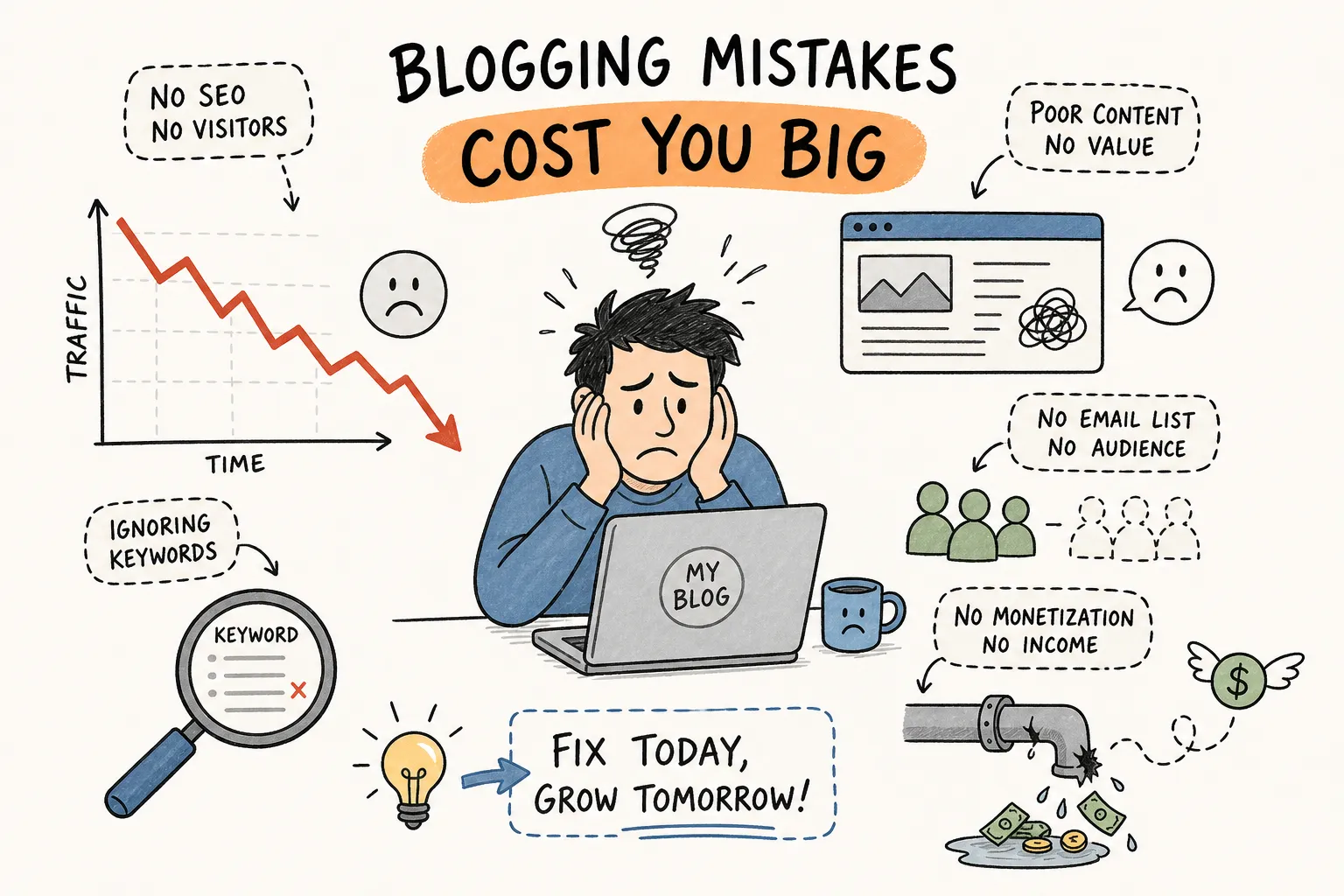
Over 96% of published blog posts get zero organic traffic from Google, and the most common blogging mistakes are the reason why. Read that again. Not "low traffic." Zero. Most blogs never break 1,000 monthly visitors, and the cause is rarely talent or effort. It comes down to the same preventable errors showing up again and again, quietly draining traffic before a post ever gets a real shot at ranking. (That 96% figure is drawn from Ahrefs' large-scale analysis of organic search data, one of the most cited benchmarks in the industry.)
Think of this article as a diagnostic tool. By the time you finish, you'll know exactly which errors are costing you the most and which fixes to prioritize first. The good news: most of these are entirely correctable with the right information and a consistent plan.
One thing worth understanding upfront: blogging mistakes rarely exist in isolation. Weak keyword research leads to low-traffic content, which discourages consistent publishing, which stalls monetization, which causes burnout. It's a cycle. That's the exact reason The Growth Engine connects blogging, personal finance, and self-discipline under one roof: fixing your content strategy tends to unlock progress in every other area, too. Here's where to start.
Common blogging mistakes that sabotage your SEO before you ever rank
Most beginner bloggers write about what interests them without checking whether anyone is actually searching for it. That's the core of the problem, and one of the most widespread beginner blog mistakes in the industry. No keyword research means no search intent match, and Google has no strong reason to surface the post. The fix isn't complicated: use a free tool like Google Search Console or a keyword research platform like Ubersuggest to find what your audience types into search bars, then build content around those specific queries.
Targeting the wrong keywords
For new blogs, the keyword targeting mistake is usually chasing high-volume "head" terms like "budgeting tips" or "how to blog" when those are dominated by sites with years of authority. Long-tail keywords, more specific three-to-five-word phrases with lower competition, are where new blogs can realistically win rankings in the early stages. They convert better, too, because the searcher's intent is sharper.
On-page SEO errors
On-page errors are just as damaging, and many are fixable inside any CMS quickly, often in under an hour per post, depending on your setup. The most common culprits: missing or duplicate meta titles and descriptions, broken heading hierarchy (multiple H1 tags, skipped levels), and images with no alt text, none of which require a developer, just attention. For a short checklist of the typical issues to watch for, see common SEO mistakes.
Keyword cannibalization
Once you have multiple posts covering related topics, keyword cannibalization deserves a dedicated audit. This happens when several posts target the same keyword and end up competing against each other; Google often ranks none of them. A quick way to check: search "site:yourdomain.com [your keyword]" in Google and see how many posts surface. When two or more appear targeting the same phrase, consolidate or differentiate them. This is one of the fastest organic traffic wins available to an established blog.
Writing content no one searched for (and no one clicks)
Passion-driven topic selection and demand-driven topic selection aren't mutually exclusive. You can write authentically about topics people are genuinely searching for. The problem is when bloggers only consult their own curiosity and never cross-reference search data. Thin content with no real search demand gets filtered out by Google's quality signals before it ever has a chance to rank, no matter how well-written it is. This is one of the most common content marketing mistakes new publishers make.
Even a post that earns a spot on page one loses if the headline is flat. A weak title directly hurts your click-through rate, and lower CTR means fewer readers, which can erode your visibility over time. The headline formulas that consistently outperform are straightforward: How-To with a timeframe ("How to Write a Blog Post in 60 Minutes"), Number plus Outcome ("7 Budgeting Habits That Actually Stick"), and Problem-Solution ("Your Blog Isn't Getting Traffic, Here's Why"). Specificity is the common thread. Numbers, timeframes, and concrete outcomes give the reader a clear expectation of what they're clicking into.
Shallow coverage is the third piece of this. Search intent isn't just about matching the keyword; it's about delivering the depth and format the searcher expects. Short, thin posts often fail to provide the depth readers and search engines expect, a brief treatment of a topic that demands comprehensive coverage signals low authority to both audiences. Before you publish, ask whether your post actually solves the problem or just mentions it. Writing to genuinely answer the question, not just to have content live on the site, is what earns long-term rankings and reader trust.
An inconsistent posting schedule that stalls your momentum
Inconsistent publishing sends mixed crawl signals to Google. Sites that update regularly get crawled more frequently; those that go weeks or months without new content get deprioritized. This doesn't trigger a direct ranking penalty, but it slows down indexing and weakens your site's freshness perception over time. Blogs publishing 11 or more posts per month see significantly higher traffic than sporadic publishers, not because volume alone matters, but because consistent output trains Google to expect and find new content.
Consistency beats frequency. A reliable post every Tuesday outperforms five posts one month and nothing the next. For solo bloggers, one well-researched post per week is more effective than three rushed ones. Only 2.6% of bloggers publish daily, and chasing that pace almost always collapses under the weight of burnout. The sustainable path is batching content in advance so your publishing schedule becomes a system rather than a daily decision made under pressure.
The real fix here is content planning. An editorial calendar removes the "what do I write today" paralysis that causes most publishing gaps. Decide your topics two to four weeks in advance, assign draft dates, and treat them like appointments. This is the same principle The Growth Engine applies across blogging, finance, and self-improvement: consistent, disciplined action in any area compounds over time. Your blog is no different. A system outlasts willpower every time.
Ignoring internal links and site structure
Orphaned posts are one of the most overlooked blogging blunders. An orphaned page is any post with no internal links pointing to it from elsewhere on the site. Search engine crawlers struggle to discover these pages, and readers have no path to reach them. On blogs with a substantial number of posts, site audits frequently surface a significant share of articles that are effectively invisible, a problem SEO research consistently flags as common, including in Ahrefs' search traffic study. Fixing this doesn't require new content: it just requires going back into existing posts and adding contextual links to your newer or underlinked pages.
The hub-and-spoke model solves this structurally. One in-depth cornerstone post anchors a topic cluster, a collection of related, more specific posts that all link back to the hub. Without this structure, your blog looks like a scattered pile of random articles rather than an authoritative resource on any subject. Google uses site structure to assess topical authority, so a well-organized cluster of posts on a subject generally signals more expertise than the same number of disconnected posts covering fragments of many topics. Think of it as illustrative rather than a hard rule: depth and coherence matter more than raw post count.
Anchor text matters more than most bloggers realize. "Click here" and "read more" tell Google nothing about the destination page. Descriptive anchor text that summarizes the linked content, such as "our guide to the debt snowball method" or "these content planning templates", passes semantic context to search engines and gives readers a clear reason to click through.
Publishing without a promotion strategy
Most beginner bloggers treat publishing as the finish line. It's the starting gun. Organic search can take anywhere from three to twelve months for a new post to crack the first page of Google results, which means relying solely on SEO in the early stages guarantees long stretches with virtually no traffic. Active distribution has to run in parallel. Share posts in relevant Reddit threads, Facebook groups, and niche communities where your audience already gathers. Pitch your best content to newsletter operators in your space. Repurpose key points into short-form content on the platforms where your readers spend time. If you're debating which platform to prioritize when repurposing, see Blogging vs. YouTube: Which is Best for Making Money in 2026?
The email list is the highest-leverage asset a blogger can build, and most people wait too long to start. Social platforms change their algorithms. Google updates its rankings. But an email subscriber is a direct line to a reader who already chose to hear from you. Bloggers with even a few thousand subscribers have reported generating over 10,000 monthly page views from email alone, independently of search traffic. Waiting until the blog "grows enough" is one of the most common and costly versions of this blogging mistake.
The fix is straightforward: add an opt-in offer on day one, before the blog has significant traffic. A checklist, a short resource, or a free email course all work as incentives, a lead magnet in a format your readers can use immediately tends to convert best. Every visitor who leaves without subscribing is a missed long-term connection. Start capturing that relationship now, not later.
How to fix the most damaging blogging mistakes and start moving the needle
Not every fix deserves equal urgency. Some common blogging pitfalls compound faster than others, so the order matters. Start with keyword research and on-page SEO: check your top 10 posts for missing meta titles, keyword targeting gaps, and heading structure issues. These are foundational and often addressable within a few hours for a small set of posts. Fixing traffic problems and content quality problems in isolation is like bailing a leaky boat; both the hull and the pump have to work together.
From there, work through this priority order:
- Fix missing meta tags and keyword targeting on your top 10 posts
- Establish a posting schedule and hold to it for at least 90 days, treat this as a structured experiment in consistency
- Build internal links between related posts, starting with your highest-traffic pages
- Add a simple email opt-in with a lead magnet your audience actually wants
- Promote each new post to at least one external channel shortly after publishing, within the first day or two is a solid target
The mindset shift underneath all of this is the most important part: blogging success isn't about writing more. It's about building a system where every piece of content has a strategy behind it, before it gets written, when it gets published, and after it goes live. Volume without strategy is just noise.
Your next step starts with one audit
None of the blogging mistakes covered here are permanent. They're the kind of fixable, structural errors that most bloggers never identify because they're too close to their own content to see it clearly. The fastest path to results is picking two or three of the fixes above and executing them fully before moving on to the next priority.
Start this week with one concrete action: audit a single post using the on-page checklist from the SEO section above. Check the meta title, the keyword targeting, the heading structure, and the internal links. Then set a publishing schedule for the next 30 days and commit to it before touching anything else. Small, completed actions compound faster than ambitious plans that never launch. If you need a step-by-step on launching your site, the post How to Start a Blog from Scratch in 2026 is a practical companion.
For readers who want to go deeper on the systems behind sustainable blogging, smart money management, and the personal discipline that holds all of it together, The Growth Engine covers all three in one place. Addressing these blog SEO mistakes and content marketing mistakes systematically, rather than all at once, is where real, lasting progress gets built. If you're looking for a primer on finances to pair with your blogging work, check out Budgeting Basics.


Comments
Post a Comment