How to Create Your First Personal Budget Step by Step
How to Create Your First Personal Budget Step by Step
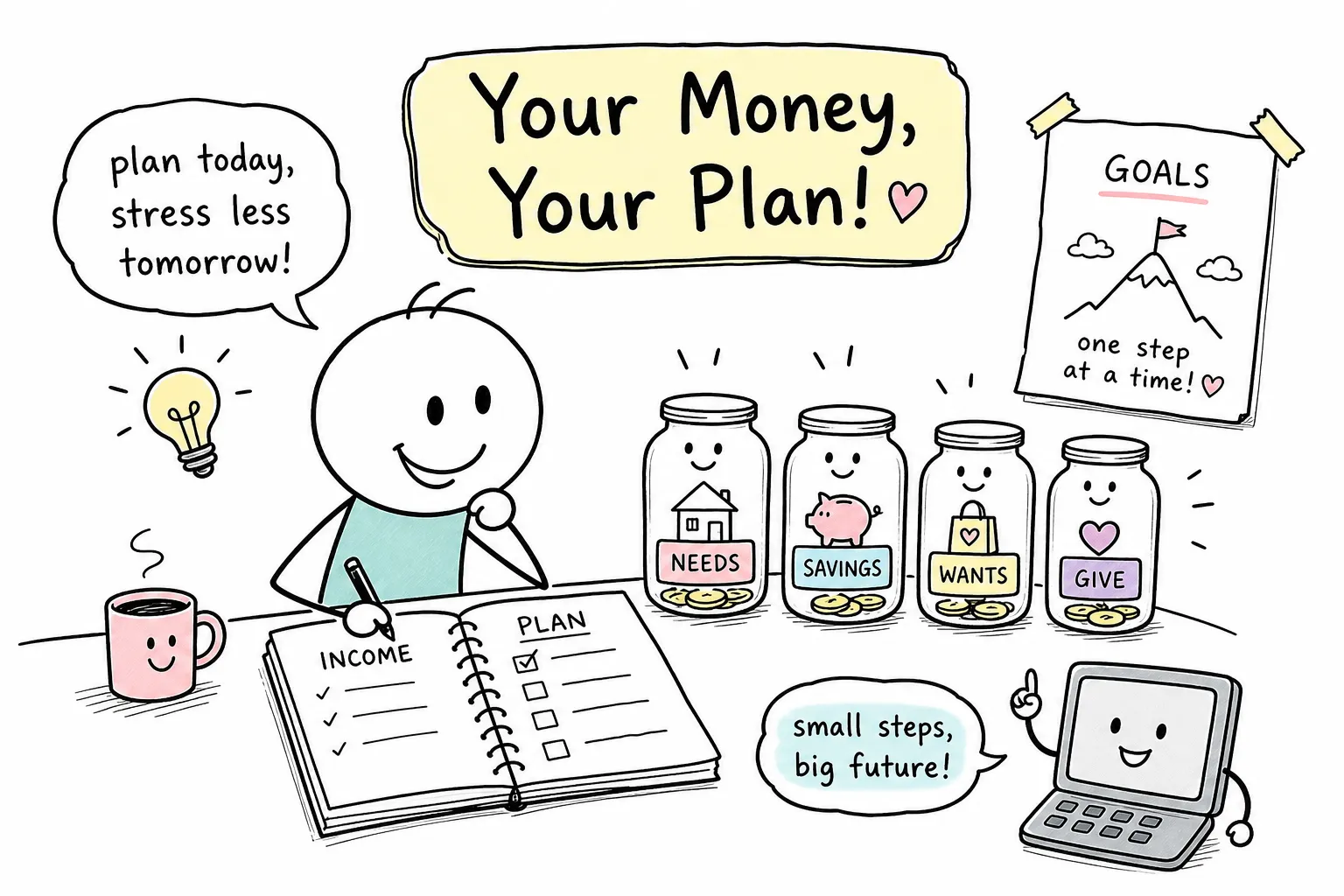
About half of Americans follow a written monthly budget, according to a 2026 Ramsey survey. The other half know they should, but never quite start. The most common reasons people give are that it feels too time-consuming and too complicated, understandable, because most budgeting advice either skips the basics or buries them under financial jargon that makes the whole thing feel bigger than it actually is.
The truth is that learning how to create your first personal budget step by step takes less than an hour when you follow a clear sequence. You don't need special software, a finance degree, or a large income. You need your bank statements, a place to write things down, and the willingness to look at your numbers honestly. This guide walks through every step: calculating your actual income, mapping your expenses, setting goals, picking a method, and building a real budget you can start using this week, complete with a household budget worksheet and a filled example.
By the time you reach the conclusion, you won't just understand how budgeting works in theory. You'll have a working first draft sitting in front of you.
Step 1: Figure Out Exactly How Much Money You Bring Home
Every budget starts with income, and the single most common mistake first-timers make is using the wrong number. Your gross salary, the figure on your offer letter or the top of your pay stub, is not the number you budget from. What matters is your net income: the money that actually lands in your bank account after everything is taken out.
Why net income is the only number that matters
American paychecks shrink considerably between gross and take-home. Federal income tax, state income tax (which varies significantly by state and doesn't exist at all in places like Texas or Florida), Social Security, and Medicare all come out before you see a dollar. Voluntary deductions like health insurance premiums and 401(k) contributions reduce the amount further. A $55,000 gross salary works out to roughly $3,500 to $3,800 per month in take-home pay for a single worker, depending on their state and deductions. That gap matters enormously for budgeting purposes. Build your plan around what hits your account, not what your employment contract says.
How to calculate income when your pay isn't consistent
Freelancers, gig workers, and anyone with a side hustle face a different calculation. The simplest approach: pull your last six to twelve months of deposits, add them up, and divide by the number of months. That gives you your average monthly net income. If your income swings a lot from month to month, use your lowest recent month as your budget baseline instead of the average. It's a conservative approach, but it protects you from overcommitting in leaner months. One more critical note for self-employed earners: set aside 25 to 30% of every payment for federal and state self-employment taxes before you assign a single dollar to anything else. That money isn't yours to spend.
Step 2: Write Down Every Expense You Have
Once you know what you bring in, the next job is understanding where it goes. Most first-time budgeters underestimate this step because they rely on memory instead of data. Pull your actual bank and credit card statements from the last two to three months. Don't guess. Look at what you actually spent, not what you think you spent or what you intended to spend. This is the step that tends to produce the most uncomfortable surprises, and that's exactly why it's so valuable.
Fixed expenses: the costs you can predict every month
Fixed expenses are bills that stay the same or very close to it each month: rent or mortgage, car payment, insurance premiums, minimum loan payments, and set subscriptions. These form the non-negotiable floor of your budget. You can't spend below this number without making a major life change. List them first, total them up, and treat that figure as the minimum your income needs to cover before anything else gets assigned.
Variable expenses: where most budgets have leaks
Variable costs fluctuate month to month, and this is where overspending hides. Groceries, gas, dining out, clothing, personal care, and entertainment all fall into this category. The key rule here is to use your actual average from your bank statements, not an optimistic number you hope is accurate. Some bills contain both a fixed and a variable component. Your electricity bill, for example, might be predictably around $120 in spring and fall but spike to $180 in summer. Budget for the higher end to avoid shortfalls.
Irregular expenses that catch first-timers off guard
This is the category that blows up more first-time budgets than anything else. Annual or infrequent costs, car registration, holiday gifts, medical deductibles, home repairs, annual software subscriptions, vet bills, feel like surprises because most people don't plan for them. The fix is simple: estimate each irregular expense for the year, divide it by 12, and treat that monthly slice as a line item in your budget. Car registration might run $150 per year, which is $12.50 per month. Build that in now, and it stops being a "surprise" when October rolls around.
Step 3: Set the Financial Goals That Give Your Budget a Purpose
A budget without goals is just a list of numbers. Goals are what turn the exercise from a chore into a strategy. When you know exactly what you're working toward, the discipline stops feeling like deprivation and starts feeling like progress. Before you build your budget, write down one or two specific things you want your money to accomplish. Those targets become fixed line items, money you pay to your future self before the rest gets allocated.
Short-term goals to work toward this year
The most common short-term goals for first-time budgeters are building a $1,000 starter emergency fund, paying off a high-interest credit card, or saving for a specific purchase. These are goals you can realistically hit within six to twelve months, which makes them motivating. The important habit to build early: treat savings as a bill you pay at the beginning of the month, not whatever happens to be left over at the end. What gets scheduled gets done; what doesn't gets spent.
Longer-term goals that deserve a spot in your budget now
Even as a beginner, you should earmark something each month for longer-range goals. A fully funded three-to-six month emergency fund, a car replacement savings account, and retirement contributions all belong in the budget from day one. For employed Americans whose employer offers a 401(k) match, contributing at least enough to capture that match is one of the highest-return financial moves available. It's an immediate 50 to 100% return on that portion of your savings. Even modest monthly contributions to long-term goals compound into meaningful amounts over time.
Step 4: Choose a Budgeting Method That Matches Your Life
With your income, expenses, and goals mapped out, you need a framework that tells you how to allocate the money. There are two methods worth knowing for beginners. Both work. The question is which one fits your situation right now.
The 50/30/20 rule: the easiest starting point for most people
The 50/30/20 framework splits your net income into three buckets. Fifty percent goes toward needs: rent, utilities, groceries, insurance, minimum debt payments, and transportation. Thirty percent goes toward wants: dining out, streaming services, hobbies, travel, and anything discretionary. Twenty percent goes toward savings and debt repayment above the minimums. On a $3,500 monthly take-home, that works out to $1,750 for needs, $1,050 for wants, and $700 for savings and debt. The simplicity of three categories makes this method easy to start and easy to maintain, which is why it's the right choice for most people learning how to make a personal budget for the first time.
Zero-based budgeting: when you want full control over every dollar
A zero-based budget assigns every dollar of your income a specific job so that income minus expenses equals zero by month's end. That doesn't mean you spend everything; it means every dollar is accounted for, including the dollars going into savings and investments. This method is more precise than the 50/30/20 rule and works especially well for people paying down debt aggressively or who want granular visibility into their spending. The tradeoff is effort: zero-based budgeting requires more setup and consistent tracking throughout the month to stay accurate.
Which method should a first-time budgeter actually use?
Start with the 50/30/20 rule. It builds the habit without overwhelming you with detail. Once tracking your spending feels natural and you want tighter control, or once you're in an aggressive debt payoff phase, graduate to zero-based budgeting. Neither method is permanent, and switching between them as your situation evolves is completely normal. The goal is to start, not to start perfectly.
Step 5: Build Your First Personal Budget Using a Simple Template
You now have everything you need: your net income, a complete expense list, your goals, and a method. This is where you put it all together into an actual budget. The household budget worksheet below uses a two-column format, Planned and Actual, so you can use the same document to track what happens throughout the month. Copy it into Google Sheets, Excel, a notes app, or even a piece of paper.
A monthly budget template you can copy right now
| Category | Planned | Actual |
|---|---|---|
| Income | ||
| Salary / Wages | ||
| Side Income | ||
| Other Income | ||
| Total Income | ||
| Fixed Expenses | ||
| Rent / Mortgage | ||
| Utilities | ||
| Internet / Phone | ||
| Insurance | ||
| Subscriptions | ||
| Debt Payments | ||
| Variable Expenses | ||
| Groceries | ||
| Transportation | ||
| Dining Out | ||
| Personal / Household Items | ||
| Entertainment | ||
| Medical / Health | ||
| Savings | ||
| Emergency Fund | ||
| Retirement | ||
| Other Savings | ||
| Total Expenses | ||
| Net Left Over |
The Net Left Over line is your budget's health check: Total Income minus Total Expenses. A positive number means your plan is balanced. A zero means every dollar has a job. A negative number means you need to adjust before the month begins, not after it ends.
A filled example: what a real beginner budget looks like
| Category | Planned | Actual |
|---|---|---|
| Income | ||
| Salary / Wages | $3,500 | $3,500 |
| Side Income | $200 | $150 |
| Other Income | $0 | $0 |
| Total Income | $3,700 | $3,650 |
| Fixed Expenses | ||
| Rent / Mortgage | $1,200 | $1,200 |
| Utilities | $150 | $165 |
| Internet / Phone | $80 | $80 |
| Insurance | $120 | $120 |
| Subscriptions | $40 | $35 |
| Debt Payments | $250 | $250 |
| Variable Expenses | ||
| Groceries | $350 | $390 |
| Transportation | $150 | $140 |
| Dining Out | $120 | $160 |
| Personal / Household Items | $100 | $95 |
| Entertainment | $80 | $60 |
| Medical / Health | $50 | $25 |
| Savings | ||
| Emergency Fund | $300 | $300 |
| Retirement | $250 | $250 |
| Other Savings | $100 | $100 |
| Total Expenses | $3,340 | $3,370 |
| Net Left Over | $360 | $280 |
Notice that this person went over budget in groceries and dining out, but stayed under in entertainment and medical. The actual net left over dropped from $360 to $280, still positive, which means the month was a success. If your first draft shows a negative net, don't cut a savings line to fix it. Cut a variable category like dining out or entertainment first. Savings is not optional; it's a bill you pay yourself.
Step 6: Track Your Actual Spending Throughout the Month
Building the budget is the planning half of the work. Tracking is the execution half. Without it, you'll hit the end of the month and discover you spent $200 more than planned on dining out with no clear memory of how it happened. Consistent tracking is what turns a budget from a document into a system.
Simple ways to track without spending an hour a day
Tracking doesn't need to be complicated. Review your bank and credit card transactions every two to three days, this takes about five minutes and catches overspending before it compounds. If you use cash for any purchases, log those in a notes app immediately after spending so they don't disappear from your awareness. Then do a brief weekly check-in where you compare what you've spent in each category against what you planned. That weekly review is where budgets are saved, because it gives you time to course-correct rather than just observe the damage after the fact. Think of it as your personal budgeting checklist: transactions reviewed, cash logged, categories checked against plan.
Budgeting apps that do the heavy lifting for you
If manual tracking feels like too much friction, budgeting apps can help by syncing directly to your bank accounts and categorizing transactions automatically. Apps like YNAB are built around zero-based budgeting principles, while Copilot uses AI-driven categorization to reduce the manual work required. Each has a different learning curve, pricing structure, and best-fit user. Over at The Growth Engine, there's a full breakdown comparing the top budgeting apps for Americans in 2026, covering features, pricing, and which app suits which budgeting style, worth a read once you have your first month under your belt.
Step 7: Review Your Budget at the End of Every Month
The monthly review is the step most beginners skip, and it's also the step that separates people who budget once and quit from people who build lasting financial control. A budget is a living document. It gets more accurate, more useful, and easier to follow every single month you review and adjust it. Skipping the review is like doing the workout but skipping the rest and recovery.
What to do when your actual spending doesn't match your plan
Overspending a category in your first month isn't failure. It's data. Sit down with your Planned vs. Actual columns and identify the one or two categories that consistently ran over. Then make a decision: either commit to genuinely cutting that spending next month, or adjust the planned amount to reflect what you actually spend in reality. Both responses are legitimate. A budget that reflects your real life is far more useful than an aspirational document you blow through every month and eventually abandon. The goal is accuracy first, optimization second.
How to turn monthly budgeting into a non-negotiable habit
The people who stick with budgeting long-term don't rely on willpower alone. They pair the monthly budget with supporting habits: a quick weekly money check-in, automated savings transfers scheduled for payday so the money moves before it can be spent, and a fixed monthly "budget reset" session to close out the old month and set up the new one. These small structures remove the friction and second-guessing that causes most people to drift away from their plan. For readers who want to build the daily financial habits that make budgeting stick month after month, The Growth Engine covers exactly that, debt payoff strategies like the snowball and avalanche methods, habit-building systems, and the routines that keep long-term financial goals on track even when life gets busy.
You Now Know How to Create Your First Personal Budget Step by Step, Start Today
Seven steps: calculate your net income, list every expense, set clear goals, pick a budgeting method, build the budget using the template, track through the month, and review at the end. That's the complete system for how to make a personal budget from scratch. Nothing in that sequence requires financial expertise or a high income. It requires honesty about your numbers and the willingness to write them down.
The hardest part of building your first personal budget isn't any of the steps above. It's starting. Most people who say they'll budget "next month" are still saying the same thing two years later. The reader who opens a spreadsheet today and puts in even rough numbers is already further ahead than that. Your first budget doesn't need to be perfect. It needs to exist so you have something to improve next month.
Open a spreadsheet or your notes app right now. Put in your net income at the top. Start listing your fixed expenses below it. You don't need to finish it tonight to make progress. You just need to begin.


Comments
Post a Comment