Why Your Blog Gets No Traffic in 2026 (And How to Fix It)
Why Your Blog Gets No Traffic in 2026 (And How to Fix It)
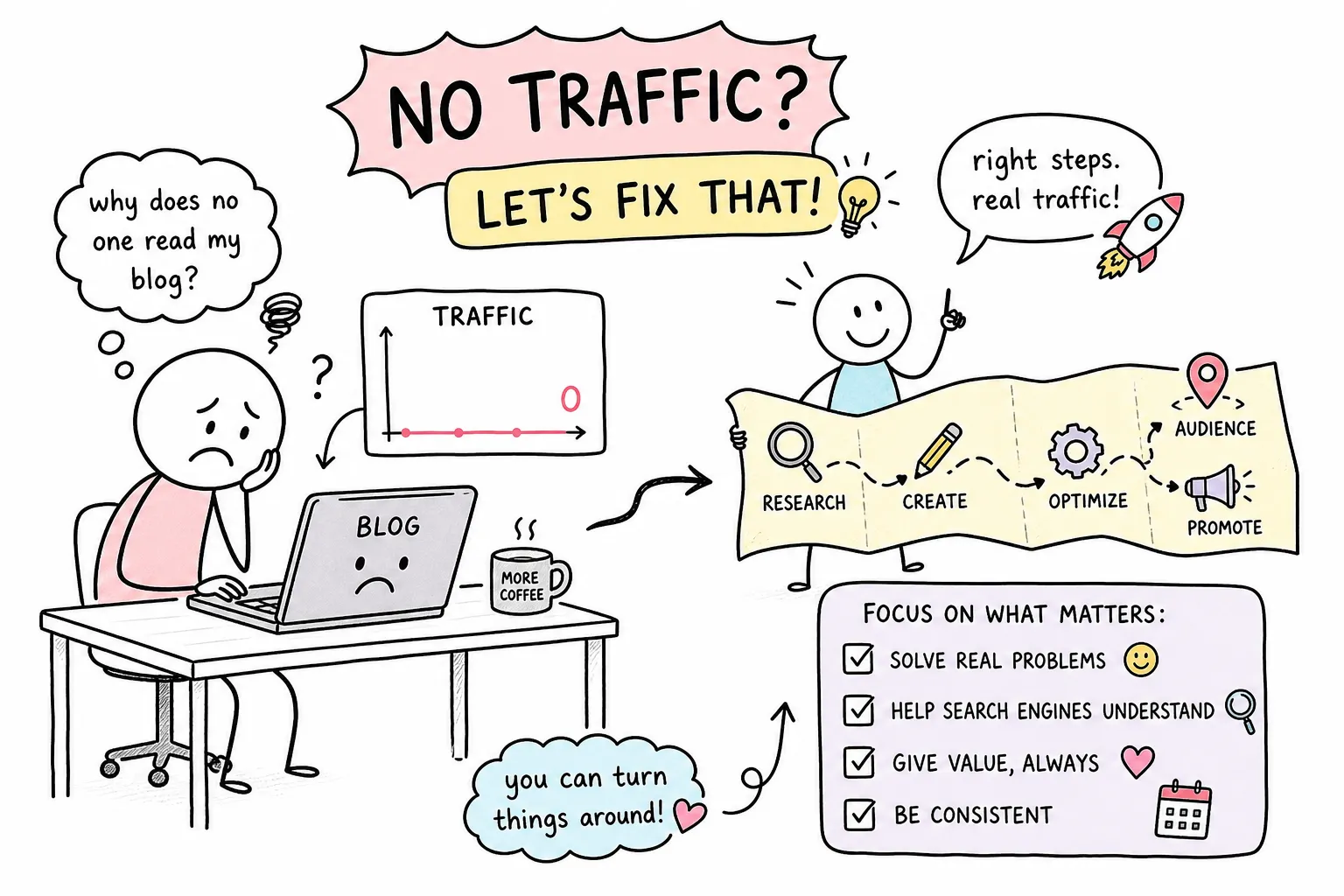
You're publishing consistently, but your analytics dashboard looks like a flatline. The posts are live, the topics feel relevant, and yet nobody is showing up. If that describes your blog right now, the problem almost certainly isn't effort, it's diagnosis. A large share of struggling blogs in 2026 address symptoms rather than root causes: visibility gaps, intent mismatches, or technical issues that silently block growth. That's why your blog is not getting traffic in 2026 the way you expected, and why the usual advice keeps missing the mark.
Rather than throwing a generic 20-point checklist at you, this article walks through the eight most common reasons blogs stay invisible, ordered by how frequently they actually cause the problem. At The Growth Engine, this is the exact diagnostic framework used to help bloggers move from invisible to growing. By the time you finish reading, you'll know which issue applies to your blog and exactly what to do about it, including a structured 90-day plan to pull it all together.
Why 2026 changed the traffic game for bloggers
Before diagnosing your specific problem, it helps to understand why the environment itself has shifted. The strategies that produced solid results in 2021 and 2022 are delivering weaker outcomes today, and that's not random. The search landscape has changed structurally in ways that affect every blog, regardless of niche.
How AI Overviews are reshaping organic clicks
Google's AI Overviews now appear on more than 20% of all searches, and when they do, click-through rates drop by nearly 60%, according to early 2026 search behavior research. Even more striking: queries that trigger an AI Overview carry roughly an 83% zero-click rate, meaning most users get their answer without ever visiting a website. Overall, an estimated 68% of Google searches in early 2026 ended without a click, a figure consistent with zero-click trend data tracked by search analytics firms. This doesn't make blogging pointless. It changes what "winning" in search looks like. Ranking is still valuable, but generating traffic now requires targeting queries where people want to go deeper than a summary answer can take them.
Google's content quality expectations have shifted
Google's core algorithm updates over the past two years have significantly raised the bar for what it calls E-E-A-T signals: experience, expertise, authoritativeness, and trustworthiness. Generic posts that restate widely available information no longer compete effectively, even on lower-volume keywords. The blogs gaining ground now demonstrate genuine knowledge, original perspective, and first-hand experience in their subject matter.
SERP competition is denser across almost every niche
A page-one ranking in 2026 often means appearing below ads, featured snippets, video carousels, AI Overviews, and local packs before a single organic result shows up. Even earning a top-five position doesn't guarantee the visibility it once did. Low blog traffic in 2026 is frequently less about content quality and more about structural factors, keyword choice, content format, and technical setup, that determine whether your post ever surfaces at all.
Why your blog is not getting traffic in 2026: keyword strategy mistakes
Keyword targeting errors are the single most common root cause of low blog traffic, especially for newer blogs still building domain authority. The research is consistent: if you're not targeting the right queries, no amount of great writing or technical optimization will produce meaningful results. Getting this right is the fastest lever most blogs have available to increase organic traffic.
Targeting keywords that are too competitive too soon
A new blog with 20 posts competing for the same keywords as Forbes, NerdWallet, or Healthline has essentially no realistic chance of ranking. Domain authority accumulates over time through backlinks, publishing history, and engagement signals. A blog under 12 months old should focus on low-competition keywords, tool-specific difficulty thresholds vary, but most SEO practitioners target a score under 20, 30 on major platforms until domain authority grows, ideally with clear search intent and at least some monthly search volume. Going after "best budgeting apps" or "how to lose weight" straight out of the gate is a strategy for frustration, not traffic.
Search intent mismatch: when your post answers the wrong question
Google evaluates whether a page actually satisfies the underlying intent behind a search query by looking at what content is already ranking. A reader searching "best budgeting apps" wants a comparison list with clear recommendations. If your post is a beginner's guide to why budgeting matters, you're answering the wrong question, regardless of how well-written it is. Before writing any post, look at what's already ranking for that keyword and let it tell you what format, angle, and depth Google is rewarding.
The fix: build topic clusters around low-competition queries
The most reliable solution for newer blogs is the topic cluster model. Instead of publishing random standalone articles, you build a network of tightly related posts around one core subject, each targeting a specific low-competition keyword. This builds topical authority faster than scattershot publishing and gives search engines a clear signal that your site genuinely covers a subject in depth. Free tools like Google Search Console and Google's autocomplete can surface question-based keywords that established sites often overlook because the volume seems too small to pursue individually, which is exactly what makes them worth targeting early.
Thin, generic content is quietly sinking your rankings
Many bloggers focus on quantity over quality, assuming more posts mean more traffic. In 2026, that math only works when each post actually earns its place in search results. Thin content is a more nuanced problem than most people realize, and it's one of the primary reasons a blog is not getting traffic even when it's publishing regularly.
What thin content actually looks like in 2026
Thin content isn't just short posts. It's content that restates what every other article on the topic says without adding original insight, specific examples, first-person experience, or genuinely useful depth. A 1,500-word post that could have been written by anyone without real knowledge of the subject is thin content, regardless of its word count. AI-generated content without thorough human editing frequently falls into this category, and Google's systems are increasingly trained to detect it.
Content decay: how older posts lose traffic over time
Posts published 12, 24 months ago that haven't been updated often lose ranking ground as competitors refresh their content and search trends evolve. This is content decay, and it's one of the quieter traffic killers because it happens gradually. A content audit to identify and revive your top decaying posts is often faster at recovering traffic than publishing brand-new articles. Check Google Search Console for posts that had traffic 6, 12 months ago but are now declining, and prioritize those first.
Building topical depth: the strategy that compounds
Covering a subject comprehensively across multiple connected posts, with strong internal links tying them together, builds the kind of topical authority that search engines reward consistently. The alternative is the "publish and forget" approach: writing a post, moving on to the next topic, and never returning to deepen the coverage or update the information. A topic cluster doesn't need to be 20 posts. In practice, three to five well-linked, genuinely useful pieces can often outperform a dozen disconnected articles, particularly in narrower niches where topical depth signals matter more than volume.
Technical SEO problems no one warned you about
Technical issues are often invisible until they cause real damage, silent failures with no user feedback to flag them. Most common technical blockers are fixable in an afternoon once you know where to look, but they can quietly suppress your rankings for months if left unaddressed.
Indexing and crawlability mistakes that block your posts
A post that's accidentally set to "noindex," blocked in robots.txt, or never submitted in a sitemap simply doesn't exist to Google. Before assuming your content isn't good enough, verify that your key posts are actually indexed. Open Google Search Console, go to the URL Inspection tool, and check your most important pages. Canonical tag errors are another frequent culprit: if category pages or pagination are creating duplicate content signals, your original posts may be competing against themselves for rankings.
Core Web Vitals and mobile performance in 2026
Page speed directly affects both rankings and how long visitors stay on your site. The metric to watch is Interaction to Next Paint (INP), which replaced First Input Delay (FID) as the primary responsiveness signal in Core Web Vitals, Cumulative Layout Shift (CLS) remains a separate metric measuring visual stability. Most blog traffic in 2026 comes from mobile devices, which means a slow, unoptimized mobile experience costs you both rankings and readers. The highest-impact fixes are compressing images (convert to WebP format), reducing render-blocking JavaScript, and switching to a lightweight theme if you're running a bloated one.
Weak internal linking and what it's costing you
Internal linking is the connective tissue of a blog. Without it, new posts take much longer to get discovered and indexed, and older posts don't pass authority to newer content that needs it. A practical rule of thumb: every new post should link to at least two or three older related posts, and at least two or three existing posts should link back to it on publication day. This simple habit alone can accelerate how quickly Google discovers and indexes new content.
Your blog is invisible to AI-powered search
Optimizing for AI-driven search features is no longer advanced strategy. It's baseline practice for any blog that wants to stay discoverable as search behavior continues to shift, and a meaningful factor in why many blogs are not getting traffic in 2026 despite solid content.
How AI search features decide what content to surface
AI Overviews and similar features pull from content that is clearly structured, authoritatively written, and formatted in a way that makes it easy to extract specific information. Blogs with descriptive headings, direct answers, and organized information have a structural advantage over posts that meander or bury the key insight three paragraphs in. Vague, general content rarely gets cited in AI-generated responses because there's nothing clean to extract from it.
Schema markup: the signal most bloggers skip
Structured data helps search systems understand what a page is about, who wrote it, and how credible the source is. For blogs in 2026, the core schema stack to implement is: BlogPosting or Article on every post, Person for the author, Organization for the site entity, and BreadcrumbList for page hierarchy. Add FAQPage schema only when your post genuinely contains a question-and-answer section, and HowTo schema only for legitimate step-by-step guides. Schema doesn't guarantee AI citations, but it makes your content significantly more machine-readable at a time when that distinction increasingly matters.
Writing extractable answers without sacrificing readability
Structure your posts so they contain clear, direct answers to specific questions, and lead with the answer rather than building up to it. A reader, or an AI system, searching for a specific answer shouldn't have to read three paragraphs of context before finding it. Concise definition blocks, short factual tables, and descriptive subheadings make your content easier for both AI systems and human readers to navigate. This doesn't mean sacrificing depth. It means front-loading the value and using the rest of the post to support and expand on it.
Publishing without promoting: the silent traffic killer
Organic search is the long game, and it's worth playing. Relying on it exclusively, especially during a blog's first year, is the fastest path to publishing into a void and burning out before the compounding effect has a chance to kick in. Content distribution for blogs isn't optional; it's what keeps early momentum alive while search authority builds.
Why organic alone isn't enough for newer blogs
New blogs typically take 6, 12 months or more to see meaningful organic traffic, and that timeline only holds if publishing and SEO are executed consistently throughout. During that window, distribution is what keeps a blog alive. Without active promotion, most bloggers quit before organic search ever delivers on its promise. The blogs that survive the early phase are almost always the ones that built an audience through channels they controlled while waiting for search rankings to develop.
Email newsletters: the highest-ROI channel you're ignoring
Well-managed email newsletters achieve 35, 50% open rates, far outperforming social media engagement, according to industry benchmark data from email marketing platforms. More importantly, your email list is the only audience you fully own. Algorithm changes on social platforms don't affect it. Platform shutdowns don't kill it. A subscriber who joined six months ago and still opens your emails represents the kind of high-intent, repeat engagement that social reach, where organic posts typically reach 1, 2% of followers, simply can't match. Start building your list from day one, even if it's just a simple "get new posts by email" form, and graduate to a lead magnet as your content library grows.
Content distribution channels worth your time in 2026
For personal development, finance, and blogging content, the core niches at The Growth Engine, the highest-ROI distribution channels beyond email are niche communities and selective content syndication. Reddit, niche Facebook groups, and Discord servers where your target audience is already gathering can drive meaningful referral traffic when you contribute genuinely helpful content rather than just dropping links. Medium and LinkedIn newsletters work well as syndication layers for thought leadership content. The key is choosing one or two channels and executing them consistently, not spreading yourself thin across every platform at once.
Realistic benchmarks: are you actually behind?
Much of the anxiety bloggers feel about traffic comes from comparing a six-month-old blog to established sites with years of authority built up. Calibrating your expectations against realistic benchmarks changes the entire experience of building a blog, and usually reveals that your blog's slow growth is normal, not broken.
What new blogs typically see in the first 6, 12 months
Fifty to 500 monthly visitors in the first three months is completely normal. Reaching 1,000, 10,000 monthly visitors by the end of year one is a strong result, not a modest one. Here's what most traffic posts skip: smaller blogs with fewer than 10,000 monthly pageviews get only about 11% of their traffic from organic search, while mature blogs average nearly 60%, according to blog traffic distribution research. That means early traffic almost always comes from direct visits, social shares, and community referrals. Expecting organic search to carry the load in month three sets you up for unnecessary discouragement.
Niche benchmarks that actually matter
A personal finance blog and a general lifestyle blog have very different realistic traffic ceilings and timelines. High-intent niches like personal finance, health, and SaaS can reach 2,000, 20,000 monthly visitors in year one with consistent, targeted publishing. Publishing frequency is also a real lever: research has found that blogs publishing 16 or more posts per month see roughly 3.5 times more traffic than low-frequency publishers. That doesn't mean you need to publish daily. A cadence of 9, 11 well-crafted posts per month is a meaningful growth zone for smaller blogs, with quality becoming the constraint above that threshold rather than volume.
Your 90-day blog traffic rescue plan
Now that you know where you likely stand, the next step is addressing the right bottleneck in a structured order. Here's how to build the next 90 days. The Growth Engine has step-by-step guides for each phase, but this framework gives you the foundation to start moving.
Days 1, 30: the diagnostic quick wins
Before adding more content, understand the actual problem. Open Google Search Console and run a coverage audit to identify any indexing issues. Check your Core Web Vitals scores, especially INP and mobile usability. Verify that your 5, 10 most important posts are properly indexed and structured with at least basic on-page optimization. Then identify your top three lowest-difficulty keyword opportunities using your current content as a starting point. Most blog traffic problems trace back to a handful of root causes: wrong keywords, weak content quality, technical blockers, or poor distribution. This phase builds a clear picture of which one is limiting you before you spend more energy publishing into a broken foundation.
Days 31, 60: content and SEO structural improvements
With the diagnostic complete, shift to structural work. Update two or three of your most decayed existing posts with fresh data, improved depth, and better intent alignment. Build or reinforce one topic cluster with three to five tightly connected posts targeting related low-competition keywords. Fix internal linking across your existing content library using the rule of at least two to three links per new post. Add the core schema stack, BlogPosting, Person, Organization, BreadcrumbList, to your key posts. The Growth Engine's content strategy and SEO fundamentals guides go deeper on each of these steps.
Days 61, 90: distribution, authority, and momentum
With a stronger content foundation in place, focus on distribution. Start or reignite an email list with a simple lead magnet or a consistent weekly newsletter. Identify one community platform where your target audience is already active and begin contributing genuinely helpful content there. Set up one syndication channel to amplify your best existing posts. By the end of day 90, you should have clear data on what's working, what needs more time, and what to prioritize next quarter. Organic search traffic builds slowly at first, but these 90 days construct the infrastructure that makes compounding possible.
The real fix starts with finding the right bottleneck
If your blog is not getting traffic in 2026, the cause almost always traces back to one of a handful of root issues: wrong keyword targeting, content that doesn't earn its ranking, technical blockers, poor distribution, or expectations misaligned with where the blog actually is in its growth cycle. The mistake most bloggers make is trying to fix everything simultaneously, which spreads effort too thin and makes it nearly impossible to tell what's actually working.
The compounding effect of fixing the right things, in the right order, is real. Organic search traffic builds slowly and then accelerates. An email list that starts at 50 subscribers becomes a traffic asset within a year. Topic clusters that seem narrow at first gradually become the authority base that broader keywords depend on. None of this happens fast, but all of it is predictable when you work the system consistently.
The Growth Engine exists to give you the step-by-step resources that support every phase of that system, from SEO fundamentals and content strategy to audience growth and monetization. Bookmark the guides that match your current phase and return as you advance. For now, go back through this article, identify the one section that felt most relevant to where your blog is today, and take one concrete action from it before you close this tab. Understanding why your blog gets no traffic in 2026 is only the first step, acting on the right diagnosis is what actually moves the numbers.


Comments
Post a Comment