Best self-help books by category: a smarter reading list
Best self-help books by category: a smarter reading list
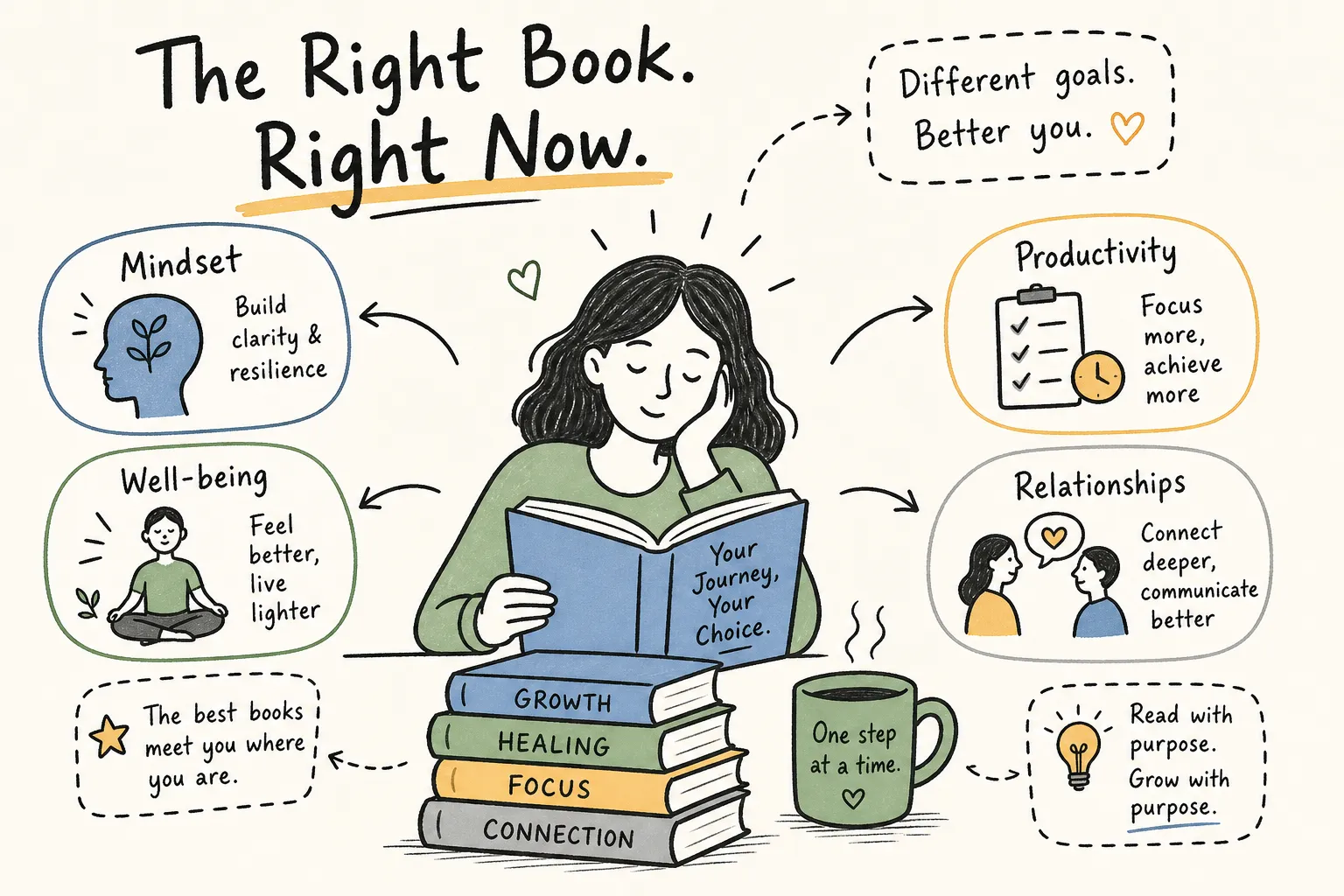
Many people buy more self help books than they ever finish. The cause is rarely a lack of motivation. More often, they grabbed whatever was trending, picked a title that didn't match where they actually are right now, and ended up with a stack that sits untouched. A productivity book often does little for someone who still doubts their ability to change. A finance book tends to bounce off a reader who hasn't addressed the emotional patterns driving their spending decisions.
This guide organizes the best self help books into four categories, mindset, habits, finance, and productivity, so you can find the right fit for your specific situation. Each recommendation covers who the book is actually for, the core lesson you'll carry with you, and how to get the most out of the format. At The Growth Engine, every book recommendation comes with a "now what," because reading is only step one. Pick one or two titles from this list, work through them fully, and build on what you learn before reaching for the next one.
Best self help books for mindset: shift how you see yourself first
For many people, beliefs about their own capabilities shape their ability to follow through more than any tactic does. If you feel stuck before you even take action, the books in this section are the right starting point. They address the internal patterns that either support or quietly undercut every goal you set.
Mindset by Carol Dweck
Dweck's research identifies two orientations people hold toward their own abilities: a fixed mindset, in which talent is seen as innate and unchangeable, and a growth mindset, in which effort and learning drive development. The book draws on decades of psychological research, though more recent studies suggest the effects are context-dependent and vary across individuals, so take the framework as a useful lens rather than a universal law. That said, if you've ever avoided a challenge because you were afraid of looking incompetent, this book gives you a clear explanation for why and a practical way to reframe it. Works well as a standard read or audiobook.
The Mountain Is You by Brianna Wiest
This book is for anyone who keeps starting over and can't figure out why. Wiest focuses on self-sabotage: the patterns you repeat, the opportunities you avoid, and the emotional cycles that pull you back to what feels comfortable rather than what's actually good for you. Her central argument is that most obstacles in your path are behaviors you constructed yourself, which means you also have the ability to change them. Paperback is ideal here, since the book rewards annotation and returning to specific sections as your thinking evolves.
The Four Agreements by Don Miguel Ruiz
Ruiz condenses a lifetime of personal philosophy into four principles: be impeccable with your word, don't take things personally, don't make assumptions, and always do your best. The book is short, but the ideas accumulate. Most of the drama people experience, in relationships and in their own heads, comes from agreements they made with themselves long ago, and Ruiz walks you through how to replace them with something more grounded. It's a one-sitting or one-weekend read; the audiobook works well for a focused listen.
Best self help books for habits: build systems that outlast motivation
Willpower fades. Systems endure. The books in this section approach behavior change from different angles, the practical mechanics, the underlying science, and a broader life-management framework, so you can choose based on what's specifically blocking you right now.
Atomic Habits by James Clear
Among the top self-improvement books published in the last decade, Atomic Habits stands out for its immediate applicability. It carries a 4.8-star rating on Amazon from over 130,000 reviews (ratings fluctuate over time; check the current listing to verify), and that reader response reflects something real: the book works because it centers on systems over goals, environment design over willpower, and 1% improvements over dramatic overhauls. If you've attempted habit-building before and stalled, this is the place to start. The core lesson: stop chasing goals and fix the system that produces them instead. It works well as an audiobook and even better as a paperback you can highlight and return to.
The Power of Habit by Charles Duhigg
Duhigg unpacks the science underneath habit formation: every habit runs on a cue-routine-reward loop, and understanding that loop is what makes deliberate change possible. The key insight is that habits can't simply be deleted, but you can replace the routine in the middle of the loop once you've identified the cue and reward on either end. This book is best for readers who want to understand why habits form before they try to change them. The structure reads like a series of interconnected case studies, which makes the audiobook particularly engaging for commuters.
The 7 Habits of Highly Effective People by Stephen Covey
Covey's framework is denser than the other two, but it's also the most complete. The book goes beyond individual behaviors to build a principle-centered approach for managing your time, your relationships, and your sense of personal responsibility. It's best suited for career-focused readers or anyone who wants a comprehensive life-management system rather than a single behavior fix. Paperback is recommended; a companion workbook is also available for readers who want structured exercises alongside the reading.
Personal finance books that go from mindset to money action
Finance books often fail readers by jumping straight to tactics without addressing the psychology underneath spending and saving decisions. These books cover the full range, from building a motivational foundation to understanding your emotional relationship with money to setting up practical systems that don't rely on constant willpower.
Think and Grow Rich by Napoleon Hill
This is the foundational text that most other success and finance books reference, directly or indirectly. Hill's argument is that wealth begins with clarity of desire and persistence, not a financial strategy. It isn't a budgeting book and doesn't pretend to be. It's for readers who need a motivational foundation before they can realistically engage with any practical money system. The prose is dated, so the audiobook makes it significantly more accessible for modern readers.
The Psychology of Money by Morgan Housel
Housel's thesis is that doing well with money has more to do with behavior than knowledge. Most people who make poor financial decisions aren't uninformed, they're acting on fear, ego, or short-term emotion. The book covers compounding, the invisibility of real wealth, the role of luck and risk, and why a "reasonable" financial plan you'll actually stick to beats a mathematically optimal one you'll abandon. This is the right pick for anyone who understands what they should be doing with money but keeps making emotional decisions instead. Short chapters make it accessible for busy readers; it works equally well in paperback or ebook.
I Will Teach You to Be Rich by Ramit Sethi
This is the most tactical book on the list, and it's written specifically for Americans in their 20s and 30s. Sethi lays out a six-week system for automating savings, paying down debt, and building a basic investment foundation. The central principle is the "85% Solution": a good-enough system you actually implement beats a perfect one you never start. If you want concrete, step-by-step money moves rather than theory, this is the book. The updated edition reflects current financial tools and platforms; the ebook format works well for the action-oriented exercises throughout.
Productivity books for people who want to do less, better
Busy and productive are not the same thing. These books address different versions of the same core problem: too many inputs, too little focus, and time absorbed by low-priority tasks while the work that actually matters waits. Read the one that matches your specific friction point.
Deep Work by Cal Newport
Newport's argument is that the ability to focus without distraction is increasingly rare and increasingly valuable. With Slack notifications, phone alerts, and open-office interruptions competing for attention at every turn, people who can do sustained, concentrated intellectual work produce dramatically better results. This book is for knowledge workers, bloggers, students, or anyone whose output depends on sustained creative or analytical effort. Medium-length read; the audiobook suits commuters well, though Newport himself would probably suggest the irony isn't lost on him.
Essentialism by Greg McKeown
McKeown makes one argument and makes it well: almost everything is non-essential, and spreading yourself across too many projects isn't ambition, it's avoidance. The book is aimed at high-achievers who feel overwhelmed and overcommitted and who suspect that doing fewer things at a higher standard would produce better results. The core lesson is to protect your time as the finite resource it is. Short chapters make this a good candidate for daily paperback reading in focused sessions.
Eat That Frog! by Brian Tracy
This is the shortest, most immediately actionable book on the productivity list. Tracy's system centers on one idea: identify your most important task and tackle it first, before anything else competes for your attention. The "frog" is the task you're most likely to avoid, and doing it first removes the low-level mental weight that makes everything else harder. If you habitually start the day with low-priority work and run out of time for what actually matters, this book is a fast reset. It's a short read, some readers finish it in a few hours, making it a practical weekend reset before the week begins.
How to pick the right book and actually apply it
A longer reading list is not a better reading list. The goal is to pick one book that matches your biggest friction point right now, read it completely, and apply the core lesson before moving on to the next title.
Match the book to your biggest friction point right now
Start with an honest assessment of what's actually blocking you, not what sounds impressive or what someone else recommended. If you feel mentally stuck, start with a mindset book. If building routines is the problem, go straight to Atomic Habits. If money stress is driving decisions you'd rather not be making, The Psychology of Money first. If overwhelm is the issue, Essentialism before anything else. One book, applied, beats four books read in parallel and half-absorbed.
Read one book, apply it for 30 days, then move on
Reading without implementation is entertainment, not growth. After you finish a book, write down three specific changes you want to make based on what you read and track them for 30 days before picking up the next title. This read-then-act cycle is what separates readers who develop lasting habits from those who feel motivated for a week and then reach for another book. As a general rule of thumb, deeply applying even one or two books tends to produce more lasting change than skimming ten.
Where to go after you've finished reading
Books give you the framework. Implementation is where most people stall, because a framework without a system is just an idea. At The Growth Engine, the practical guides, habit trackers, and finance breakdowns are built specifically to help you act on the lessons from books like these. Whether you're working through Atomic Habits or setting up your first automated savings system after reading Sethi, the blog translates book theory into step-by-step systems you can put to work this week, not someday.
The right book at the right time makes all the difference
The best self help books aren't the most popular titles on a bestseller list. They're the ones that meet you where you are and give you a clear next step. A mindset book does nothing useful for someone who already has solid self-belief but can't build a routine. A productivity book wastes the time of a reader whose unaddressed money stress is quietly driving every decision they make.
Use the four categories in this personal growth reading list as a filter: mindset, habits, finance, productivity. Identify your most pressing friction point, choose one book from that section, and commit to it fully. Use The Growth Engine's guides and trackers to move from reading to doing, that's where the real progress happens.
Reading opens the door. Walking through it is the work. When you're ready to translate what you've read into concrete systems you'll actually use, The Growth Engine's habit trackers, finance guides, and implementation resources are there to help you make that move.


Comments
Post a Comment