Personal Development Books: 35 Picks by Life Goal
Personal Development Books: 35 Picks by Life Goal
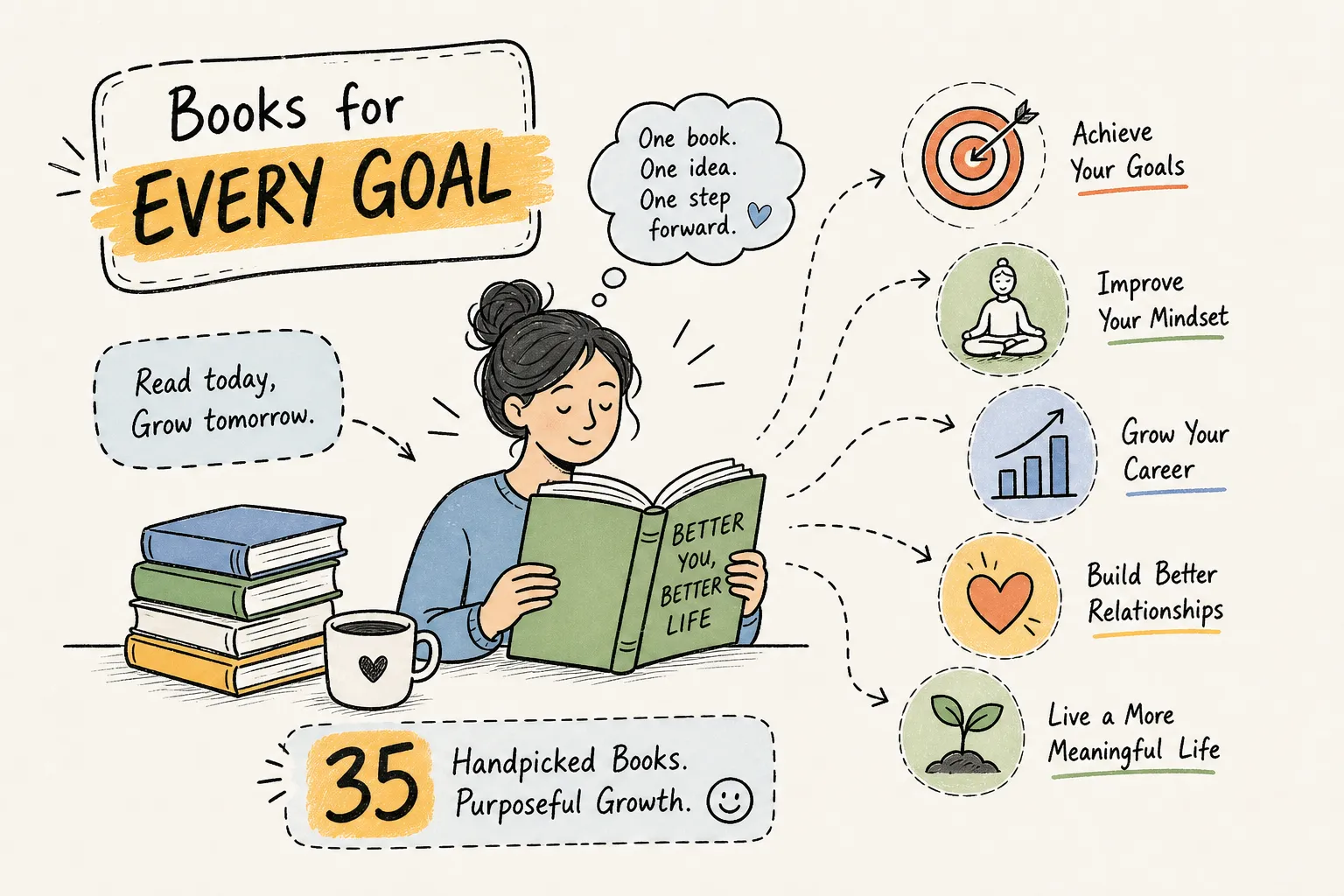
Choosing the right personal development books for your current life stage is the real problem, not reading itself. You pick up a self-help book because someone raved about it on a podcast, you read it, you feel a surge of motivation, and then two weeks later nothing has changed. The book wasn't bad; it just wasn't the right book for where you are right now. A 22-year-old who needs confidence has different needs than a 35-year-old building a side income or a burned-out professional trying to reclaim their focus.
This reading list fixes that by organizing the most recommended personal growth books by the life goal each one actually moves. Titles were selected based on their consistent appearance across major self-improvement best-of lists, Goodreads Best Self-Help rankings, and recommendation patterns from U.S.-based life coaches and career counselors. At The Growth Engine, we believe reading is only valuable when it connects to a system you can implement, so this list comes with a 6-month reading plan built for sustainable progress, not heroic sprints.
By the end of this guide, you'll know which 6 to 12 books fit your current goals, what each one delivers in plain English, and exactly how to sequence them so you actually finish them.
Why most self-help reading produces zero real change
Reading a personal development book and feeling inspired is not the same as changing. Habit-formation research, including a widely cited study by Lally et al., found that new behaviors take an average of 66 days to become automatic, with some habits requiring up to five months of consistent repetition. A single book read once, with no plan attached to it, doesn't come close to triggering that kind of change. The motivation spike fades, and the old default wins.
The fix isn't reading more books. It's reading the right book with a clear intention. Before you choose anything from this list, answer one question: what is the single area of your life where real progress would change everything right now? That answer is your starting point. Everything else is noise until you've moved that needle.
Best personal development books for building lasting habits
Atomic Habits by James Clear is the non-negotiable starting point for anyone in this category. It's built around a four-part behavior loop (cues, cravings, responses, and rewards) that makes new behaviors automatic rather than effortful. The book's "2-Minute Rule" is one of its most widely applied frameworks, and one of the most practical tools in any self improvement books category. Pair it with The Compound Effect by Darren Hardy, which reinforces the same core truth. Small, consistent actions always outperform dramatic overhauls.
For anyone who struggles to start, The 5 Second Rule by Mel Robbins offers a single, almost absurdly simple tool: count backward from five and move before your brain talks you out of it. It sounds too easy, but behavioral research on interrupt-and-redirect techniques supports the underlying logic. The Slight Edge by Jeff Olson completes the habit section by explaining why the actions that build success are the same ones that are easiest to skip. And The Willpower Instinct by Kelly McGonigal, built on Stanford research, turns self-control from a personality trait into a trainable skill.
Books that reshape how you think
Mindset by Carol Dweck introduced the fixed-versus-growth mindset framework to a mainstream audience, and it still holds up as required reading for anyone who ties their self-worth to performance outcomes. Man's Search for Meaning by Viktor Frankl operates on a different level entirely. It doesn't offer tactics; it argues that meaning is the deepest driver of human resilience, which makes it the most foundational book on this entire list regardless of your specific goal.
For mental toughness, Can't Hurt Me by David Goggins challenges every excuse you've made about your limits. The Subtle Art of Not Giving a F*ck by Mark Manson is commonly misread as nihilism, but it's really a sharp argument for choosing your values with intention and letting go of everything else. The Obstacle Is the Way by Ryan Holiday adapts Stoic philosophy into a practical manual for turning setbacks into forward momentum. The Mountain Is You by Brianna Wiest rounds out this section by addressing the most underrated topic in personal growth: self-sabotage and why we do it to ourselves.
Read one or two mindset books before tackling any productivity or finance titles. Without the right mental framework, the tactics in every other book will feel like a burden rather than a tool, and the sequencing matters more than most readers expect.
Financial literacy reads for building real wealth
Think and Grow Rich by Napoleon Hill is one of the most historically influential self-help books ever published. Its core argument is that financial progress starts with a specific, written goal backed by genuine desire, not vague wishes. For readers who find money conversations intimidating, The Go-Giver by Bob Burg reframes earning as a product of the value you create for others, making it one of the least threatening entry points into financial mindset work.
Once the mindset foundation is in place, The 4-Hour Workweek by Tim Ferriss offers a structural shift: design the lifestyle first, then engineer the income around it. That mental model is especially useful for side hustlers and solopreneurs building income outside a 9-to-5. The Happiness Advantage by Shawn Achor adds the research layer, drawing on positive psychology studies that link optimism and engagement to measurable performance improvements. Books in this financial category work best when read after at least one strong mindset title, because money behavior is strongly influenced by psychology as well as by basic financial principles like compound interest and fee structures.
For Americans in their 20s and 30s specifically, consider adding I Will Teach You to Be Rich by Ramit Sethi and The Psychology of Money by Morgan Housel to your reading stack. Both appear consistently on financial advisor and career counselor recommendation lists as practical starting points for early-career wealth building.
Personal development books for career growth and communication
How to Win Friends and Influence People by Dale Carnegie was published in 1936 and remains widely recommended today because its principles are behavioral, not situational. Human nature hasn't changed, and Carnegie's insights into motivation, listening, and influence hold up across every professional context. Never Split the Difference by Chris Voss translates FBI hostage negotiation into everyday career conversations, covering salary negotiations, difficult client calls, and feedback sessions where the stakes are real.
The 7 Habits of Highly Effective People by Stephen Covey ties communication into a complete character-development framework, making it one of the most comprehensive career-focused titles on this list. It consistently ranks among the most recommended books by U.S.-based life coaches and career counselors, and that staying power isn't accidental. For output and focus, Deep Work by Cal Newport makes a compelling case that focused, undistracted work is the rarest skill in a distracted economy. And Grit by Angela Duckworth closes this section with research showing that perseverance and passion outperform raw talent over time, consistently and measurably.
Your 6-month personal development reading plan
Months one through three are about building the foundation before adding any tactics. Start with Mindset and The Obstacle Is the Way in month one. Move to Atomic Habits and The Slight Edge in month two. Finish the foundation phase with Man's Search for Meaning and The Subtle Art of Not Giving a F*ck in month three. Read at a pace of one book per two weeks, this is an editorial guideline based on absorption, not speed. Slower pacing consistently supports better retention and follow-through than racing through titles.
Months four through six are where you go deep by goal. Choose your priority category and stack three to four books from that section consecutively. Someone building a side income would pair The 4-Hour Workweek, Think and Grow Rich, and High Performance Habits by Brendon Burchard. Someone focused on career advancement would run How to Win Friends and Influence People, Deep Work, and Never Split the Difference back to back. One book, two weeks, then the next.
After you finish each book, spend 20 minutes writing down the one idea you're going to implement that week. Not five ideas. One. Keeping your focus narrow makes follow-through far more likely, coaches who work with high-volume readers consistently recommend single-idea implementation over multi-point highlight reviews. With a reading plan now in hand, The Growth Engine is where you'll find the systems, templates, and step-by-step guides that help you translate what you've read into habits, income streams, and results you can measure. Turn these personal development books into measurable results, start the 6-month plan today. Reading is the input. Action is the output. This plan gives you both.


Comments
Post a Comment