12 Science-Backed Daily Habits of Highly Successful People
12 Science-Backed Daily Habits of Highly Successful People
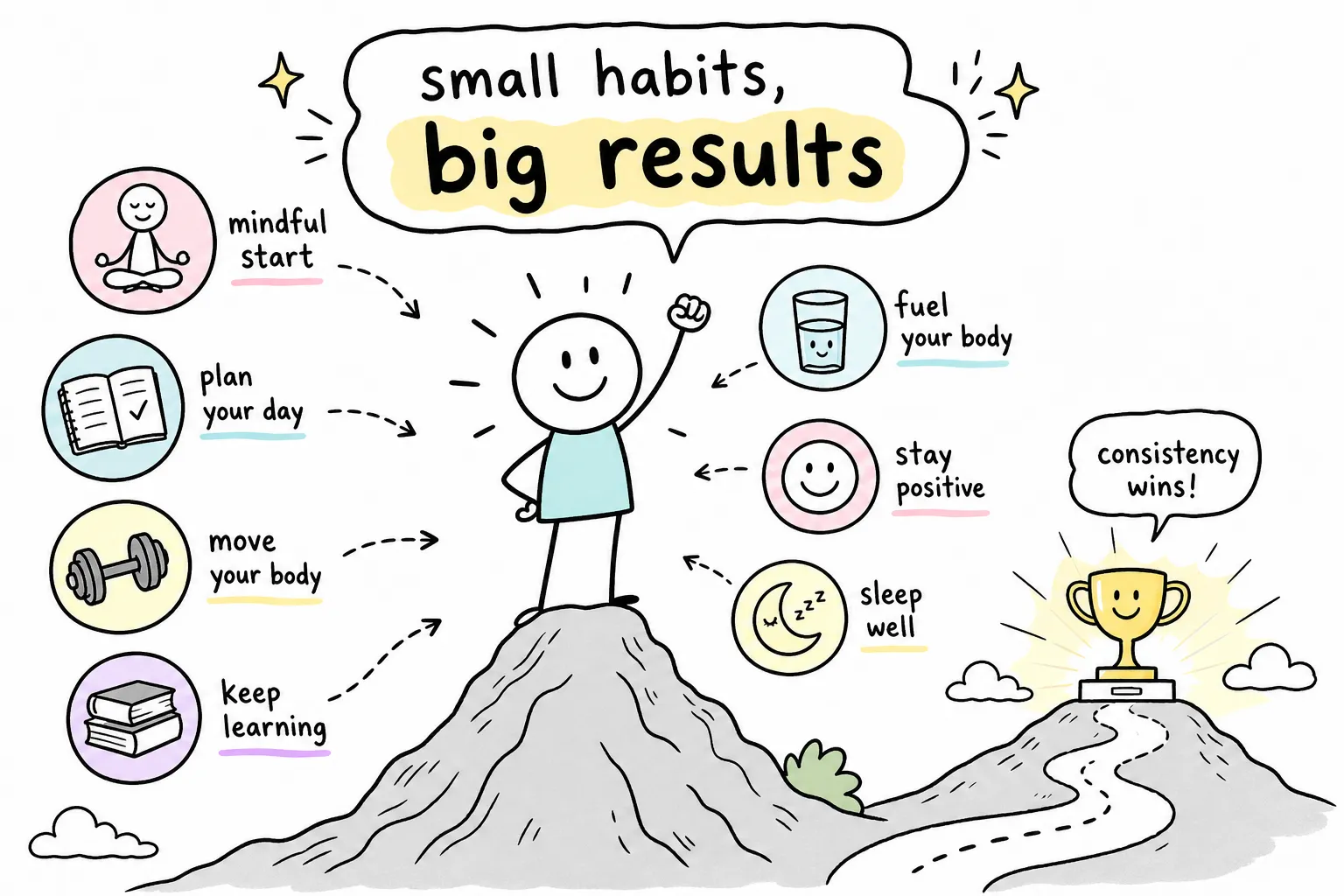
Most people already know what high performers do. They exercise, they sleep well, they journal, they read. The information is everywhere. But knowing a habit exists is not the same as building one, and that gap is where most self-improvement efforts quietly die. The real problem is not awareness; it is the behavioral design behind why habits actually form and hold. This article covers the science-backed habits highly successful people use every day, not as inspiration, but as a repeatable system grounded in peer-reviewed research.
Behavioral science has produced decades of research on how humans actually change their behavior, and the findings are more precise and actionable than most productivity content lets on. At The Growth Engine, the overlap between what peer-reviewed research shows and what high performers consistently practice is a core focus, because growth is not accidental. It is engineered.
What follows is a breakdown of 12 evidence-based daily habits drawn from systematic reviews, randomized controlled trials, and documented examples from entrepreneurs and thought leaders. By the end, you will know which habits deliver the highest return, what the science actually says about each one, and how to start at least three of them within the next 7 to 14 days. Note that the strength of evidence varies by habit: some are supported by large-scale meta-analyses, while others rest on smaller trials or observational data, those distinctions are flagged throughout.
Why Successful People Rely on Habits, Not Willpower
Many behavioral models treat self-control as a limited resource, and motivation clearly fluctuates based on mood, sleep, stress, and dozens of other variables outside your control. Whether willpower is best understood as a depleting resource is still debated in the literature, meta-analyses and replication attempts have produced mixed results, but the practical implication holds: depending on motivation alone is a fragile strategy. Habits, once formed, operate below conscious decision-making. Defaulting to automatic behavior conserves cognitive energy for higher-order tasks, and high performers take advantage of that biology by design.
The habit loop model (cue, routine, reward) describes the mechanism: a specific trigger initiates a behavior, and a reward response reinforces it over repetition. What makes this practically useful is that you can build new habits by deliberately attaching them to existing cues rather than relying on willpower to remember or feel motivated.
The Most Reliable Behavior-Change Tool Most People Overlook
Implementation intentions are among the best-supported techniques in the behavior change literature. A meta-analysis by Gollwitzer and Sheeran of 94 independent studies found a medium-to-large effect size of d = 0.65 on goal achievement, substantial for behavioral science. The format is simple: "If [cue], then I will [behavior]." By pre-deciding your response to a specific situation, you remove the need for in-the-moment decision-making and substantially increase follow-through.
Every habit in this article becomes more likely to stick when you assign it an if-then plan tied to an existing anchor in your day. That is not a motivational tip; it is a replication of one of the most consistent findings in habit formation research.
Science-Backed Habits Highly Successful People Use Every Day: The Full List
The 12 habits below span six domains, physical performance, cognitive recovery, stress management, sustained focus, daily ritual anchoring, and knowledge compounding. Taken together, these evidence-based routines address the areas with the strongest research support for closing the gap between intention and consistent behavior.
Habit 1: Daily Physical Movement as a Cognitive Primer
The productivity case for exercise is not about aesthetics or longevity. It is about what happens to your brain on the days you move versus the days you do not. A 2025 umbrella review of 133 systematic reviews concluded that exercise significantly improved general cognition, memory, and executive function across populations. A separate Bayesian meta-analysis confirmed small but reliable acute cognitive gains, with particular improvements in executive function tasks and reaction time.
The effects are real but not dramatic, which is an important distinction. Small, consistent gains in executive function and attention may plausibly compound over months and years of decision-making, problem-solving, and creative output, though direct longitudinal evidence linking short-term cognitive gains from exercise to career-level outcomes is limited. That said, the case high performers make when they protect their movement habits is grounded in solid evidence at the session level.
Habit 2: Structuring Movement Without Losing Time
High achievers tend to treat physical activity as a cognitive primer, not a fitness goal. Walking meetings, early morning workouts completed before the day's decision demands pile up, and bodyweight sessions between work blocks are common approaches. The practical target backed by research is moderate-intensity activity on most days, not elite-athlete volume. Your if-then plan: "After I make my morning coffee, I will do 20 minutes of movement before opening my laptop."
Habit 3: Sleep Quality as an Active Performance Decision
Sleep is not passive recovery. It is one of the highest-leverage performance habits available, and most people optimize the wrong variable. A longitudinal daily-diary study found that sleep quality predicted next-day work productivity with a within-person effect size of 0.14, while sleep duration alone was not a significant predictor. How well you slept matters more than how long you slept.
A systematic review of healthcare workers reinforced this finding, linking adequate sleep quality to better decision-making, situational awareness, and communication, all transferable to any high-stakes professional context. The duration question is secondary. Quality is where the leverage lives, and that has direct implications for how you spend the hour before bed.
Habit 4: The Sleep Quality Levers That Actually Move the Needle
Consistent sleep-wake timing is one of the better-supported levers for improving sleep quality. Your circadian rhythm is a biological clock, and irregular timing disrupts it regardless of how many hours you log. Additional practices with reasonable backing include reducing blue light exposure in the 90 minutes before bed and maintaining a cool room temperature, both supported by circadian and sleep hygiene research. Each of these is an implementation intention opportunity: "After I finish dinner, I will set my phone to Night Mode and avoid screens after 9 p.m."
Arianna Huffington's public advocacy for sleep as a leadership tool was not abstract philosophy. After collapsing from exhaustion, she built an entire platform around the evidence for sleep as a performance asset. Her experience is an extreme case, but it reflects what the research shows: sleep quality is a critical input for sustained high performance.
Habit 5: Brief Daily Mindfulness for Stress Reduction
The mindfulness research deserves an honest read, not a breathless endorsement. The stress-reduction evidence is strong and consistent. A randomized clinical trial of 78 healthcare professionals found that a five-session mindfulness program significantly reduced stress and anxiety compared to a control group. A large RCT of 1,458 employees using a digital mindfulness program showed significant reductions in perceived stress, job strain, and burnout at eight weeks. The practical conclusion: brief, regular mindfulness practice has genuine peer-reviewed support for reducing stress in working professionals.
Habit 6: What the Research Says About Attention, Specifically
The attention benefits of mindfulness are more modest. A major review of meditation programs found low-to-insufficient evidence for direct attention gains, though there is moderate evidence that mindfulness reduces repetitive negative thinking, which frees up attentional resources indirectly. That nuance makes the habit more credible, not less. You are not guaranteed sharper focus from five minutes of meditation, but you are likely to carry less mental noise into your work.
A study of five-minute daily mindfulness in mental health professionals showed significant stress reduction, a practical starting point. Your if-then plan: "After I pour my morning coffee, I will sit quietly without my phone for five minutes." Jeff Weiner, former LinkedIn CEO, made daily mindfulness a public part of his leadership practice. Oprah Winfrey has spoken about it for years. The habit has both research support and documented precedent among high performers.
Habit 7: Deep Work Blocks and the Single-Tasking Advantage
Task switching is expensive. Research by Rubinstein, Meyer, and Evans on task-switching costs found that rapid context switching can reduce productive output by as much as 40%, though the authors describe this as a rough estimate from a 2001 study, not a clean experimental ceiling. The mechanism is attention residue: cognitive traces of a previous task linger after you shift focus, degrading performance on the next task even when you have moved on. Knowledge workers, bloggers, and anyone doing cognitively demanding work are especially vulnerable, because their output requires sustained mental engagement rather than reactive short-burst tasks.
Field research by Gloria Mark found that workplace interruptions take roughly 23 minutes to fully recover from. The math is unforgiving: three interruptions in a morning may eliminate sustained deep focus entirely.
Habit 8: Time-Blocking as a Focus System
A 2023 study of 89 office workers who used software to protect calendar blocks found that, compared with a control group, they worked less after hours, felt more engaged during focus sessions, and reported higher productivity. Some productivity research reports substantially higher task completion rates among people who time-block versus those who work reactively, though the specific figures vary by study and context. Cal Newport has documented his own deep work practice publicly for years, and the research supports the underlying mechanism he describes.
The implementation is straightforward: schedule one 90-minute deep work block per day, protect it from reactive tasks, and write your plan the night before. Your if-then plan: "At 9 a.m., I will close all communication apps and work only on my most important task for 90 minutes." Start with one block before scaling.
Habit 9: Morning Rituals That Prime Direction
Morning routines work because they are implementation intentions at scale. Pre-deciding your first hour in a low-decision state removes friction and primes your brain before the day's demands accumulate. Research on expressive writing and cognitive off-loading supports practices like journaling and goal review: putting thoughts on paper has been shown in multiple studies to reduce anxiety and clarify priorities, a measurable cognitive benefit, not a lifestyle trend.
Tim Ferriss's five-minute journaling practice, writing three things he is grateful for, three things that would make the day great, and one daily affirmation, is a structured example of this. Oprah's long-standing gratitude journaling practice reflects the same mechanism. The specific format matters less than the consistency of the practice.
Habit 10: Evening Reflection to Close Mental Loops
High performers use end-of-day reviews to close open loops, which reduces rumination and improves next-day readiness. Unfinished tasks occupy working memory until they are either completed or explicitly scheduled, so a brief written review captures them and frees your brain to release them. Expressive writing research and cognitive off-loading studies directly support this as a stress-reduction strategy, not just a productivity preference.
A simple three-question evening format works: What did I accomplish today? What is the single most important task for tomorrow? What do I want to let go of from today? This takes under five minutes and creates the mental closure that separates a well-rested morning from one spent mentally replaying yesterday.
Habit 11: Daily Reading for Knowledge Compounding
Warren Buffett has said in interviews that he reads roughly 500 pages a day. Bill Gates has noted publicly that he reads around 50 books per year. These are personal anecdotes, not empirical prescriptions, but they reflect a pattern that deliberate practice research, notably work in the tradition of Ericsson and colleagues on expertise development, consistently supports: sustained, structured knowledge input accelerates domain mastery and builds the creative raw material for original thinking and problem-solving. Reading widely across your field and adjacent disciplines is a compounding investment, not a leisure activity.
A practical starting point is a protected 20-minute daily reading window attached to an existing habit. After lunch, before bed, or during your morning routine are common anchors. The key is that it is scheduled, not left to whenever you feel like it.
Habit 12: Writing and Publishing as a Thinking Tool
Many of the world's most effective thought leaders write publicly, and not primarily for audience growth. Writing forces a precision that reading alone never produces. James Clear built Atomic Habits into a cultural movement starting from a weekly email newsletter. Tim Ferriss, Ryan Holiday, and hundreds of high performers write as a tool for clarifying their thinking first and reaching an audience second.
This is exactly why platforms like The Growth Engine exist: writing publicly has a compounding return on both personal clarity and professional authority. A weekly or twice-weekly writing practice, even a short one, builds both habits simultaneously. Your if-then plan: "Every Sunday at 7 p.m., I will write for 30 minutes on one idea I read about this week."
Turning All of This Into a System That Survives Week One
Knowing 12 habits does not help you build 12 habits. Behavior change research is consistent on this point: smaller starting targets outperform ambitious ones in long-term adherence. This is a well-supported practical recommendation across habit formation guidance, even if the precise comparison between starting-small versus ambitious-start strategies varies by study. The goal is not to overhaul your entire day; it is to build habit identity over the first 14 days by succeeding at a minimum viable version of each behavior.
Habit stacking, linking a new behavior to an existing anchor in your routine, is the most practical application of implementation intention research. "After I [current habit], I will [new habit]" is the structure. It works because you are not creating a new trigger from scratch; you are borrowing the reliability of an existing cue. The d = 0.65 effect size from implementation intention research applies here directly.
Your 7 to 14 Day Action Plan
Choose three habits from this article, assign each one a specific cue that already exists in your day, and write an if-then plan for each. Then track completion for 14 days without breaking the chain. Here is a practical starting stack:
- Movement: "After I make my morning coffee, I will do 20 minutes of movement before opening my laptop."
- Deep work: "At 9 a.m., I will close all communication apps and work only on my most important task for 90 minutes."
- Evening review: "After I finish dinner, I will write my three-question reflection before watching anything."
Use the minimum viable version of each habit to reduce friction. A 10-minute walk counts. A 45-minute focus block counts. A two-sentence evening note counts. The behavioral science is consistent: starting smaller produces better long-term adherence than starting ambitious. Your goal in the first two weeks is not transformation; it is repetition.
Science-Backed Habits Highly Successful People Use Every Day: The Design Principle Behind All of Them
The daily rituals of successful people are not about discipline, willpower, or having more hours in the day. They are about design. When you build your environment and schedule around implementation intentions, anchored cues, and small consistent actions, the research shows the results follow. The evidence-based routines covered here are not the habits of people with unusual talent or extraordinary time. They are the habits of people who decided to make deliberate decisions about how they spend their days.
The three habit categories with the strongest evidence base are worth highlighting: movement, sleep quality, and brief mindfulness for baseline cognitive performance; and deep work blocks, ritual anchoring, and knowledge compounding for sustained output and growth. These six areas are among the most evidence-supported levers for performance and behavior change available in the current literature.
Your challenge for the next 14 days is specific: pick three habits from this list, write your if-then plan for each, and start tomorrow. Not next Monday. Not after you finish reading one more productivity book. Tomorrow. Research on implementation intentions shows that writing a specific if-then plan substantially increases follow-through, across many studies, the effect is reliable and meaningful. That is not motivation. That is design working in your favor.


Comments
Post a Comment