How to Build Daily Habits That Actually Stick in 2026
How to Build Daily Habits That Actually Stick in 2026
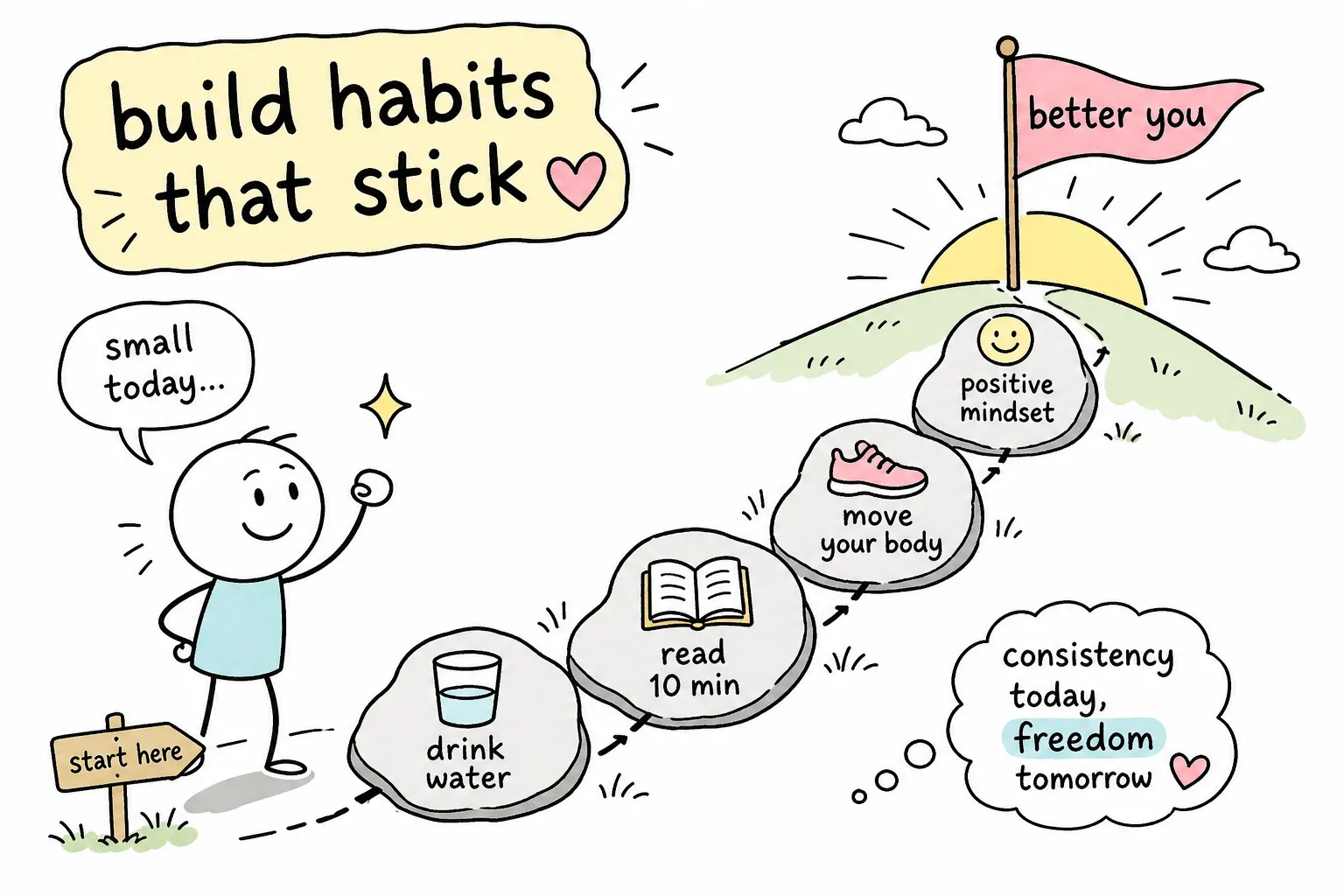
Most people don't fail at habits because they're lazy or undisciplined. Research suggests the more common culprit is a flawed setup, a strategy built for the first week, not the first year. A 2020 longitudinal field study found that self-control level did not predict habit-formation speed, meaning the people who stuck with their habits weren't more disciplined; they had a better system. Sound familiar? You start strong in January, hit a wall around day 10, and find yourself restarting the same routine three months later, a pattern widely documented in behavior change literature, with fresh guilt and the same vague plan.
Here's the number that changes the game: the popular belief that habits take 21 days is a myth commonly attributed to Dr. Maxwell Maltz, whose 1960s observations about patients adapting to physical changes after surgery were never intended as behavioral science. A 2025 systematic meta-analysis found that health behaviors take anywhere from 18 to 254 days to reach automaticity, with reported means landing between 106 and 154 days, notably higher than the often-cited average of roughly 66 days from earlier research, a difference explained by variations in behavior complexity and study methodology. For a simple habit like drinking water after brushing your teeth, you're on the shorter end. For a 30-minute workout routine, expect the longer end. The 21-day figure is off by a factor of five.
This guide gives you a complete system for how to build better daily habits that actually stick in 2026: how to choose one high-impact habit, design it to be nearly impossible to skip, and keep it running long after motivation fades. At The Growth Engine, the guiding principle is that personal growth compounds across areas, lock in your core habits, and your money habits and content-creation discipline tend to follow. That's the site's organizing philosophy, and it's why the guides here connect behavior change, personal finance, and blogging into one coherent playbook rather than treating them as separate subjects.
Why most habits die before day 14 (and it's not a willpower problem)
The 21-day myth and what the research actually says
The 21-day myth persists because it's optimistic and easy to remember. It's commonly traced to Dr. Maxwell Maltz's informal observations about patients adapting to physical changes, not from any controlled study of behavior change. The research that followed tells a very different story. A 2025 systematic review and meta-analysis found that habit automaticity develops across a range of 18 to 254 days, and the average for health behaviors sits well above the three-week mark. The complexity of the behavior determines the timeline more than anything else.
A simple, low-effort behavior anchored to an existing routine forms faster because it requires less neurological rewiring. A 30-minute gym session requires equipment, travel, scheduling, and physical exertion, which is why it sits at the complex end of the formation spectrum. Knowing this reframes the whole enterprise: you're not behind at day 22. You're just beginning.
The three real reasons behavior change doesn't hold
Behavioral science literature identifies three structural failure points that show up repeatedly in the first two weeks. People start without an anchor cue, which means the new behavior has no reliable trigger and depends entirely on remembering to do it. They rely on motivation rather than a system, and motivation often wanes over time, making it an unreliable sole mechanism for sustaining any behavior. And they have no plan for what to do when they miss a day, so one skipped session becomes three, then a week, then a reset.
A 2020 longitudinal field study made this point clearly: self-control level did not predict habit-formation speed. The people who built lasting habits weren't more disciplined; they built a better setup. That's the entire point of the system you're about to design.
How habits actually form in your brain
The habit loop: cue, routine, reward
Every habit runs on a three-part loop: cue, routine, reward. The cue is the trigger that tells your brain to initiate the behavior. The routine is the behavior itself. The reward is what your brain registers as a positive outcome; that signal reinforces the loop. A practical example: your morning coffee brewing (cue) triggers you to open your journal (routine), and checking off the tracker when you're done (reward) provides a small reinforcing signal that makes repetition more likely.
Understanding this loop is foundational because every strategy in this guide is designed to strengthen one or more parts of it. The part that breaks first is almost always the cue, without a reliable trigger, even a well-designed routine collapses. You can't build a lasting habit without a reliable cue and a meaningful reward, no matter how good your intentions are.
What automaticity means and why context is everything
Automaticity is what happens when a behavior stops requiring conscious decision-making. You don't think about brushing your teeth; you just do it. That state is the goal of habit formation, and research is clear on what drives it: context stability matters more than raw repetition volume. Doing a behavior in the same place, at the same time, linked to the same trigger builds the neural groove far more efficiently than doing it whenever you feel like it.
This is why gym-goers who switch locations often fall off their routines. The physical environment was part of the cue. When the context changes, the trigger breaks. Design your habit around a stable context from day one, and you're already ahead of most people who attempt behavior change.
How to build better daily habits that stick: start much smaller than feels logical
Designing a habit so small it's almost impossible to skip
The two-minute rule and the tiny habits method solve the same problem: startup cost. When your habit takes two minutes or less, you can't honestly tell yourself you don't have time. The tiny habit recipe developed by BJ Fogg follows this structure: "After I [anchor], I will [tiny behavior]." Immediately after completing that tiny behavior, you celebrate, because positive emotion right after an action reinforces the behavior. Fogg's method, grounded in positive reinforcement principles, works because the brain strengthens pathways that end with a positive signal.
The smallness is the mechanism, not a compromise. The goal in weeks one and two is not performance; it's presence. Show up for the tiny version until it's automatic, then scale.
Proven tiny habit scripts you can use today
These anchor-based scripts follow BJ Fogg's anchor-behavior-celebration formula and are ready to plug in without modification:
- "After I pour my morning coffee, I will write one thing I'm grateful for."
- "After I get out of bed, I will do one pushup."
- "After I sit down at my desk, I will write today's most important task on a sticky note."
- "After I put my dinner plate in the sink, I will wipe down one kitchen counter."
- "After I get into bed at night, I will put my phone on do not disturb mode."
None of these take more than 90 seconds. Once the anchor becomes automatic, the one pushup becomes five, then ten. The one grateful thought becomes a page of journaling. But the anchor-behavior connection has to form first. Scaling before you have that connection is how people burn out in week two.
Habit stacking: linking new behaviors to what you already do
How to build your first habit stack
Habit stacking extends the tiny habit model by chaining multiple behaviors together into a sequence, each one acting as the cue for the next. The structure is: anchor habit (something you already do automatically) + new behavior (the habit you're building) + immediate reinforcement. The anchor habit does the heavy lifting because it's already embedded in your day and requires zero decision-making to trigger.
For a blogger or side hustler building a morning system, a realistic stack might look like this: brew coffee (anchor), write 200 words (new behavior), mark it on the tracker (reinforcement), then review one content goal before opening email. That entire sequence takes 15 minutes and connects your creative output directly to your morning anchor before the noise of the day starts. Routine building like this works because you're borrowing the automaticity of an existing habit and attaching something new to it.
Morning, midday, and evening stack templates
These three templates are starting points based on common daily anchors. Audit your own day first: what do you already do automatically every morning, after lunch, and after dinner? Slot the new behavior directly after those existing anchors.
- Morning stack: after coffee is ready, do one writing sprint (200 words or 10 minutes), then check your single most important goal for the day before opening any app.
- Midday stack: after finishing lunch, take a 5-minute walk, then open your budgeting or finance app to log one transaction or review spending.
- Evening stack: after dinner, read one page of a book or article, then close your laptop and set it away from the bedroom.
The evening stack in particular pays dividends for anyone building a consistent publishing cadence or financial review habit. Small, daily contact with your goals at a predictable time accumulates into significant momentum over 60 to 90 days.
Implementation intentions: the if-then plan that removes decision fatigue
The science behind if-then planning
Implementation intentions are one of the most well-researched behavior change strategies in the literature. The basic structure is: "If [situation or time], then I will [specific behavior] at [location]." A 2024 conceptual review confirmed that these plans consistently outperform vague goal statements like "I'll exercise more" because they eliminate the mental negotiation that happens in the moment. When the brain already has a pre-decided response loaded, the decision cost drops to near zero.
Effect sizes across meta-analyses range from small to moderate for health behaviors, with one review reporting an SMD of 0.31 at post-intervention (SMD, or standardized mean difference, is a standard measure of effect size). That's not a large effect in isolation, but when layered on top of a habit stack and a stable cue, it becomes the difference between a habit that survives a bad week and one that doesn't. Specificity is the mechanism: the more precisely you define when, where, and what, the less room there is for your future self to negotiate.
How to write an implementation intention for your target habit
The practical formula is: When [situation or time], I will [behavior], at [location]. For a personal finance beginner: "When it is Sunday at 9 a.m., I will review last week's spending in my budgeting app, at my kitchen table." For a new blogger: "When it is 7 a.m. on a weekday, I will write for 20 minutes, at my desk before checking email." For a side hustler: "When my lunch break starts at noon, I will spend 10 minutes on my content calendar, at my work desk."
Layer this onto your tiny habit stack and you have a complete behavior change blueprint: a stable context, a pre-decided time, a specific anchor, and a tiny action with a clear reward. This combination addresses the three most common early failure points simultaneously, and it works even on days when motivation is low.
Environment design and the best habit-tracking tools for 2026
Designing your space to make habits automatic
Environment design works by reducing friction for the behaviors you want and increasing friction for the ones you don't. Research from 2024 confirms that context stability is one of the key drivers of automaticity: when the setting is consistent across repetitions, the behavior becomes more automatic faster. The physical environment acts as a passive cue system that triggers behavior without requiring conscious effort.
Concrete examples that work: place your journal on your pillow so you see it before bed; put your gym bag by the door the night before; delete social media apps from your phone's home screen and replace them with your habit tracker. Each of these changes makes the right behavior easier and the competing behavior slightly harder, which shifts the default without relying on willpower.
Which habit tracker apps keep you consistent in 2026
Based on 2024 to 2026 editorial comparisons and usability research, the features that drive long-term adherence are fast check-in (under 30 seconds), visible streak or progress tracking, smart reminders, and some form of social accountability. Here are the top options by use case:
- Streaks: best for Apple users who respond to "don't break the chain" mechanics and want minimal friction.
- Habitica: best for people who need gamification and social accountability; its guild system is associated with higher short-term retention, with some sources reporting roughly 40% higher 30-day retention among social users.
- Habitify: best for reminder-heavy, cross-platform users who want analytics and time-of-day planning.
- Finch: best for users who get discouraged by harsh streak resets; its gentler framing reduces dropout after a miss.
- Keel: best for people who want bounce-back tracking instead of punishment, emphasizing consistency rate over perfect streaks.
Pick one app and stay with it for at least 30 days. Cycling through apps is procrastination dressed up as optimization. The app doesn't build the habit; the app makes the habit visible. That distinction matters.
Accountability, relapse planning, and the "never miss twice" rule
The accountability methods with the strongest evidence
The numbers here are worth knowing. Research associated with the American Society of Training and Development found that committing to another person raises success rates to 65%, and adding regular accountability check-ins pushes that figure to 95%. A Dominican University study found that weekly progress reports to a friend produced roughly twice the goal attainment of going it alone, 70% versus 35%. These aren't small effects.
The practical options range from a single accountability partner to a public commitment in a community, a structured weekly check-in, or an app-based social layer like Habitica's guild system. Human accountability has stronger evidence behind it than AI-only reminders as a primary method, though smart reminders serve a useful secondary role. Commit to one person and schedule a weekly five-minute check-in, and you've addressed one of the most significant predictors of long-term habit retention.
How to plan for the miss before it happens
The "never miss twice" rule is simple: one skipped day is an accident; two in a row is the start of a new pattern. Most people treat a miss as a failure and respond emotionally, which leads to all-or-nothing thinking that kills habits. A 2023 meta-analysis on habit interventions found that problem solving for anticipated barriers was the technique most positively associated with better outcomes. The people who stayed consistent had already thought through what they'd do when things went wrong.
Write down three specific scenarios where you might skip your habit: travel, illness, an unusually demanding workday. Then write your pre-decided response for each. "If I'm traveling and miss my morning routine, I will do the two-minute version in the hotel room before breakfast." Having the plan removes the decision cost in the moment and keeps one miss from becoming a full reset. This same problem-solving framework applies whether you're building a writing habit, a saving habit, or a publishing cadence, which is exactly why The Growth Engine applies it across guides on habits, personal finance, and blogging education. The structure is the same even when the behavior is different.
Your 4-week plan for building daily habits that actually stick in 2026
Weeks 1 and 2: design, anchor, and track
Your only job in the first two weeks is to show up for the tiny version of your habit every single day. Choose one habit, not three. Write your tiny habit script and identify your anchor. Set up your tracker and define your accountability method before day one. The reason you choose only one habit is mechanical: automaticity requires context repetition. Spread your attention across five new behaviors and none of them get enough repetition in a stable enough context to start forming. Dilution is the enemy of habit formation.
By the end of day one, you should have a written plan that includes your anchor cue, your tiny behavior, your implementation intention (when, what, where), your tracker, and your accountability contact. Spending 20 minutes on that plan does more for your 60-day outcome than any amount of motivation or inspiration.
Weeks 3 and 4: measure, adjust, and scale
In weeks three and four, shift from setup to evaluation. Check your tracking data: how many days did you complete the habit, where did you miss, and was the anchor strong enough? If the habit still feels effortful every day, shrink it further, the behavior isn't too small, it's still too large for where you are in the formation process. If it feels close to automatic, add one small extension. One pushup becomes five. One grateful sentence becomes a short paragraph.
The metric that matters most at 30 days is your consistency rate, not your streak. A high, sustained completion rate over 30 days is a stronger foundation than a 10-day perfect streak followed by a full reset. The former shows that the behavior is becoming part of your normal operating rhythm even on difficult days. That's the real signal of a forming habit.
The system is the point
Building daily habits that actually stick isn't about motivation, personality, or grit. It's about system design. Use behavior change strategies like implementation intentions, anchor your new behavior to a stable cue, shrink it until it's nearly impossible to skip, and plan for the inevitable miss. Do that, and the habit stops being something you have to remember to do and starts being part of how you operate.
Personal growth compounds across areas in ways that are easy to miss until you're inside the process. The same routine building that locks in a journaling habit tends to spill into budgeting consistently, showing up for a blog on a publishing cadence, and making better financial decisions without the friction that used to make them feel hard. The behavior change system is the same; only the content of the habit changes.
If you want to take the next step, explore the related guides on The Growth Engine covering personal finance basics, blogging systems for side hustlers, and the mindset frameworks that connect all of it. The habits you build today, however small they start, are how the bigger changes actually happen.


Comments
Post a Comment