12 Science-Backed Habit Building Tips That Really Stick
12 Science-Backed Habit Building Tips That Really Stick
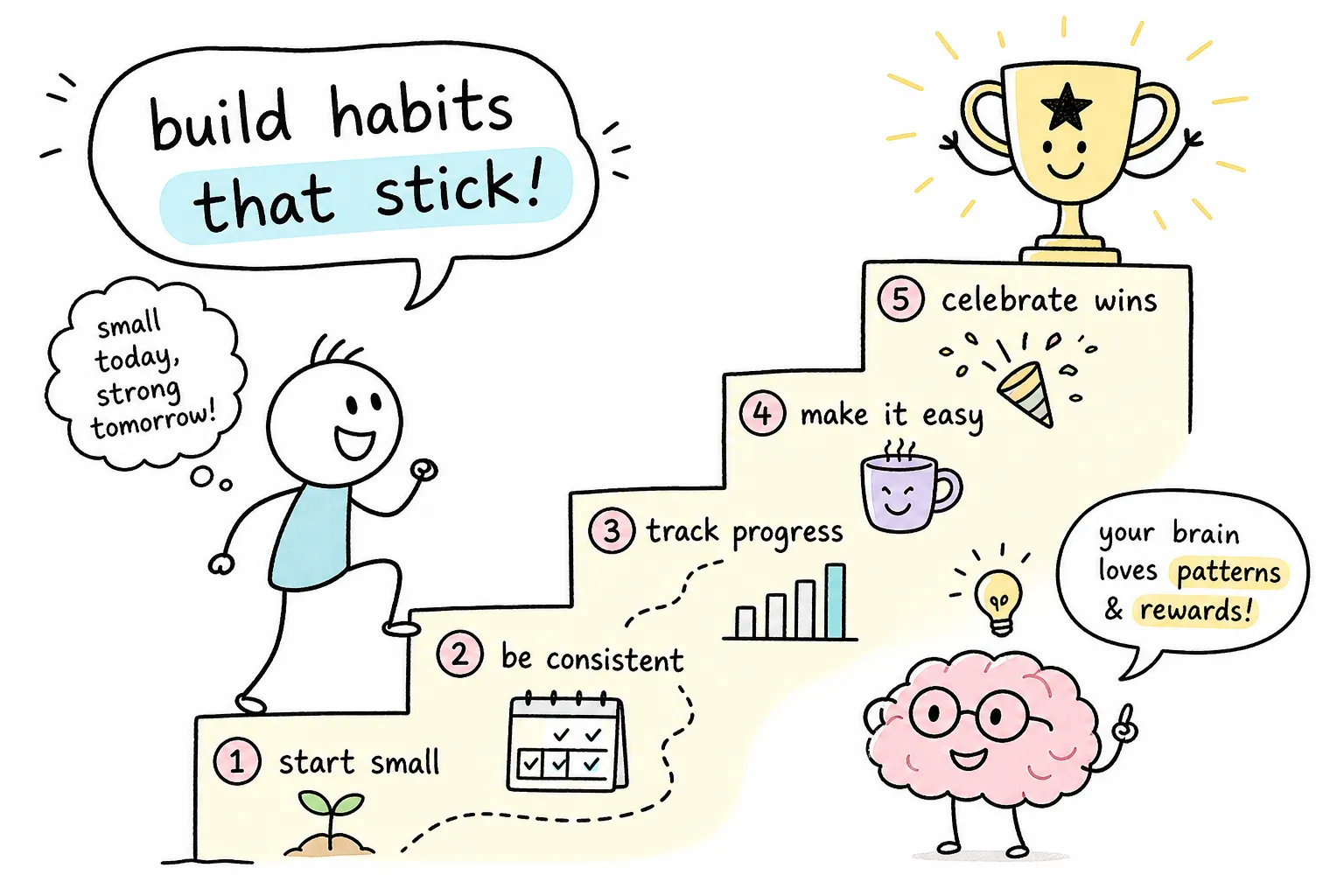
You've probably done this before: picked a new habit on a Sunday night, felt genuinely fired up about it, and then watched the whole thing quietly collapse by Thursday. Not because you're lazy. Not because you lack willpower. Because the system you were using was never designed to work in the first place.
Behavioral science has made this clear for decades, with habit formation research dating back to foundational work on operant conditioning and more recent meta-analyses on implementation intentions: habits aren't built through motivation or discipline. They're built through repetition in stable contexts, small actions attached to reliable cues, and environments shaped to make the right choice easier than the wrong one. That's a skill, not a personality trait, and it's fully learnable.
Whether your goal is waking up earlier, managing your money more intentionally, or writing consistently enough to actually grow a blog, the same foundational habit building tips apply. The 12 habit formation strategies below are grounded in peer-reviewed research, organized into a practical system, and designed to be applied this week. Not someday. This week.
Why so many habit attempts fail early on
The motivation myth
Most people treat motivation like fuel: fill the tank on Monday and ride it as far as it'll go. The problem is that motivation is unreliable by design. It spikes when a goal feels new and exciting, then fades as the novelty wears off and daily friction kicks in. The behavioral science on this is well-established: automatic habits are triggered by cues and context, not by how inspired you feel on a given morning. Building a routine on motivation alone is like building a house on sand.
The habits that last aren't the ones you felt most passionate about starting. They're the ones you attached to consistent cues, repeated in the same context, and designed to require as little conscious decision-making as possible. That's the shift the research actually supports.
Starting too big, too soon
The other common failure pattern is ambition. You decide to start meditating for 30 minutes a day, exercise five times a week, and overhaul your diet simultaneously. Any one of those is a significant behavior change. All three at once, stacked on top of a full schedule, creates a system that one stressful Tuesday can completely derail. Research indicates that behavior complexity is a major factor that typically makes habits harder to form, more steps upfront means more opportunities for the brain to say "not today."
The missing ingredient: context stability
Habits form best when the same cue reliably triggers the same action in the same environment. Without that stability, the brain never builds the automatic pathway that makes behavior feel effortless over time. Switching when, where, or how you attempt a habit makes it feel like starting from scratch every time, because neurologically, you basically are.
The science behind how habits actually form
The habit loop: cue, routine, reward
Every automatic behavior follows the same basic structure: a cue triggers a routine, and a reward reinforces the pattern. That's the habit loop, and understanding it isn't just academic. It's the foundation for designing new habits intentionally instead of accidentally stumbling into them. When you know which element is missing, you can fix the actual problem rather than blaming your character.
Most failed habits are missing either a clear cue or a meaningful reward. The behavior exists in theory but floats untethered in the day, waiting for motivation to show up and carry it. The fix is to design both ends of the loop deliberately.
How long it really takes (not 21 days)
The 21-day habit myth persists everywhere, but the research doesn't support it. A frequently cited study puts the average closer to 66 days, with a realistic range of 59 to 154 days depending on the behavior's complexity and the individual. Simpler habits, like drinking a glass of water after waking up, form faster than more complex ones, like going to the gym five times a week. The exact number matters less than what it implies: consistency over weeks and months, not a two-week sprint followed by self-congratulation.
Why repetition in the same context is the real mechanism
The brain builds automatic pathways through repeated cue-action pairing in a stable context. The habit doesn't form because you willed it into existence. It forms because you paired the same cue with the same action enough times that the cue starts triggering the action without a conscious decision being made. That's automaticity, and it's what you're actually working toward when you try to build a new routine.
Habit building tips 1, 2: Start so small it almost feels pointless
Tip 1: Pick one behavior and make it tiny
The small habit method works because it removes the most common failure point: the gap between intention and action. Choose a single behavior and strip it down to its smallest possible version. One push-up. One sentence written. One glass of water. The goal of that tiny action isn't immediate results; it's building the repetition pattern that makes the habit automatic. Results come later, once the routine is stable enough to expand.
Choosing one behavior also matters. Trying to build three habits simultaneously divides your attention and makes each one less likely to stick. Pick the one that, if it became consistent, would create the most positive downstream change. Start there.
Tip 2: Use the two-minute rule to lower the entry barrier
Any new habit should take two minutes or less to start. Not to finish, to start. The two-minute rule, a practical heuristic used widely in behavior-change practice, isn't about accomplishing everything in 120 seconds; it's about eliminating the resistance that kills follow-through before it ever begins. Once you start, continuing becomes dramatically easier than starting was. The hardest part of any habit is showing up on the days when you genuinely don't feel like it, and a tiny version of the habit protects your consistency streak on those days without letting you off the hook entirely.
Habit building tips 3, 5: Build a trigger system that does the thinking for you
Tip 3: Write an implementation intention
An implementation intention is a specific "if-then" plan that pre-decides when and where a behavior happens. Instead of "I'll meditate more," the plan becomes: "After I pour my morning coffee, I will meditate for two minutes." Decades of behavioral research support this format, including a meta-analysis across 94 studies that found implementation intentions produced a medium-to-large effect on goal attainment compared to goal intentions alone. The effect size measured at d=0.65 across those studies, roughly equivalent to the difference between an average and a notably successful outcome in behavioral terms, which researchers consider substantial.
The reason it works is structural: by specifying the cue in advance, you remove in-the-moment negotiation. The decision is already made. When the cue appears, the action follows automatically, which is exactly the mechanism that builds habits.
Tip 4: Stack the new habit onto an existing one
Habit stacking is one of the most reliable techniques for building habits that stick, and the process is straightforward. Rather than embedding the steps as a long prose chain, here's the sequence clearly:
- Choose a reliable anchor, something you already do automatically every day, like brushing your teeth, starting your laptop, or making your morning coffee.
- Write the stack as a clear sentence using this exact format: "After I [anchor], I will [new habit]."
- Place any tools you need for the new habit where the anchor already happens.
- Repeat the pairing consistently until it feels automatic before adding anything else to the chain.
Concrete examples make this tangible. After brushing your teeth, you open your budgeting app and log yesterday's spending. After starting your laptop, you write one sentence in your draft. After making your coffee, you write down your three priorities for the day. The anchor does the triggering; the new habit just rides along.
Tip 5: Lock in the time and place
Specificity of when and where strengthens cue-behavior learning significantly. Habits tied to vague intentions, "I'll work out sometime this week", fail at a much higher rate than those tied to a specific time slot and location. "I will do ten minutes of movement at 7:00 a.m. in my living room" gives the brain an exact context to pair with the behavior. The more specific the context, the faster the automatic association forms.
Tips 6, 8: Design your space so the right choice is the obvious one
Tip 6: Reduce friction for habits you want to build
Environment design is one of the most underused habit formation strategies in personal development, and it works because it shifts behavior before motivation even enters the picture. Put the journal on the pillow. Place the running shoes by the front door. Set the vitamins next to the coffee maker. When the desired action requires zero searching and zero setup, the likelihood of doing it rises significantly without any additional willpower required.
Small reductions in friction compound over time. Shawn Achor's research on positive habit design suggests that making a behavior roughly 20 seconds easier to initiate can meaningfully increase follow-through. That's not a large structural change; it's just removing a step or two from the path between you and the behavior.
Tip 7: Add friction to habits you want to break
The flip side of reducing friction is increasing it for behaviors that compete with your new habit. Delete the distraction app from your phone's home screen. Put the TV remote in a different room during the hours you want to write. Set a website blocker during your morning work window. Friction doesn't eliminate temptation, but it inserts a pause that breaks the automatic pull of the competing behavior.
The same mechanism that makes desired habits easier applies in reverse: more steps between you and an unwanted behavior means fewer automatic executions of that behavior. Design your environment for both directions simultaneously and the desired habit becomes the path of least resistance by default.
Tip 8: Use visual cues as anchors in your environment
Physical reminders act as passive triggers throughout the day without requiring any memory or willpower. A sticky note on the monitor, a habit tracker on the desk, a piece of workout gear left in a visible spot, all of these serve as environmental nudges that prompt the behavior before you've even had time to talk yourself out of it. Visual cues work because the brain responds to environmental signals automatically, which is exactly the mechanism you're trying to leverage.
Tips 9, 10: Track your reps and make the habit feel rewarding
Tip 9: Use a habit tracker (paper or app)
Tracking is a behavioral tool, not just an organizational one. Crossing off a day or maintaining a visible streak creates a small but real reward signal that reinforces the cue-action loop before the habit has become fully automatic. The visual record of effort becomes part of the motivation system, which is especially valuable in the early weeks when the behavior itself doesn't yet feel rewarding on its own.
The best habit tracking tools in 2026 break down by platform and preference. Streaks is the top pick for Apple users who want a clean, minimal streak system with deep Apple Health integration. Loop Habit Tracker is the best free Android option for straightforward tracking without unnecessary complexity. Habitify works well across iOS, Android, Mac, and web for people who need cross-device syncing and analytics. Habitica is worth considering if gamification and social accountability keep you engaged. The best tracker is ultimately the one you'll still open on a bad day, not the one with the most features.
Tip 10: Build in an immediate reward after each repetition
Habits need a reward signal, especially in the early stages before the behavior itself feels natural or produces visible results. The reward doesn't need to be elaborate. A quick moment of self-acknowledgment works. So does a favorite playlist during the habit, or the satisfaction of a checkmark on a physical tracker. The brain needs to associate the cue-action pairing with something positive in order to reinforce the loop and accelerate automaticity.
Without a reward signal, the loop stays incomplete. The habit forms more slowly and breaks more easily under pressure. Building in even a small, immediate positive signal after each repetition closes the loop and tells the brain: this is worth repeating.
Tips 11, 12: Recover fast when you miss a day
Tip 11: Aim to never miss twice
Missing one day has minimal long-term impact on habit formation. The research on this is reassuring: occasional lapses don't derail automaticity when the pattern is otherwise consistent. What does cause problems is missing several days in a row, research supports that the longer the gap, the harder re-entry becomes, so the goal is to resume as quickly as possible. The "never miss twice" rule replaces perfectionism with a simple, no-drama recovery standard: whatever happened yesterday, you show up today. And when you do return, making the next attempt very small lowers the barrier enough that re-entry is almost guaranteed.
This principle matters because most habit abandonment doesn't happen on the day someone misses. It happens in the two or three days after, when the story shifts from "I missed a day" to "I'm someone who can't stick to things." Catching that narrative early and re-entering immediately is one of the most effective relapse-recovery techniques supported by the behavioral science literature.
Tip 12: Shrink the habit after a lapse to guarantee re-entry
When you return after a break of several days or more, drop back to the smallest possible version of the habit to guarantee a win. After missing several days of writing, the goal isn't 1,000 words. It's opening the document and writing one paragraph. After missing the gym, the goal is just to show up and do ten minutes of anything. Re-establishing the cue-action link matters far more than making up lost volume, and a guaranteed small win restores momentum faster than an ambitious comeback attempt that gets abandoned again.
Planning for slips before they happen
The most effective recovery happens before the lapse, not after it. Identify your most likely triggers for missing a day: travel, late nights, high-stress weeks, social disruptions. For each one, write a specific if-then response in advance. "If I travel and miss my morning routine, I will do a five-minute version in the hotel before checking my phone." This pre-commitment reduces the chance that a single miss becomes a full abandonment, because the decision of what to do next is already made.
How habit consistency compounds into something bigger than a single routine
Keystone habits and their ripple effect
Some habits function as leverage points because they alter the conditions under which other behaviors occur. Regular exercise tends to improve sleep quality, reduce stress-related eating, and sharpen daily focus without any of those areas being directly targeted. Consistent morning planning changes how the rest of the day unfolds. These are keystone habits: behaviors that trigger a cascade of other positive changes by reshaping the structure and context of your entire day.
The scientific support here is strongest as a pattern rather than a guaranteed law, but the underlying mechanisms are real. Small wins build self-efficacy, which increases follow-through on other goals. Environmental and routine restructuring makes adjacent positive behaviors easier to perform. Choosing the right anchor habit from the beginning doesn't just build one routine; it can shift how you operate across multiple areas simultaneously.
The habit that powers bloggers and creators
The most consistent bloggers and content creators aren't more talented or more motivated than everyone else. They've turned writing into a non-negotiable daily anchor, usually a short, specific window tied to the same cue every day. Many successful creators report short daily writing windows, something in the range of 20 minutes, anchored to the same cue, which helps them publish with far more regularity than those who wait for large blocks of inspiration to appear. Consistency compounds. A mediocre post published is worth more than a brilliant post that never gets finished.
At The Growth Engine, this is exactly the philosophy the platform is built around: helping readers develop the practical systems, including consistent writing habits, that make growing a blog feel sustainable rather than exhausting. The same behavioral principles that help you build a morning exercise routine also help you show up to write three times a week, manage a budget consistently, and make progress on goals that actually matter to you.
Your one-week action plan
Pick one habit right now. Not three. One. Shrink it to its smallest possible version, then attach it to an existing anchor using the "After I [anchor], I will [new habit]" format. Set up your environment so the tools you need are already in place. Decide in advance what your recovery move looks like if you miss a day. Then track it for seven days without judgment, just information.
Frame this as a short diagnostic experiment, not a lifelong commitment. Seven days won't form a fully automatic habit, research suggests that takes weeks to months on average, but it will tell you whether the cue is reliable, whether the timing works, and whether the behavior needs to be adjusted. That's useful feedback, not failure. Adjust and go again.
The system beats the sprint every time
These habit building tips aren't about discipline or motivation. They're about designing a system that makes the behavior easy to repeat in the same context until it becomes automatic. Start small. Attach to a cue. Shape your environment. Track it. Recover fast when you slip. That's the entire framework, and it's backed by decades of behavioral science rather than productivity mythology.
The goals that readers at The Growth Engine are working toward, whether that's better financial habits, a more intentional daily routine, or a blog that actually gets written and published consistently, all run through the same underlying system. Habit consistency is the foundation. Everything else builds on top of it.
Pick the one habit building tip from this article that resonates most and test it this week. If you want to go deeper on building the writing and productivity systems that support a growing blog or a more intentional life, explore the rest of what The Growth Engine has to offer. The frameworks are here. The next step is yours.


Comments
Post a Comment