How to Build a Self-Improvement Routine That Sticks
How to Build a Self-Improvement Routine That Sticks
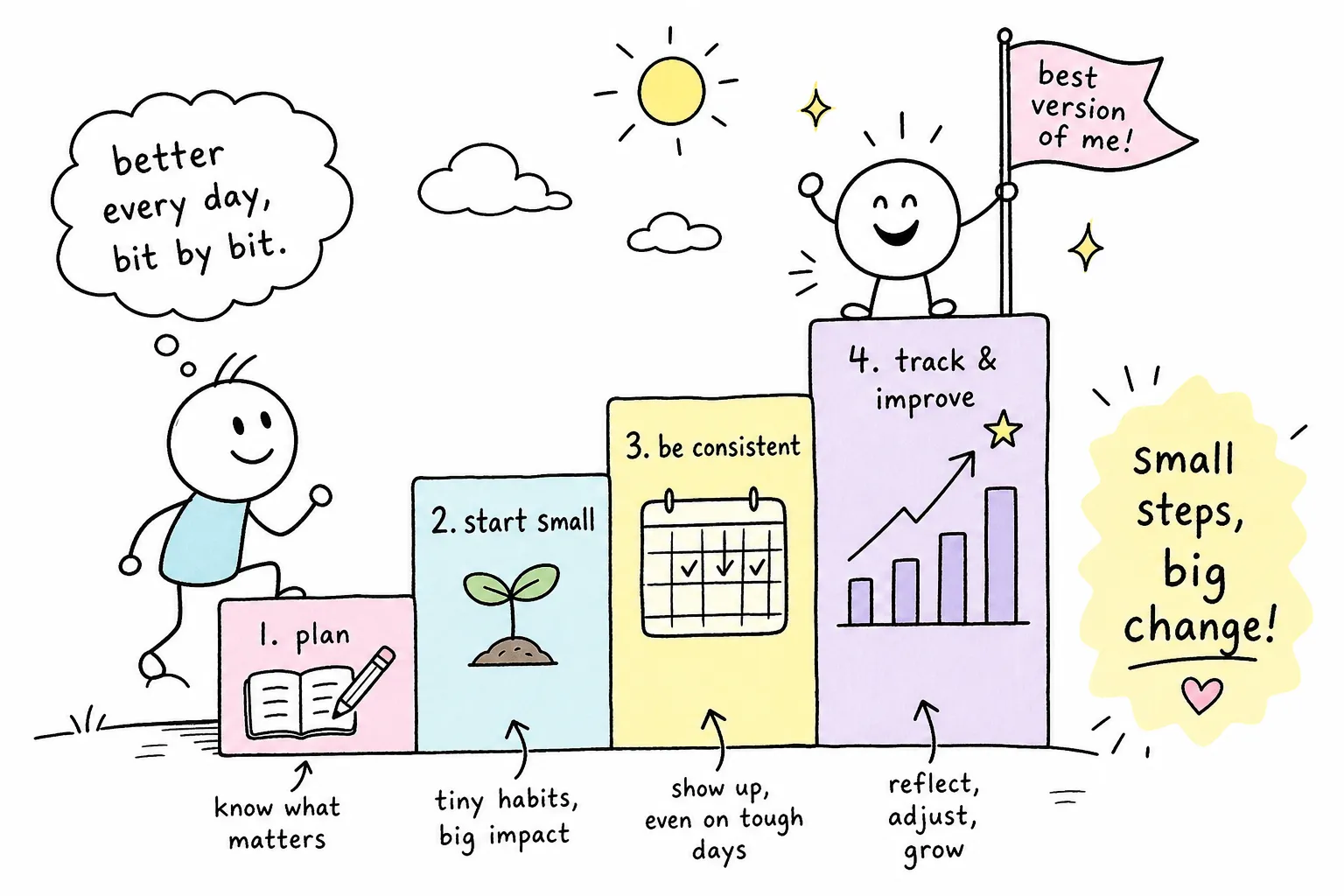
You've been here before. You set the alarm for 6 a.m., downloaded the habit tracker, bought the planner with the motivational quotes on every page, and committed to a complete overhaul of your mornings. By day nine, the alarm was snoozed, the app was buried three screens deep, and the planner sat unopened on your desk. If your self improvement routine keeps collapsing this way, the problem isn't your willpower or your motivation. The problem is the routine itself: designed for a perfect, uninterrupted life that doesn't actually exist.
A real personal growth routine isn't about doing everything. It's about doing the right things in the right order, consistently enough that they become automatic. That distinction sounds small, but it changes everything about how you design your days. At The Growth Engine, this is the core of what we help readers build: practical systems that connect better habits, smarter productivity, and intentional personal growth into one workable daily structure.
By the end of this article, you'll have three flexible morning templates, an evening wind-down system, a habit stacking method you can start using today, and a 30-day framework to make all of it stick. No perfection required.
Why most self-improvement routines fall apart by week two
Before building anything new, it helps to understand exactly why the last version didn't work. Most routines fail for the same two reasons, and neither of them is a character flaw.
The all-or-nothing trap that kills momentum
Most people design routines that require a perfect morning: a full hour of uninterrupted time, a well-rested and motivated version of themselves, and zero unexpected demands from work, kids, or life. The routine works fine on calm Tuesdays. Then a bad night's sleep happens, or an early meeting lands on the calendar, and the whole structure collapses because there's no version of it that fits a messy day. Routines designed for flexibility tend to outlast routines built on perfection because they can survive the hard days, not just the easy ones. The goal is a system that works on your worst day, not your best one.
Starting with too many habits at once
Adding multiple new habits simultaneously drains your decision bandwidth faster than almost anything else. When you try to wake earlier, exercise, journal, meditate, and eat a better breakfast all at once, each habit competes for cognitive resources that are still limited in the early weeks. People typically abandon multi-habit stacks within the first two to three weeks, not because the habits are wrong, but because the cognitive load is too high. The fix isn't trying harder. It's starting with one anchor habit and letting the rest of your self improvement routine grow around it over time.
What the science actually says about effective daily routines
You don't need a PhD to use this research. You just need to know which habits have the strongest evidence behind them so you can prioritize them when designing your own routine.
The four evidence-backed habits worth building first
Aerobic movement is one of the most consistently supported habits for brain health, attention, and working memory. The practical target from most research is about 150 minutes per week of moderate activity, which works out to 20 to 30 minutes on most days. Consistent sleep timing, waking and sleeping at roughly the same time daily, is strongly linked to better reasoning, next-day focus, and emotional stability. Even mild dehydration or a disrupted sleep schedule degrades cognitive performance in measurable ways.
Brief mindfulness practice rounds out the evidence-based foundation. Multiple reviews report improvements in attention, cognitive flexibility, and stress control after just four to eight weeks of regular short sessions. Reflective writing, while less robustly studied than sleep or exercise, supports emotional processing and stress regulation in ways that indirectly protect your focus and follow-through throughout the day. These four habits, movement, consistent sleep, mindfulness, and journaling, form the foundation of any serious daily self-improvement plan.
Why consistency matters more than intensity
A 10-minute walk done every day beats a 60-minute gym session done twice a month. That's not a motivational slogan; it's the mechanism through which habits actually form. Consistency builds the neural pathways and identity signals that make behavior automatic over time. Intensity, by contrast, tends to build soreness and guilt without delivering the repetition habits need to take root. When you design your routine around finding the minimum effective dose for each habit, you're not compromising. You're engineering for longevity.
Morning routine templates for every schedule and lifestyle
These aren't aspirational lifestyle templates borrowed from someone with a personal chef and three hours of free time before work. They're real time-block options built around schedules that actually exist.
The 10-minute routine for packed mornings
This is the floor, not the ceiling. Wake and hydrate (2 minutes), do a brief stretch or movement (3 minutes), set three priorities for the day (3 minutes), and prep to go (2 minutes). That's it. The purpose of this version isn't to maximize output; it's to protect the habit on the days when everything else competes for your time. Consistent short routines generally build more lasting momentum than infrequent longer sessions, the daily repetition is what locks the habit in, not the duration.
The 30-minute beginner morning stack
This is where most people should start. Wake and drink water (5 minutes), then move into light movement or stretching (5 minutes), followed by mindfulness or focused breathing (5 minutes). Eat breakfast next (10 minutes), then close with your daily plan (5 minutes). The order is intentional: movement before screens, planning before distractions. Starting with physical action wakes up your body and primes your brain before you expose it to reactive information like email or news, a sequencing approach supported by research on morning exercise and cognitive readiness. Planning last means you're setting direction after your mind is already awake and settled.
The 60-minute intermediate morning routine
This is a build-toward target, not a starting point. Wake and hydrate (5 minutes), exercise with intention (15 minutes), journal or reflect (10 minutes), eat breakfast (15 minutes), shower and get dressed (10 minutes), then review your top priorities (5 minutes). The key word there is "build." If you're currently running a 10-minute morning, your next step is a 30-minute version, not jumping straight to an hour. Add one block at a time, let it stabilize over a week or two, then add the next. That's how this level becomes sustainable rather than aspirational.
Evening wind-down habits that make tomorrow easier
Most personal development content spends 90% of its energy on mornings and treats evenings like an afterthought. That's backwards. Your evening routine is the setup for your morning. They're two halves of the same system, not separate practices.
The shutdown sequence: how to end your workday with intention
A simple three-part shutdown sequence works for most schedules. First, reset your physical environment in a brief five to fifteen minutes depending on your workload: clear your workspace, close open tabs, and close the loop on anything that's still mentally open. Second, prepare for tomorrow by laying out clothes, packing your bag, and writing down your single most important priority for the next day. Third, start your digital wind-down by dimming screens and cutting off new information at a set time. Sleep researchers and general sleep-hygiene guidelines consistently identify late-evening light exposure as a disruptor of sleep onset, which means the screen-off habit isn't just a productivity tip, it's supporting the quality of your recovery.
The wind-down ritual that signals your brain to rest
A consistent pre-sleep cue in the 10 to 90-minute window before bed can help shorten sleep onset and improve sleep quality. That cue can be light reading, slow breathing, or a short gratitude note. The specific activity matters less than the consistency of it. When you do the same thing at roughly the same time each night, your brain begins to associate that sequence with the transition to sleep. Many readers at The Growth Engine use this window for a short journaling entry, which serves double duty as both stress processing and reflection on the day's progress.
Learning rituals and the habit that compounds everything
Exercise, sleep, and mindfulness form the foundation. But there's a fourth layer that most personal growth systems underutilize: intentional daily learning, and the writing practice that makes it actually stick.
How to build a consistent daily learning ritual
Protect 15 to 20 minutes of reading or focused learning every day and tie it to a slot that already exists in your schedule: morning coffee, a lunch break, or the wind-down before bed. Pick one input source per week rather than cycling through five podcasts, three newsletters, and two books simultaneously. Consuming more than you apply is just intellectual entertainment. The goal is to take in one idea clearly enough to use it, not to collect as many ideas as possible.
Why writing is the most underrated self-improvement habit
When you write about what you're learning, whether in a private journal or a public blog post, you're forced to organize your thinking, identify the gaps in your understanding, and articulate ideas in your own words. Educational researchers sometimes call this a teaching or explanation effect (referred to in some literature as the protégé effect): actively explaining a concept accelerates retention and clarity more than passive reading or listening alone. You can't fake your way through writing about something you haven't actually understood.
At The Growth Engine, this is one of the core principles behind how we approach blogging education. Maintaining a writing practice isn't just a content strategy; it's one of the most powerful personal development habits available, because it creates a documented record of your own thinking over time. The person who reads consistently builds knowledge. The person who reads and writes about what they've read builds compounding clarity that accumulates over months in ways passive consumption never does. If you're curious about building this kind of practice, The Growth Engine has practical guidance on starting and sustaining a journaling or blogging habit that works alongside your daily routine.
How to stack your habits into one cohesive self improvement routine
Now that you have the components, here's how to assemble them into a routine that runs on autopilot rather than willpower.
The "after this, I do that" formula for building automatic habits
Habit stacking works by anchoring a new behavior to an existing, automatic one. The formula is simple: "After [current habit], I will [new habit]." Morning hygiene routines often make effective anchors because they're frequent, emotionally neutral, and tied to a consistent time and place, conditions that research on habit formation links to higher adherence rates. A few practical examples from the templates above: after you pour your morning coffee, you sit and read for 15 minutes. After you brush your teeth at night, you write three sentences in your journal. After you sit down at your desk, you set your three priorities before opening email.
Studies on habit stacking suggest that tying new behaviors to stable anchors, especially when paired with a small sensory reward, meaningfully improves retention over a three-month period compared to habits practiced in isolation. Those findings point to a real mechanism: stable anchors plus small habits plus consistent rewards create behavioral loops that persist long after motivation has faded.
Building your personal growth checklist for the week
Keep the weekly structure simple enough to run on a bad day. A practical baseline looks like this: three morning anchors (hydration, movement, priorities), two learning habits (15 minutes of reading, one journal entry), one evening shutdown ritual, and one weekly review. That becomes your personal growth checklist, and the goal is to make it simple enough that checking off each item feels easy rather than burdensome. Complexity is the enemy of consistency. A checklist you can complete in a rough week is more valuable than one that only works when everything goes right.
Tracking progress in your 30-day self improvement routine
A 30-day experiment only becomes a long-term habit if you have a review process that catches problems before they turn into abandonment.
The best tools for tracking your daily routine without overcomplicating it
For simple binary habit tracking, Streaks on iPhone and Strides for structured goals are strong starting points. Habitica works well if you respond to gamified accountability: it tracks habits, dailies, and to-dos with a game-like reward system that keeps engagement high in the early weeks. For readers who want a full planning dashboard, Notion or ClickUp offer flexible goal tracking and project-style progress visibility. Fabulous is worth trying if you prefer guided routine building with built-in prompts. On the analog side, structured planners like the Full Focus Planner or Clever Fox give you a paper-based system that works without screens.
Regardless of the tool you choose, use binary tracking in the first two to three weeks: done or not done, nothing more. Tracking volume or quality before a habit is established adds friction and shifts your focus from building consistency to evaluating performance. Identity comes before optimization. Check the box first, refine later.
How to run a weekly review that keeps your self improvement routine alive
Set aside 15 minutes at the end of each week for a simple review. Look at what got done and what didn't (5 minutes), then identify one friction point, one specific thing that made a habit harder to complete (3 minutes). Make one small adjustment rather than an overhaul, and set one clear priority for the coming week. Keep it tight enough to finish in one sitting.
This process is your accountability mechanism. It catches a missed day before it becomes a missed week, and it prevents the all-or-nothing spiral that kills most routines. Research on habit adherence consistently finds that structured check-ins improve long-term follow-through, the weekly review is where that compounding effect is earned. Skipping it is how a two-day gap quietly becomes a two-week reset.
Build the routine, then let it build you
A self improvement routine isn't a rigid schedule you follow perfectly. It's a flexible system that adapts as your life changes and as you grow into it. The structure outlined here, a morning anchor, an evening shutdown, a daily learning habit, and a weekly review, is a starting framework, not a final destination. It will look different in six months than it does on day one, and that's exactly how it should work.
The readers who make the most progress aren't the ones who found the perfect routine on day one. They're the ones who started with something small, reviewed it honestly, and kept adjusting until it fit their actual life. The people still running their routines at the six-month mark didn't get there because they had more discipline. They got there because they had a system flexible enough to survive the weeks when everything else fell apart.
Start with the 10-minute morning stack today. Add the evening shutdown this week. Introduce a daily learning habit in week two. Run the weekly review every Sunday. One element at a time, built on a real schedule, tracked honestly, and adjusted when needed. That's how a daily self improvement routine becomes something you don't have to think about anymore, because it's just what you do.


Comments
Post a Comment