Debt Snowball vs Avalanche: Which Method Actually Works?
Debt Snowball vs Avalanche: Which Method Actually Works?
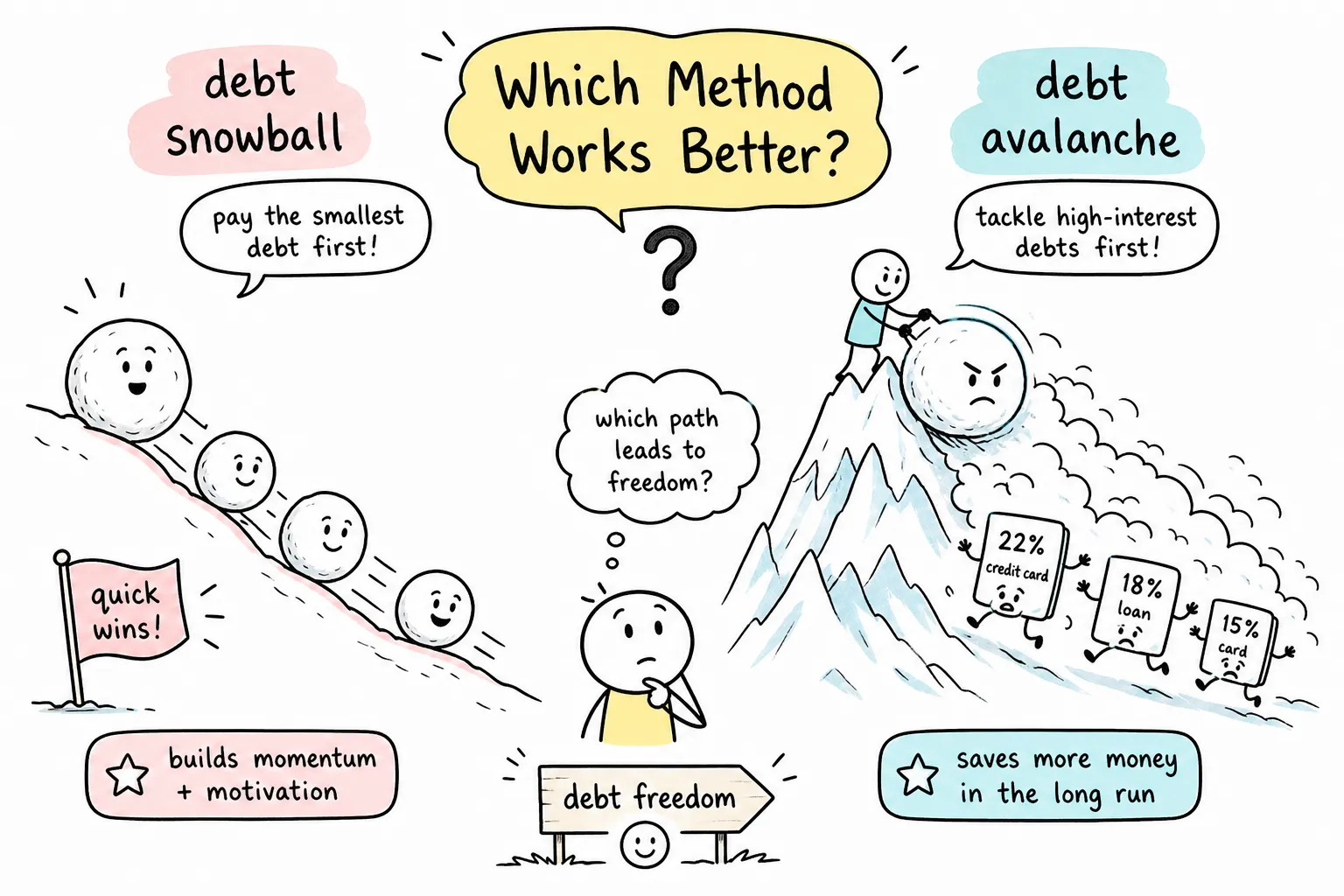
You've finally decided to get serious about your debt. You've done the research, found two methods that everyone recommends, and now you're stuck in the same spot most people land: snowball or avalanche? Most people pick one based on a YouTube video, stay motivated for six weeks, then quietly give up. This article compares the snowball vs avalanche method so you can choose the debt payoff strategy that actually fits your situation.
What follows is a direct comparison of both approaches, including the real interest math using a concrete three-debt example, the behavioral research that actually predicts who succeeds, and a five-question quiz to match the right method to your financial behavior, not just your personality type. By the end, you'll know exactly which method to start this week and how to execute it step by step.
At The Growth Engine, this kind of side-by-side breakdown is part of a broader debt-and-budget framework designed to help readers get to zero, then build from there. Let's start with the mechanics.
How the debt snowball method works
The snowball method is built on a simple principle: eliminate the smallest balance first, regardless of its interest rate. You list every debt from smallest balance to largest, pay the minimum on all of them, and send every extra dollar toward the top of the list. Once that balance hits zero, you take that full payment and roll it into the next debt. The payment grows, or "snowballs," with each account you close.
The logic is purely behavioral. Each closed account is a visible win, and those wins compound your motivation just like extra payments compound your payoff speed. That's not a coincidence, it's the core design of the strategy.
The mechanics in plain numbers
Picture three debts: a $1,800 store card at 18.99% APR with a $45 minimum, a $4,200 credit card at 24.99% APR with a $125 minimum, and a $9,000 personal loan at 7.5% APR with a $210 minimum. Your total minimums come to $380 per month, and you have $200 extra to put toward debt each month, bringing your total debt payment to $580.
In the snowball approach, you attack the $1,800 store card first. You throw $245 at it every month ($45 minimum plus the $200 extra) while paying minimums on everything else. That card is gone in roughly eight months. Then you roll the full $245 into the credit card payment, so you're now sending $370 toward the $4,200 balance each month. You clear that in about 14 more months. Then you redirect the full $580 toward the personal loan until it's done. Every account closed feels like a finish line, and that rhythm keeps most people moving forward.
Who the snowball is actually built for
The snowball is built for anyone who has started a debt payoff plan before and stopped. If past plans faded out after a few months, the problem almost certainly wasn't discipline, it was motivation. The snowball solves for that directly by delivering a cleared account within the first year.
It also fits people carrying multiple small balances: store cards, medical bills, credit lines. When you have six or seven accounts on your list, the avalanche can feel like you're paying on the same card for two years with nothing to show for it. The snowball gives you something to cross off. For many people, that difference is the entire plan.
How the debt avalanche method works
The avalanche method uses the same core mechanic but a different ordering rule. You list every debt from highest APR to lowest, pay the minimum on all of them, and put all extra money toward the highest-rate debt first. When that balance is gone, you roll the payment forward to the next highest rate. The structure is identical to the snowball, only the sorting changes.
The avalanche prioritizes math over momentum. By attacking the most expensive debt first, you reduce the total interest accruing across your whole balance sheet as quickly as possible. Over time, that efficiency adds up to real money.
The mechanics in plain numbers
Using the same three debts from above, the avalanche reorders the list: the $4,200 card at 24.99% APR goes first, the $1,800 store card at 18.99% comes second, and the $9,000 loan at 7.5% stays last. You send $325 per month toward the credit card ($125 minimum plus $200 extra) while paying minimums elsewhere. That card takes about 16 months to clear. Then the $1,800 store card, receiving $370 per month, clears in about five months more. The personal loan gets the full $580 at the end.
The payoff sequence takes roughly the same total time, but the interest you pay along the way is lower because you eliminated the 24.99% rate first. The actual dollar difference between the two methods on this scenario falls in the range of $300 to $500, which you'll see calculated in the next section.
Who the avalanche is built for
The avalanche is the right fit for someone who carries one or two high-APR balances, particularly credit cards above 20%, and has the consistency to stay the course without needing frequent account closures to feel progress. If you've successfully followed a savings plan or budget for several months before, you've already demonstrated that you can delay gratification for a long-term goal.
The avalanche also becomes more compelling as the APR spread between your debts grows. When your highest-rate debt is 26% and your lowest is 6%, the interest savings from attacking the 26% balance first are significant. If all your debts sit between 18% and 22%, the difference between methods narrows considerably.
Snowball vs Avalanche Method: Interest, Timing, and Who Wins
Using the three-debt scenario above ($1,800 at 18.99%, $4,200 at 24.99%, $9,000 at 7.5%, with $580 total monthly payment), the avalanche saves approximately $400 to $500 in total interest compared to the snowball on this setup. Both methods result in full payoff within roughly 36 to 38 months.
That range aligns with what broader modeling shows. In a modeled sample of 1,000 representative debt profiles, based on the kind of analysis used in consumer finance research, the median extra interest paid under the snowball method comes out around $500 compared to the avalanche. In some scenarios with closely clustered rates, the gap can shrink to under $100. In cases where one debt carries a dramatically higher rate, the gap can exceed $1,000. Think of those figures as illustrative benchmarks, not a single-study guarantee; your actual gap depends entirely on your specific balances and rates.
What the numbers actually show
The avalanche wins on total interest paid in nearly every scenario. That is a mathematical fact, not a preference. But the size of the win depends entirely on your actual APR spread. If your debts are clustered within a 5% range of each other, the interest savings from choosing avalanche over snowball may be less than $200 on a $15,000 balance. That context matters when you're weighing methods.
The current average credit card APR in the United States sits at approximately 20.94% across all accounts, with accounts actively accruing interest averaging closer to 22.15%. Many Americans carry multiple cards in a tight band between 18% and 26%, which means the avalanche advantage in those situations is real but not enormous. Knowing your specific rates before choosing a method is non-negotiable.
How to Run a Snowball vs Avalanche Method Calculator
Rather than estimating, put your actual numbers into a dedicated snowball vs avalanche calculator. Solid options include Undebt.it, NeatCalc, Ordio, and DebtPaydownCalculator.com. Each lets you enter balance, APR, minimum payment, and monthly extra payment, then shows both methods side by side with total interest paid and a projected debt-free date.
When you run the comparison, focus on two outputs: total interest paid and projected payoff month. Ignore the monthly breakdowns until you've committed to a method. The goal is to see the actual dollar difference between methods for your specific debts, then weigh that number against your behavioral track record.
What the research says about sticking with your plan
The most cited piece of peer-reviewed evidence on this question comes from research by Gal and McShane, published in the Journal of Marketing Research, which analyzed real debt-management account data and found that consumers who focused on eliminating individual accounts were significantly more likely to fully eliminate their overall debt than those focused on minimizing interest costs. In some comparisons within that research, snowball-style approaches produced debt-elimination rates 30% to 80% higher than interest-minimization approaches.
The reason isn't complicated. Paying off an account and watching it disappear from your list produces a concrete psychological reward. That reward keeps people enrolled in the plan long enough to finish it.
The real cost of quitting mid-plan
An avalanche plan you abandon at month nine is objectively worse than a snowball plan you complete, full stop. The math only works in the avalanche's favor if you follow through to zero. If you have a history of starting budgets or repayment plans and letting them slide, that history is data about your actual behavior, not a character flaw to ignore.
Research on debt repayment completion is mixed, but available studies suggest that somewhere between one-third and two-thirds of people who start a structured plan actually finish it. The most common reason people quit is that they can no longer sustain the monthly payment amount. Motivation loss is the second most common factor. Both of those problems hit the avalanche user harder than the snowball user.
What this means for choosing between the snowball vs avalanche method
If you have a track record of abandoning financial plans, the snowball's early wins aren't a psychological trick, they're a practical risk management tool. Early closed accounts reduce the chance you quit before the plan is done. If you've successfully followed a budget or savings goal for six or more months before, the avalanche's interest savings are genuinely within your reach. That distinction is the most honest framework for choosing between the two.
Neither method is smarter than the other in every situation. The right method is the one calibrated to your specific behavioral tendencies and debt profile.
Quiz: which method fits your financial situation?
Answer each question honestly based on your actual behavior, not the version of yourself you aspire to be. The goal is an accurate read on your financial personality so you start with the method most likely to get you to zero.
The five questions
- Q1: When you've tried paying off debt before, what stopped you?
- A: Lost motivation and stopped
- B: Money literally ran out
- Q2: How many separate debt accounts do you currently have?
- A: Four or more
- B: One to three
- Q3: What's the APR spread between your highest-rate and lowest-rate debt?
- A: Less than 5%
- B: More than 10%
- 5, 10% spread: lean on your behavioral track record to decide, if you've quit plans before, lean A; if you've held to financial goals, lean B
- Q4: How do you feel when you clear a balance to zero?
- A: Very motivated, ready for the next one
- B: Neutral, I just move on to the next item
- Q5: How consistently do you follow a monthly budget?
- A: Rarely or inconsistently
- B: Most months, with minor adjustments
How to score and interpret your result
Mostly A answers: the snowball is your method. Your profile shows that motivation and visible progress are the variables most likely to make or break your plan. Protecting those variables is worth more than optimizing interest to the dollar. Mostly B answers: the avalanche is your method. Your profile shows financial discipline and a rate spread where the interest savings are meaningful enough to pursue deliberately.
An even split between A and B answers points toward a hybrid approach. Here's how that works: identify your smallest balance. If it's under $500, pay it off in the first one to three months to capture a quick win, then immediately switch to avalanche order for the rest of your debts. This structure captures most of the avalanche's interest savings while protecting your motivation in the critical early months when most people quit.
Once you've picked a method, pair it with a budgeting system that protects your monthly payment floor. At The Growth Engine, we cover how to connect your chosen debt strategy to a complete monthly budget framework. For readers who want to accelerate payoff without cutting lifestyle further, we also walk through how a blog-based side income can generate an extra $200 to $500 per month, turning a three-year payoff timeline into something significantly shorter.
Step-by-step implementation checklist for either method
The core execution process is identical for both methods. The only variable is the ordering rule you apply in Step 3. Everything else stays the same: list every debt, cover every minimum, attack one target, roll the payment forward when it's gone.
Build your debt list and set your payment floor
Start by writing down every debt you owe. For each one, record the creditor name, current balance, APR, minimum payment, and due date. Don't leave anything out, including medical debt, family loans, or buy-now-pay-later balances. You can't manage what you haven't fully mapped.
Next, add up all your minimum payments to find your payment floor. That number is non-negotiable, missing minimums triggers fees and rate increases that derail the plan before it starts. Then look at your monthly budget to find your surplus after covering minimums and essential expenses like housing, utilities, and food. That surplus is your acceleration payment, and even $75 extra per month makes a measurable difference in payoff speed. If the surplus is too small to move the needle, examine either expenses or income before launching the plan.
Execute, roll, and track progress
Apply your ordering rule: smallest balance first for snowball, highest APR first for avalanche. Send every dollar of your surplus to that one target debt every month. Pay only minimums on everything else. When the target debt hits zero, immediately redirect its full payment amount to the next debt on your ordered list.
The rollover mechanic is the engine of both strategies, and many people overlook it. They close an account and reduce their total monthly payment instead of rolling it forward, a mistake that adds months to the plan. Set up autopay for every minimum payment so missed due dates never become a variable. Track each balance in a spreadsheet, a free app, or even a handwritten list updated monthly. Seeing balances drop is part of what sustains the plan, so make the tracking visible rather than buried in a banking app you rarely open. Review the list whenever a balance closes or your income changes, and adjust the order if needed.
When consolidation or a hybrid approach outperforms both
Debt consolidation through a personal loan can outperform both the snowball and avalanche on total interest paid when three conditions align: the new interest rate is meaningfully lower than your current weighted average APR, the loan fees don't erase the rate savings, and you close or freeze the paid cards afterward so you don't add new balances. The threshold where consolidation starts to make sense is roughly when your existing debts are averaging 22% to 28% APR and you can qualify for a personal loan at 12% or below.
Where consolidation loses is when the repayment term stretches too long, when origination fees are high, or when the underlying spending habits that created the debt haven't been addressed. A lower rate on a five-year loan can still cost more in total interest than a focused avalanche attack on a two-year timeline.
Signs that consolidation is worth running the numbers on
Three specific signals suggest consolidation deserves a serious look. You carry multiple credit cards all charging above 22% APR with no end in sight on current minimums. Your credit score qualifies you for a personal loan at 12% or lower, at that spread, the math becomes compelling quickly. And you're genuinely prepared to close or freeze the paid credit cards afterward and not treat them as available spending capacity.
If all three of those conditions apply, use a debt consolidation calculator to compare the total interest on your current repayment path against the personal loan scenario. The output will tell you whether the savings justify the switch. If only one or two conditions apply, consolidation is likely not the right move right now.
The hybrid approach for everyone else
If consolidation doesn't pencil out, the hybrid works well in one specific situation: your smallest balance is genuinely small (under $500) and you have at least one debt with an APR more than 10 percentage points above your other debts. Pay off that quick-win balance first, typically within one to three months, then switch to strict avalanche order for every remaining debt. This structure captures most of the avalanche's interest savings while giving your motivation the early win it needs to stay enrolled through the harder middle months of the plan.
The hybrid is not a compromise for people who can't decide. It's a deliberate strategy for a specific debt profile. If your balances are all roughly similar in size and your rates are all bunched together, pick one primary method and commit to it fully.
Your next move after picking a method
The snowball vs avalanche method debate ultimately comes down to this: the snowball wins on behavioral follow-through, the avalanche wins on total interest paid, and the right method is the one you'll actually finish. No method beats one that you complete, even if it's not the mathematically optimal choice.
Before you commit, run your actual numbers through a free snowball vs avalanche calculator like Undebt.it or NeatCalc. The interest gap between methods on your specific debts may be $150 or it may be $800, that number should inform your decision, not someone else's hypothetical scenario. Once you know the dollar difference, weigh it against your honest behavioral track record and make the call.
After that, the next real lever in your debt freedom timeline is how much you can put toward that target debt each month. Cutting expenses helps, but there's a floor to how much you can cut. Growing income doesn't have a ceiling in the same way.
At The Growth Engine, we cover how to pair your debt payoff plan with a monthly budget framework that protects your payment floor. For those ready to accelerate, we also have a beginner's guide to launching a blog-based side income that can realistically generate an extra $200 to $500 per month. Apply that income directly to your target debt each month and a 36-month payoff plan gets much shorter. The method you pick this week is step one. Building the income to fuel it is step two.
#DebtFreeJourney #DebtSnowball #DebtAvalanche #PersonalFinance #MoneyManagement


Comments
Post a Comment