Debt Snowball vs. Avalanche: Which Method Wins for You?
Debt Snowball vs. Avalanche: Which Method Wins for You?
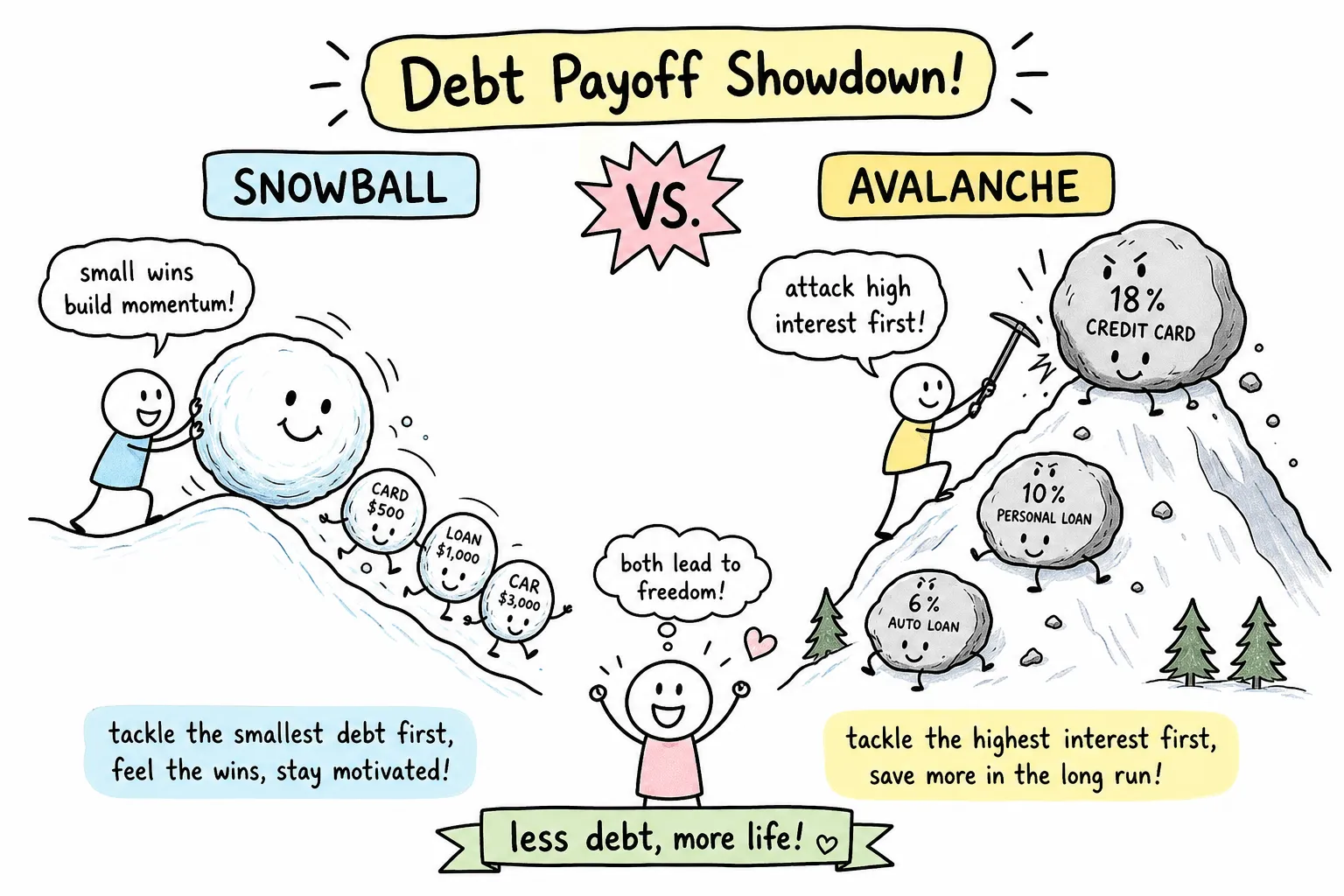
You've decided to get serious about debt. You've laid out every balance, found some breathing room in your budget, and you're ready to move. Then you search your options and land on two debt payoff methods that both sound completely logical. The snowball says start with your smallest balance and build momentum. The avalanche says start with your highest interest rate and stop the bleeding. Both are smart. So how do you choose between the debt snowball and avalanche method?
That moment of paralysis is more common than you'd think, and it's exactly the wrong place to get stuck. Every month you spend deciding is another month interest compounds on balances you haven't touched yet. This article gives you the real math, the behavioral science, and a five-factor decision test to land on the debt payoff method that fits your actual situation, not just the one that sounds most sophisticated on paper.
The practical financial playbook at The Growth Engine is built around one principle: the best strategy is the one you'll finish. This one will get you there.
Why the choice between these two methods matters beyond just math
People tend to approach this decision like a math problem, but it's really a behavioral one. The "right" debt payoff method is the one you complete, and research shows that completion rates vary significantly based on which approach a person chooses. A strategy that saves you $500 in interest means nothing if you abandon it after four months and the debt rolls right back.
The real cost of choosing wrong
Consider what happens when someone selects the mathematically optimal plan but loses momentum six months in. The debt is still there. Interest is still accruing. And now they're demoralized on top of being in debt, which makes the next attempt even harder. Compare that to someone who picks the "less efficient" method on paper but grinds through to a zero balance. That person wins, every time.
What you're actually comparing
Here's the reframe that clears up a lot of confusion: the snowball and avalanche methods are alike in almost every mechanical way. Your total monthly debt payment stays the same. Your minimum payments stay the same. The only thing that changes is which debt you target with your extra money each month. One variable, different ordering. The methods diverge in the psychological experience they create, account closures, visible progress milestones, and mental bookkeeping all feel different depending on which sequence you run. Once you see the comparison that way, it becomes a lot less overwhelming.
How the debt snowball method works
The mechanics are straightforward. You list your debts from smallest balance to largest. You pay the minimums on all of them. Then you throw every extra dollar you have at the smallest balance until it's gone. When that account reaches zero, you take what you were paying on it and roll it into your payment on the next smallest debt. The payments stack, and your attack budget grows with every account you close.
Why the order feels motivating
The design is intentional. Each time you eliminate a debt, you remove a payment from your monthly obligations, shrink your account count, and earn a concrete, measurable win. Behavioral researchers call this the "small wins" effect, and its impact on follow-through is more significant than most people expect. Closing an account isn't just a financial event. It's a psychological one that reinforces the belief that the plan is working.
A sample debt list ordered by snowball
Take a realistic four-debt profile: a store card at $600, a personal loan at $3,200, a credit card at $7,500, and an auto loan at $11,000. The snowball attacks them in exactly that order, smallest to largest. The store card goes first, regardless of its interest rate. Then the personal loan. Then the credit card. Then the auto loan. The sequence is determined entirely by balance size.
How the debt avalanche targets your highest-rate debt first
Same system, different ordering. You list your debts from highest APR to lowest. You pay minimums on all of them. Every extra dollar goes to the highest-rate balance until it's eliminated, then that payment rolls to the next highest rate. The payment stack still grows, just in a different sequence.
The interest-first logic
The reasoning is simple: the longer a high-rate balance sits, the more it grows. A credit card charging 24% APR is compounding against you every single month you leave it unpaid. Eliminating the highest-rate debt first limits the total interest that accumulates across your entire debt load over time. This is the core difference between the two strategies: interest-first versus balance-first.
The same sample debt list reordered by avalanche
Using the same four debts but assigning realistic APRs: the credit card at 24%, the store card at 19%, the personal loan at 14%, and the auto loan at 7%. The avalanche now attacks them in that rate order, credit card first, then store card, then personal loan, then auto loan. Notice the credit card moves from third position to first, and the store card moves from first to second. The same debts, a completely different attack sequence, and a meaningfully different outcome over time.
The real numbers compared side by side
Here's where most articles stay vague and this one doesn't. Using a representative consumer debt set run through a payoff calculator, the results are specific: the avalanche method finishes in 54 months with $4,765 in total interest paid. The snowball method finishes in 55 months with $5,285 in total interest paid. The difference is $520 saved and one month faster with the avalanche.
What the math actually shows
That $520 gap is real, but it's probably smaller than you expected. Across many debt profiles, the avalanche advantage shrinks considerably when APRs cluster close together. If your highest-rate debt is 21% and your lowest is 18%, the two methods produce nearly identical results. The gap widens when one debt carries a dramatically higher rate, say, a 28% credit card sitting alongside 10% loans. In that scenario, leaving the 28% balance untouched while you chase small balances costs you meaningfully more over time.
The simplified formula for estimating your own payoff time
You don't need to run the full formula manually. The spreadsheet function =NPER((APR/100)/12, -(Minimum+Extra), Balance) gives you the months to payoff for any single debt when you plug in your actual numbers. Run it for each debt in your stack, then use a free payoff calculator to see the full combined picture for both methods side by side.
When the interest savings gap grows
The relationship between APR spread and avalanche savings follows a clear pattern. When the spread between your highest and lowest-rate debts is under five percentage points, the avalanche advantage is essentially zero. At a spread of 10 to 15 points, the illustrative savings runs around $296 based on typical debt profiles modeled in payoff calculators. At a spread of 20 or more points, that figure climbs to roughly $881. The spread between your specific debts determines how much the ordering actually matters financially.
What behavioral research says about sticking with a plan
Most debt payoff articles stop at the math. The more useful question is why people actually finish one method and not the other, and the behavioral science on this changes the calculus significantly.
The studies on completion rates
A 2011 Journal of Marketing Research study found that people were consistently more motivated by paying off smaller balances first than by minimizing interest, even when the interest savings from the alternative were clearly explained to them. A 2016 Journal of Consumer Research study found that a more concentrated repayment strategy led to roughly 15% faster debt repayment in experimental settings. These aren't anecdotal observations. They're peer-reviewed findings showing that the human brain responds to progress signals more than to abstract savings.
The accounts-closed finding
One of the most striking findings in this space comes from practitioner research on debt-settlement program participants: the number of accounts closed predicted successful program completion better than the dollar amount paid off. Closing an account creates a form of psychological closure that reducing a balance doesn't replicate. That's why the snowball isn't just a "feel-good" method with no substance behind it. It's behaviorally engineered to keep people in the game.
What this means for your decision
The research points to a practical rule. If your main risk is losing motivation, the snowball's completion advantage can easily outweigh an interest savings gap of a few hundred dollars. If your APR spread is wide and you have a strong track record of following through on financial commitments, the avalanche wins on total cost. Both conditions matter equally when you're building a debt repayment strategy you'll actually run to completion.
How do I choose between debt snowball and avalanche method? A five-factor test
You now have the math and the behavioral research. This section turns both into a structured decision you can make in five minutes with your actual debt list in front of you.
1. Your interest rate spread
Pull out the APRs on each of your debts and find the gap between your highest and lowest rate. If that spread is more than eight to ten percentage points, the avalanche saves you meaningful money and is worth the extra discipline required. If your rates cluster within about five percentage points of each other, the mathematical difference shrinks to the point where motivation should drive the call entirely.
2. Your number of open accounts
More accounts means more opportunities for small wins with the snowball. If you're carrying six debts and two of them are under $1,000, clearing those first delivers a real psychological payoff. You'll eliminate two monthly payments, two account logins, and two mental burdens in a relatively short time. That freed-up mental space matters more than most budgeting frameworks acknowledge.
3. Your track record with long-term commitments
Be honest here, because this one separates people who pick a method from people who finish one. If you've started and stalled on financial plans before, the snowball's momentum isn't a nice-to-have. It's your risk management strategy. The avalanche requires you to make large payments toward a high-rate balance for months before you close a single account, and for many people, that extended stretch without a visible win is exactly where plans fall apart.
4. The emotional weight of one specific debt
Some debts carry a psychological burden that goes well beyond their dollar amount. A medical bill from a difficult period. A loan from a family member that strains the relationship every time you see them. Clearing the emotionally heavy debt first is a legitimate factor in any sound debt reduction plan. The best financial decisions account for the full picture, not just the spreadsheet.
5. Your timeline urgency
If you have a major financial move coming up within 24 to 36 months, buying a home, leaving a job, starting a family, that one-month difference in payoff date can actually matter. In a compressed timeline, the avalanche's small speed advantage becomes more relevant, and the interest savings contribute to a larger down payment or emergency fund. Factor your near-term goals into the method you choose.
When a hybrid approach makes more sense than either pure method
The hybrid isn't a compromise for the indecisive. It's a deliberate debt payoff strategy with its own logic, and for a specific debt profile, it genuinely outperforms both pure methods.
What a snowball-then-avalanche hybrid looks like
The approach is simple: apply what some planners call the 60-90 day quick-kill rule. Identify any debts you can fully eliminate within roughly three months using your extra payment budget. Pay those off first for the motivational win. Once they're gone, reorder your remaining debts by APR and switch to strict avalanche order. You capture the behavioral benefit of small wins without leaving a high-rate balance compounding against you for years.
Sample scenarios where the hybrid outperforms
Consider three debts: $400 at 19%, $6,000 at 24%, and $9,000 at 11%. A pure snowball clears the $400 first (good), but then moves to the $6,000 at 24%, which also happens to be the high-rate balance. In this case, snowball and hybrid produce the same first move. But in a different scenario with five debts clustered between 18% and 22% APR plus one small $400 bill, the hybrid clearly wins. The $400 costs almost nothing to clear first in interest terms, removes a mental drag, and then the full avalanche takes over for the rest of the stack. You get the win without the financial penalty.
When to use a balance transfer alongside your strategy
A 0% balance transfer card changes the hybrid math significantly. When you move your highest-rate balance to a 0% promotional offer, you temporarily neutralize that rate, which removes it from the top of the avalanche queue. That frees you to snowball one or two small balances for momentum without the penalty of leaving high-rate debt running. The transfer fee, typically 3% to 5%, reduces your savings, so this move pays off most when the avoided interest clearly exceeds that fee and you can eliminate the transferred balance before the promotional period ends. If you can execute it cleanly, a balance transfer is often a bigger interest-savings lever than the choice between snowball and avalanche on its own.
How to run your own numbers and lock in your plan
Open last month's statements, pull each balance and APR, and give yourself five minutes to turn this framework into a decision you can commit to today.
The best free calculators for side-by-side comparisons
Several tools let you enter your exact balances, APRs, and extra monthly payment and see both debt payoff methods compared directly. BudgetLabs, Ordio, Monarch, and Undebt.it are among the solid options for this. All four accept custom debt inputs and produce a clear debt-free date and total interest figure for both methods. Setup is quick, and the side-by-side output makes the decision visually obvious for your specific numbers.
Setting up a simple tracking system
Keep your tracking to one page or one spreadsheet tab. The columns you need are: debt name, current balance, APR, minimum payment, and whether it's your current active target. Update it once a month. Watching your balance drop is its own form of motivation, separate from which method you're running. The act of recording progress reinforces the habit of continuing.
Committing and adjusting
Neither snowball nor avalanche is a set-and-forget plan. Life changes: income drops, bonuses appear, new expenses hit. The best debt payoff method is the one you review monthly and adjust when your situation shifts. Put a 10-minute monthly check-in on your calendar, the same way you'd schedule any other recurring commitment. That monthly review is the actual habit that gets people to zero. The Growth Engine covers the full habit-building and budgeting system for readers who want to build the complete financial framework alongside their payoff plan.
The bottom line: which debt repayment strategy should you choose?
The core decision logic comes down to two things: your APR spread and your relationship with consistency. If your spread is wide, more than eight to ten percentage points, and you have a strong track record of following through on long-term commitments, run the avalanche. You'll save real money. If motivation is your biggest vulnerability, or if your APRs are clustered within about five points of each other, run the snowball. The completion research is clear enough to take seriously.
If you have one or two tiny debts alongside a significant high-rate balance, run the hybrid. Clear the quick wins in 60 to 90 days, then switch to avalanche order. You don't have to choose between momentum and math; you just sequence them correctly.
The most important insight from all of this is that the gap between the two debt payoff methods is often smaller than the gap between starting and quitting. Choosing between the debt snowball and the avalanche is ultimately a question of knowing yourself as much as knowing your numbers. Both methods work. The one you finish is the right one.
Pull up a free calculator today, enter your debts, and look at both payoff dates. Five minutes of real numbers will tell you more than any article can. Pick your method and run it.
#DebtFreeJourney #DebtSnowball #DebtAvalanche #PersonalFinance #MoneyManagement


Comments
Post a Comment