25 Personal Development Books Experts and Leaders Recommend
25 Personal Development Books Experts and Leaders Recommend
You finish a book on a Sunday afternoon, feel genuinely lit up, dog-ear half the pages, and swear this one is going to change things. By Thursday, nothing is different. The book is on the shelf. You're back to the same patterns. That experience isn't a character flaw; it's what happens when reading stays disconnected from a real system for applying ideas.
This roundup of the top personal development books recommended by experts and leaders is built differently from most "best self-help books" lists you've seen. Many of these titles appear repeatedly on reading lists curated by people who actually lead organizations, run research programs, coach Fortune 500 executives, or build high-performance teams. These aren't books that sold well because of a good cover. They're books that changed how people operate. At The Growth Engine, the goal has always been to take book-level ideas and turn them into concrete next steps, because that's where the real growth happens, after you close the cover.
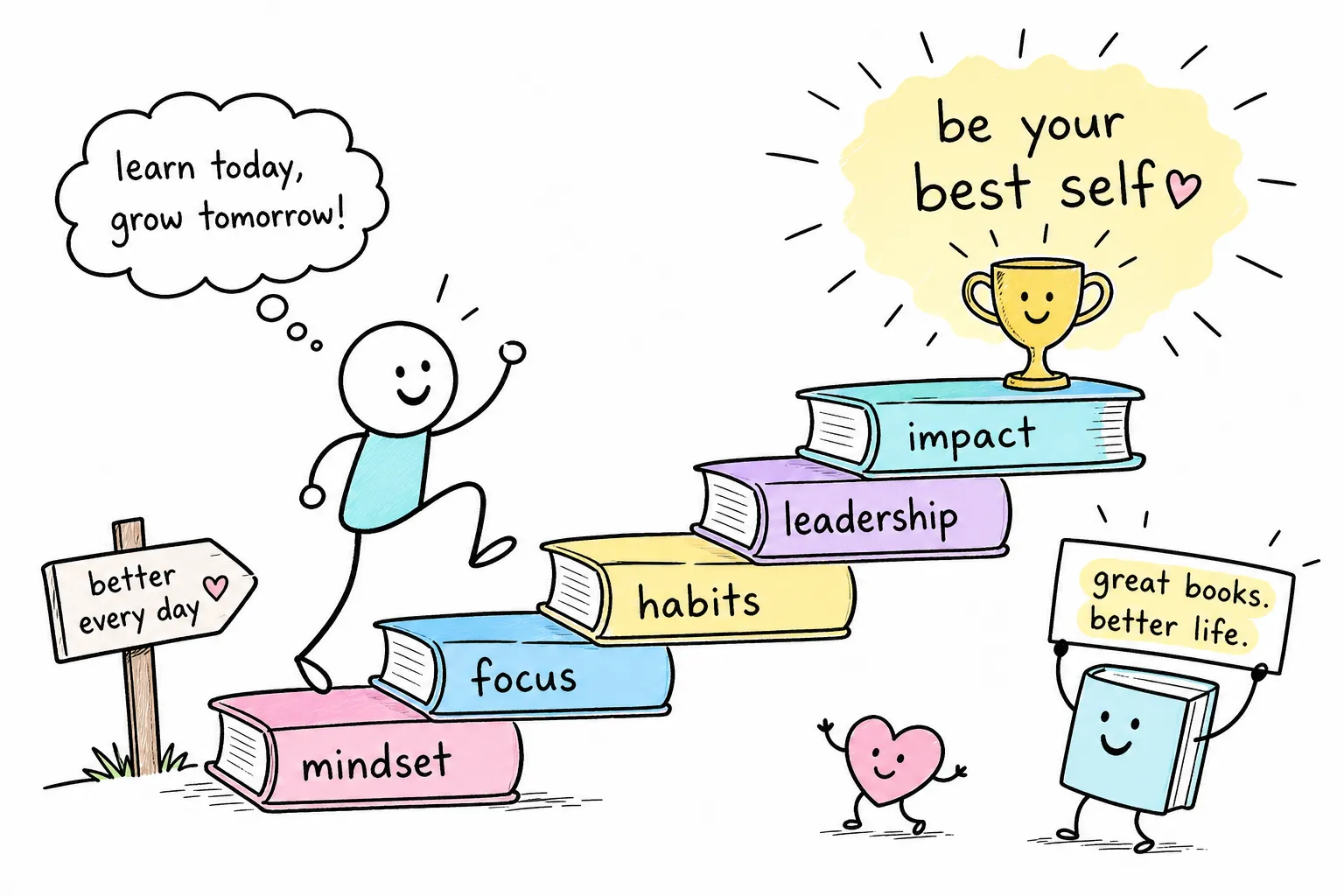
The 25 books below are grouped by goal: habits, mindset, leadership, productivity, and emotional intelligence. You don't need to read all 25. Find the category that matches your biggest growth gap right now, start with one title, and use the reading plan in the final section to make sure it actually sticks.
What makes an expert-recommended book different from a bestseller
A book can hit the bestseller list because of a strong podcast tour, a celebrity endorsement, or a well-timed news cycle. That's a marketing outcome, not a quality signal. The books on this list earned their spots through a different mechanism: they keep appearing on the reading lists of CEOs, researchers, executive coaches, and leadership authors who have no incentive to name the same titles unless those titles genuinely changed something for them.
The pattern across CEO surveys, academic reading lists, executive coaching programs, and leadership roundtables is consistent. The books that keep surfacing share one quality: they tend to shift how a reader makes decisions, not just how a reader feels. Many motivational titles deliver a short-term emotional lift that fades within days. The books here work at the level of the operating system underneath the decisions, the mental models, the default behaviors, the way a person responds when things get hard.
The difference between feeling inspired and thinking differently
Inspiration is easy to generate and nearly impossible to sustain. Genuine thinking shifts are slower to build but far more durable. A book like Thinking, Fast and Slow by Daniel Kahneman is commonly recommended in business and leadership reading lists not because it's entertaining but because it changes how readers understand their own cognition. Most motivational titles are forgotten in six months. Books that get referenced by executives a decade after publication are doing something structurally different.
How to use this list without getting overwhelmed
Twenty-five books sounds like a semester-long project, but the approach here is simple: read the section that matches your current biggest challenge first, pick one title, and finish it before you touch another. Research and practitioners in behavior change warn that attempting too many simultaneous habit changes often reduces follow-through sharply. One book, read actively, with notes and one concrete action, is worth more than five books skimmed in parallel.
Top personal development books recommended by experts and leaders, habit picks
Habits are the most practical entry point into personal development because they're the mechanism through which every other goal gets built or destroyed. The books in this section are the ones certified habit coaches and professionals in corporate wellness programs cite most consistently when someone asks where to start with behavior change. Each one approaches habit formation from a different angle, which means the right pick depends on where you've gotten stuck before.
1. Atomic Habits, James Clear
Executive coaches and leadership writers name this the most actionable book on behavior change available right now. Clear ties tiny behavioral shifts to measurable long-term results through a framework built on identity, environment design, and the four laws of behavior change: make it obvious, attractive, easy, and satisfying. The book's core argument is deceptively simple but structurally sound. Your habits are a vote for the person you want to become; cast enough votes and identity changes. Coaches cite this one because it gives readers a specific system, not just inspiration.
2. The Power of Habit, Charles Duhigg
This one is frequently cited in popular discussions of habit loops and systems for change because Duhigg explains the habit loop, cue, routine, reward, in a way that applies equally to personal behavior and organizational culture. Leaders find it useful because it makes habit formation feel less like willpower and more like systems design. If you want to understand why habits form before you try to change them, this is the right starting point.
3. Tiny Habits, BJ Fogg
Fogg is a behavioral scientist at Stanford, and his approach offers a research-backed alternative to willpower-based change. The central argument is that starting absurdly small removes the friction that kills most habit attempts. This book is particularly well-regarded among practitioners who work with clients who have tried and failed with larger habit systems, because it reframes failure as a design problem, not a motivation problem.
4. The Compound Effect, Darren Hardy
Popular in entrepreneurial and CEO circles, this book makes a focused case for the power of small daily disciplines accumulating into outsized results over time. Hardy isn't breaking new scientific ground, but he translates the compounding principle into a framework that founders and operators find immediately applicable to business and personal performance. It's a short read with a long-term payoff.
5. Better Than Before, Gretchen Rubin
Most habit books skip a crucial layer: personality and tendency. Rubin's research identifies four tendencies that explain why the same habit strategy works brilliantly for one person and fails completely for another. Coaches who work with clients who have tried and abandoned multiple habit systems recommend this one because it helps readers diagnose why they've struggled before designing a new approach.
Top personal development books recommended by experts and leaders, mindset picks
Mindset work underlies every other personal development goal. If your beliefs about your own potential are fixed, no productivity system or leadership framework will move the needle much. The books in this section are the ones researchers, executives, and therapists cite when asked what created the biggest internal shift. They're not feel-good reads; they're evidence-based frameworks for changing how you interpret failure, challenge, and growth.
6. Mindset, Carol S. Dweck
Recommended by McKinsey leaders, business school faculty, and executive coaches across industries, Dweck's research on fixed versus growth mindset has reshaped how top companies run performance reviews and feedback conversations. Satya Nadella used this book to shift Microsoft's culture from "know-it-alls" to "learn-it-alls," and that example alone explains why it keeps appearing on CEO reading lists. Believing your abilities can grow changes how you respond to failure, and failure is where growth actually happens. This is the foundational mindset text.
7. Think Again, Adam Grant
Grant is an organizational psychologist and Wharton professor, and this book makes a rigorous case for intellectual humility as a leadership skill. The core argument is that the ability to challenge your own assumptions, update your thinking when new evidence appears, and resist the pull of confirmation bias separates high performers from people who plateau early. Leaders cite it for teaching the specific skill of productive disagreement with your own past conclusions.
8. Grit, Angela Duckworth
Duckworth's research-backed case is that passion and perseverance predict long-term success more reliably than raw talent. Executive coaches in sports and business settings recommend it because it reframes the relationship between effort and achievement in a way that's both scientifically grounded and immediately motivating. If you've ever wondered whether you have what it takes, this book answers that question with evidence.
9. Man's Search for Meaning, Viktor Frankl
Frankl's account of finding purpose under conditions most people can't imagine remains one of the most enduring books on resilience ever written. It consistently appears across generations of leader reading lists because its central argument, that meaning can be found in any circumstance, is both philosophically demanding and practically applicable. This is the book executives reach for when life, not just work, gets hard.
10. The Obstacle Is the Way, Ryan Holiday
Holiday translates Stoic philosophy into a practical framework for turning setbacks into forward movement. Athletes, military leaders, and CEOs recommend it for its direct, no-self-pity approach to adversity. The book's structure around perception, action, and will gives readers a repeatable mental model for handling pressure without collapsing into avoidance or blame. Consider how that model works in practice: when a project stalls, perception reframes the setback as information rather than failure, action focuses on what can still be controlled, and will sustains forward movement without waiting for conditions to improve.
Leadership and career books CEOs name-drop most
The books in this section don't just teach leadership theory; they appear in Fortune 500 CEO surveys, commencement speeches, and executive coaching programs because they change how people operate at the top of an organization. The research signal here is strong: these titles earn their recommendations through track record, not marketing.
11. Good to Great, Jim Collins
Collins' research project on what separates companies and leaders that achieve sustained excellence from those that don't produced one of the most frequently recommended books in compiled Fortune 500 and Inc. 500 CEO surveys, with 53 direct recommendations in one such analysis. The book's concepts, Level 5 Leadership, the Hedgehog Concept, and the Flywheel, have become standard vocabulary in executive circles because they give leaders a shared language for disciplined decision-making.
12. The 7 Habits of Highly Effective People, Stephen R. Covey
This has been a staple in leadership training programs worldwide for decades, and it has earned that status. Covey's framework covers proactivity, priority management, and the principle of seeking to understand before being understood. These aren't motivational platitudes; they're behavioral blueprints that organizations have used to build management programs. Effectiveness starts with taking responsibility for your own responses before trying to influence anything outside yourself. That principle alone makes it worth the read.
13. Leaders Eat Last, Simon Sinek
Sinek's case for why the most trusted leaders prioritize their team's well-being ties biology and organizational culture together in a way that managers and executives find immediately applicable. The book explains the chemical and structural reasons why safety, belonging, and trust drive performance, which gives leaders a framework for understanding what great culture actually requires at a physiological level.
14. Extreme Ownership, Jocko Willink and Leif Babin
Two former Navy SEALs translate battlefield leadership principles into business applications through a no-excuses accountability framework. Founders and operations leaders recommend it because it eliminates the gray area around responsibility: everything that happens on your team is on you, and that clarity is both uncomfortable and transformative. The book pairs leadership stories with direct business application in each chapter.
15. How Will You Measure Your Life?, Clayton M. Christensen
Recommended by executives including Jeff Kim, CEO of Yanolja Cloud, this book applies business strategy frameworks to personal decisions about career, relationships, and legacy. Christensen's argument is that most people let circumstances make their most important life choices by default, and that deliberate design is the only way to avoid that outcome. It's one of the rare leadership books that forces readers to think about life, not just work performance.
Productivity and deep focus books top performers live by
Productivity in this section means deliberate focus on what matters most, not hustle for its own sake. The books here are recommended by people who do high-stakes knowledge work and protect their attention fiercely. Each title attacks a different dimension of the attention crisis that defines modern professional life.
16. Deep Work, Cal Newport
Newport's argument is that the ability to focus without distraction is the defining skill of the modern economy, and that most knowledge workers are losing it by default. Knowledge workers, writers, and executives managing constant interruption cycles consistently recommend this book because it treats deep focus as a trainable skill with a specific practice protocol, not just a nice idea. If you feel chronically scattered, this is the right starting point.
17. Essentialism, Greg McKeown
Recommended across leadership and executive circles, this book makes a disciplined case for doing less but doing it better. McKeown's framework challenges the default assumption that more activity equals more progress and replaces it with a rigorous process for identifying what actually matters. The problem isn't too little time; it's too many things treated as if they're equally important. That reframe alone changes how most readers approach their weekly calendar.
18. The ONE Thing, Gary Keller and Jay Papasan
Built around a single focusing question, this book helps high performers identify the most leveraged action available to them at any given point. Entrepreneurial communities recommend it widely because its framework for narrowing focus to one priority is simple enough to use daily but rigorous enough to produce real results. It works well paired with Essentialism for readers who need both the philosophy and the daily practice.
19. Getting Things Done, David Allen
Allen's system for capturing and organizing commitments has been standard reading among professionals managing complex, multi-stream workloads for years, including many executive assistants and knowledge workers. The core insight is that your brain is not a reliable storage system and that externalizing everything you need to track frees up cognitive bandwidth for actual thinking. It's a foundational productivity system, not a quick-fix read.
20. The 4-Hour Workweek, Tim Ferriss
Ferriss's book introduced the concept of lifestyle design and challenged conventional assumptions about where, when, and how work has to happen. Whether you agree with every premise or not, the book asks questions about work structure that most professionals never ask, and it consistently appears near the top of recommendation aggregators tracking which titles come up most frequently across entrepreneur and executive reading lists. That questioning alone is worth the read for anyone building a career or side income on their own terms.
Top personal development books recommended by experts and leaders, emotional intelligence picks
Multiple longitudinal studies, including Goleman's own research, highlight emotional intelligence as an important predictor of leadership effectiveness alongside cognitive ability. The books in this section are the ones psychologists, coaches, and HR leaders cite when asked what builds people-centered organizations. These titles complement the leadership and mindset books above because they operate at the level of interpersonal effectiveness, not just individual performance.
21. Emotional Intelligence, Daniel Goleman
Goleman's foundational text is cited repeatedly in positive psychology, leadership, and human resources literature as the book that made emotional intelligence a mainstream leadership concept. It explains the five components of EQ and why they matter more than technical competence for long-term career and leadership success. If you're new to the concept of emotional intelligence, this is the right place to start.
22. Give and Take, Adam Grant
Named by multiple experts as a book they "always recommend," Grant makes a research-backed case that generous, other-focused professionals outperform takers and matchers over the long run, and explains why most people misread the pattern. The counterintuitive finding here is that strategic generosity is not naive; it's a competitive advantage that compounds over time, much like the habit systems discussed earlier in this list.
23. How to Win Friends and Influence People, Dale Carnegie
Decades old and still commonly recommended by negotiators and executives for its timeless principles on listening, genuine interest in others, and making people feel valued. The longevity of its placement on expert reading lists is itself a signal: the core interpersonal dynamics it describes haven't changed because human psychology hasn't changed. This remains one of the highest-leverage reads for anyone in a role that requires working with other people, which is essentially every role.
24. Emotional Agility, Susan David
David's framework for unhooking from difficult emotions instead of being controlled by them is recommended across leadership and mindset roundups for anyone in a high-pressure role. The book's practical insight is that the goal isn't to eliminate negative emotions but to create enough distance from them to make deliberate choices rather than reactive ones. Coaches working in high-stakes environments use this framework regularly with their clients.
25. The Gifts of Imperfection, Brené Brown
Brown's research on shame and perfectionism belongs at the end of this list intentionally. All 24 books above point toward growth, change, and better performance. This one addresses the internal force that blocks most people from pursuing that growth in the first place. Leadership and personal development circles recommend it for its honest examination of how perfectionism masquerades as high standards while actually functioning as a barrier to the vulnerability that real growth requires.
How to build a reading plan around your current goal
The most common mistake with personal development reading is treating it as a consumption activity rather than an application activity. Reading a book and feeling good about it is not the same as using a book. The gap between reading and changing is where most people get stuck, and the fix is structural: you need a system for application, not just a system for choosing what to read next.
The framework here is straightforward. Identify your single biggest growth gap right now: habits, mindset, leadership, productivity, or emotional intelligence. Pick the top-recommended book from that section. Read it actively with a pen nearby and a single page dedicated to your three biggest takeaways. Before you open the next book, implement one of those takeaways in your actual daily life for at least two weeks. That sequence, one book, three takeaways, one immediate action, is more valuable than consuming ten books in a row with no application layer.
A simple rule for picking your first book
If you're building routines from scratch, start with Atomic Habits. If you lead a team or want to, start with The 7 Habits of Highly Effective People or Good to Great. If focus and output are the problem, start with Deep Work or Essentialism. If you feel stuck inside your own head, start with Mindset or Emotional Agility. The goal is one clear starting point that matches the friction you're actually feeling right now, not the book with the best cover or the most recent publication date.
Where The Growth Engine fits in your reading journey
A great book gives you the "why" and the "what." The systems, templates, and step-by-step guides at The Growth Engine are built to handle the "how," so you don't stay in inspiration mode indefinitely. After you finish one of these titles and identify your action steps, the habits, productivity, and personal finance content here is designed to give you the implementation layer: habit trackers, content frameworks, budget templates, and workflows built for people managing real lives with limited time.
Explore the habits and productivity sections to find guides that map directly to the books above. If you're working through the financial side of your growth journey alongside your reading practice, the personal finance content here connects money management to the same mindset and systems thinking these books cover. Growth compounds across all three areas when you treat them as connected, not separate.
The best book is the one you actually finish and use
Ultimately, the top personal development books recommended by experts and leaders earn their reputations not because they're the most famous titles in each category but because they change how people think and act over time. That's a different standard than bestseller status, and it's a more useful one for anyone serious about making real progress.
The most important instruction is also the simplest: pick one section, pick one book, finish it, extract three actionable ideas, and implement one of them before you touch the next title. Reading is the beginning of the growth process, not the destination. The real work happens in the week after you close the cover, when you're deciding whether to use what you learned or file it away with every other good idea you've had and not acted on.
Personal growth, financial clarity, and building a system for doing your best work all reinforce each other when you approach them as connected rather than separate pursuits. That's the exact intersection The Growth Engine was built to serve. Start with one book from the section that matters most to you right now, and come back here when you're ready to turn the ideas into a working system.
#PersonalDevelopment #BookRecommendations #LeadershipBooks #HabitBuilding #SmartMoney


Comments
Post a Comment