25 Must-Read Personal Growth Books for Young Professionals
25 Must-Read Personal Growth Books for Young Professionals
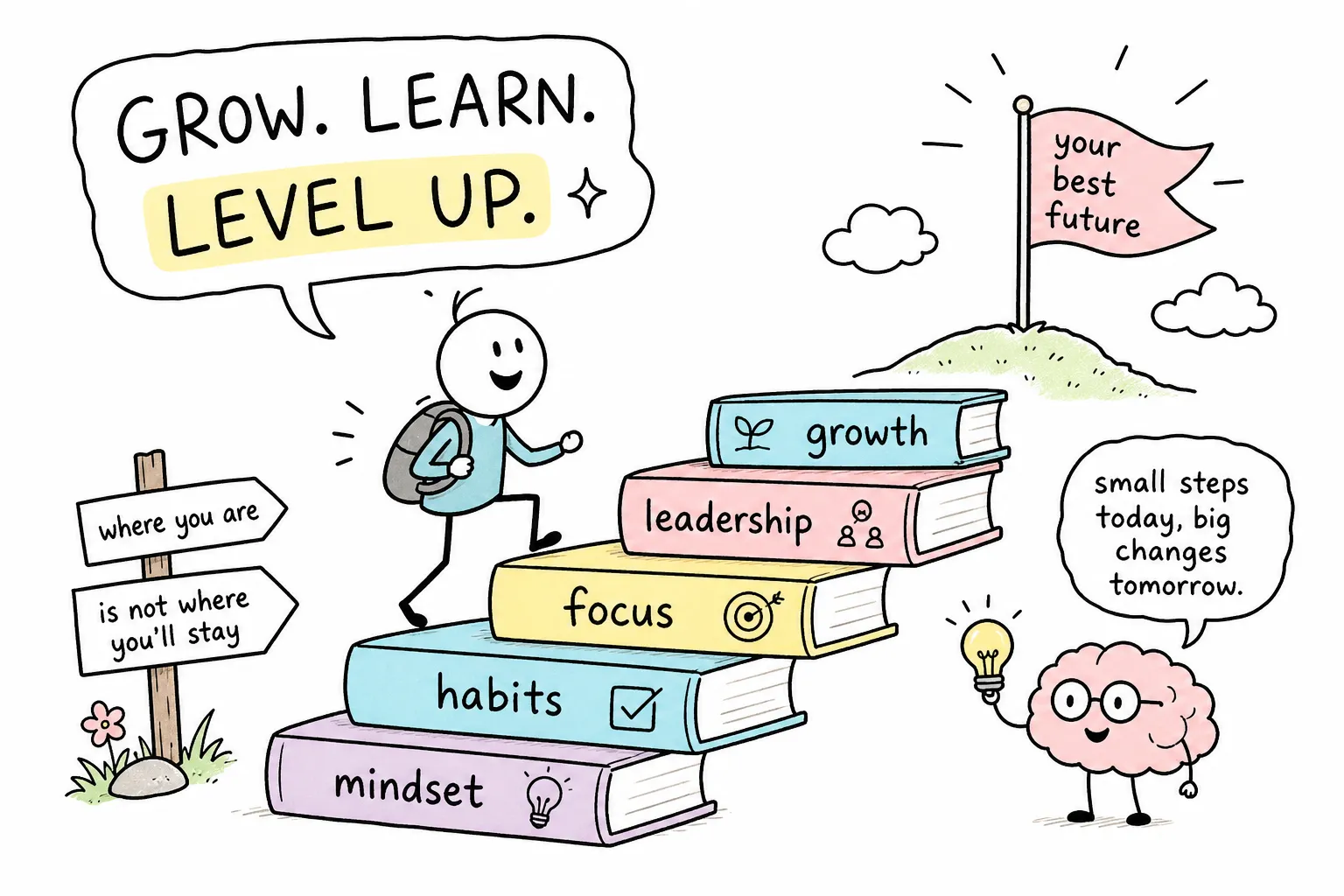
Most young professionals buy more books than they finish. A title catches your eye, you order it with good intentions, it sits on the nightstand for six weeks, and eventually you feel mildly guilty every time you walk past it. But here's what actually matters: the right book at the right career stage can shift your trajectory faster than any course, certification, or mentor ever could. The problem isn't access to great books. It's knowing which ones to read and when.
Generic "best books" lists don't help much because they're built for everyone, which means they're optimized for no one. They mix titles aimed at retiring CEOs with advice written for college freshmen, then expect a 26-year-old managing student loan stress and a demanding first job to somehow extract a coherent strategy. This list is built differently. Every title here was selected specifically as a must-read personal growth book for young professionals in America, ambitious, stretched thin, and serious about building something meaningful.
The 25 must-read personal growth books below are organized by goal, not by popularity. Whether you need to fix your focus, rewire your money habits, grow into a leader, or stop self-sabotaging, there's a clear starting point for you in each section. And alongside a reading list like this, having a go-to resource for practical articles on habits, finance, and career-building makes a real difference. That's the gap The Growth Engine was built to fill. Now, here are the books.
Why Your Reading List Is Your Biggest Career Advantage in Your 20s
The compound effect of consistent reading on career outcomes
Reading one career-relevant book per month doesn't sound dramatic. Over five years, it compounds into a serious edge. Most senior leaders and high earners point to reading as a deliberate habit, not a passive one, and the gap between someone who reads strategically and someone who doesn't widens slowly, then suddenly.
The key word is "strategically." Reading the wrong book at the wrong career stage wastes the most valuable resource you have in your 20s: focused attention. A book on executive leadership is mostly theoretical noise when you're still figuring out how to manage your inbox. A book on networking is wasted if your internal communication habits are creating friction first. These are the best personal development books for young professionals precisely because they're matched to the right career moment, not just assembled by bestseller rank.
How this list is organized and how to use it
The 25 titles are grouped into five goal-based categories: habits and focus, mindset and resilience, leadership and career growth, communication and networking, and financial confidence. Each book gets a one-sentence summary and one practical takeaway you can apply before you even finish the chapter. Toward the end, there's a "start here" shortlist for anyone who wants a no-decision entry point.
You don't need to read these in order. Jump to the category that matches your most pressing challenge right now, and work your way outward from there. The only sequencing that matters is covered in the final sections: mindset first, systems second, skill-specific books third.
Top Personal Growth Books for Early-Career Professionals: Habits and Focus
1. Atomic Habits, James Clear (2018)
Systems beat goals, and tiny 1% improvements compound into massive results over time. Practical takeaway: identify one habit you want to build this week and attach it to something you already do every morning.
2. Deep Work, Cal Newport (2016)
The ability to focus without distraction on cognitively demanding tasks is becoming both rare and increasingly valuable in the modern workplace. With a Goodreads rating of 4.16 and nearly 190,000 ratings, this one has resonated far beyond productivity circles. Practical takeaway: block one 90-minute distraction-free window into your calendar tomorrow and protect it like a confirmed meeting.
3. The Power of Habit, Charles Duhigg (2012)
Habits run on a cue-routine-reward loop, and understanding that loop is the key to changing any behavior at work or at home. Duhigg makes the science genuinely readable, which is rare. Practical takeaway: map out the cue and reward driving one habit you want to break. Awareness is the first intervention.
4. Indistractable, Nir Eyal (2019)
Distraction is not a technology problem. It's an internal discomfort problem. Eyal argues that every distraction starts as an attempt to escape an uncomfortable emotion, and his system gives you practical tools to reclaim your attention. Practical takeaway: the next time you reach for your phone in the middle of focused work, write down the emotion you were trying to escape. That's where the real fix starts.
5. Slow Productivity, Cal Newport (2024)
The obsession with busyness is burning out young professionals at an alarming rate, and Newport's case for fewer, deeper commitments done at a natural pace is a direct antidote to hustle culture. This is especially relevant for anyone who has confused being busy with being effective. Practical takeaway: cut your active project list in half and commit to finishing two things completely before starting anything new this month.
Must-Read Personal Growth Books for Young Professionals: Mindset and Resilience
6. Mindset, Carol S. Dweck (2006)
Talent is not fixed. People with a growth mindset consistently outperform those with a fixed mindset because they interpret challenges as the path to capability, not as proof of inadequacy. This book reframes every professional setback you'll face. Practical takeaway: the next time you receive critical feedback at work, replace "I failed" with "what can I learn from this?"
7. Think Again, Adam Grant (2021)
The most effective professionals are not those who think fastest. They're those most willing to rethink their assumptions when new evidence arrives. Grant's research-backed case for intellectual humility is one of the most practically useful mindset books written in the last decade. Practical takeaway: identify one belief about your career or industry you've never questioned, then spend 20 minutes genuinely stress-testing it.
8. The Mountain Is You, Brianna Wiest (2020)
Self-sabotage is not weakness. It's the mind trying to protect you from outcomes it finds threatening, and dismantling it starts with honest self-understanding. Wiest writes with a clarity that most self-help authors never achieve. Practical takeaway: name one recurring pattern in your professional life that keeps blocking progress, then sit with the question of what that pattern might be protecting you from.
9. The Let Them Theory, Mel Robbins (2024)
A deceptively simple mindset shift: letting other people make their own choices without it costing you your energy frees up enormous mental space for your own growth. This is especially useful for anyone who burns through their best hours worrying about what coworkers or managers think. Practical takeaway: the next time a coworker frustrates you, silently say "let them" and redirect your attention to what you can actually control.
10. Man's Search for Meaning, Viktor Frankl (1946)
Meaning is the most resilient motivator a person can have, and Frankl's account of finding purpose under extreme adversity reframes what professional setbacks actually are. No other book on this list has aged as well or delivered as much perspective per page. Practical takeaway: write one sentence that answers why your current work matters beyond the paycheck, and return to it every time your motivation dips.
Books for Career Growth and Leadership
11. The 7 Habits of Highly Effective People, Stephen R. Covey (1989)
True effectiveness comes from character, not technique. Covey's framework for self-management, proactivity, and interdependence remains one of the most complete career playbooks ever written, which is why it's still on reading lists 35 years after publication. Practical takeaway: spend 15 minutes this week separating your tasks into "Circle of Control" versus "Circle of Concern" categories, then cut the time you spend on the latter.
12. So Good They Can't Ignore You, Cal Newport (2012)
Passion follows mastery, not the other way around. The fastest path to a career you love is building rare and valuable skills first, then leveraging those skills for autonomy and purpose. Newport's argument is uncomfortable and almost certainly correct. Practical takeaway: identify the one skill that would make you significantly more valuable in your current role and invest 30 minutes a day in developing it this month.
13. Start with Why, Simon Sinek (2009)
Great leaders and great careers are driven by a clear sense of purpose. Sinek's Golden Circle framework shows how to communicate that purpose in a way that genuinely moves people, not just informs them. His core insight, that people don't buy what you do, they buy why you do it, applies as directly to career positioning as it does to building organizations. Practical takeaway: before your next team presentation or meeting with your manager, lead with why the work matters, not just what needs to get done.
14. Unforgettable Presence, Lorraine K. Lee (2024)
Executive presence is learnable, and Lee's modern framework specifically addresses how young professionals can build visibility and influence in a remote-first, hybrid work environment. Among the professional development books for recent grads on this list, this one is the most workplace-current. Practical takeaway: identify one recurring meeting where you're currently silent and commit to contributing one clear, prepared insight the next time it happens.
15. Radical Candor, Kim Scott (2017)
The best managers care personally about their team while challenging them directly. Even if you don't manage anyone yet, this book rewires how you give and receive feedback in ways that accelerate your own development immediately. Practical takeaway: give one coworker a specific, honest piece of constructive feedback this week, not vague encouragement, but a real observation that actually helps them grow.
Books That Make You a Sharper Communicator and Networker
16. How to Win Friends and Influence People, Dale Carnegie (1936)
Human nature hasn't changed in 90 years, and Carnegie's principles for making people feel heard, respected, and valued remain the foundational playbook for professional relationship-building. The staying power of this book is itself the endorsement. Practical takeaway: in your next conversation, ask a follow-up question about something the other person said before you introduce your own idea.
17. Never Eat Alone, Keith Ferrazzi (2005)
Professional networking is not transactional relationship-banking. It's a lifelong habit of showing up generously for others without keeping score, and Ferrazzi makes that case more convincingly than anyone else in this category. Practical takeaway: reach out to one person in your professional network this week with a genuinely useful article, introduction, or opportunity, and attach no ask to it.
18. They Don't Teach Corporate in College, Alexandra Levit (2004)
The unwritten rules of workplace culture are rarely explained to new professionals, and most people learn them the hard way through avoidable mistakes. Levit exposes those rules clearly so you can skip the painful part of the learning curve. Practical takeaway: after your next project wraps up, ask your manager for one specific piece of feedback rather than waiting for a formal annual review.
19. Talk Like TED, Carmine Gallo (2014)
The world's best public communicators share nine habits that make ideas stick, and every one of them applies in job interviews, client calls, and team meetings. This is a practical communication guide disguised as a book about famous speeches. Practical takeaway: the next time you need to make a point at work, open with a 60-second story instead of a data point. Stories embed in memory; statistics rarely do.
20. The Fine Art of Small Talk, Debra Fine (2005)
The ability to initiate and sustain light professional conversation is a learnable skill that directly drives networking opportunities, promotions, and team trust. Most people underestimate how much career capital is built in the five minutes before a meeting starts. Practical takeaway: arrive five minutes early to your next meeting and practice one genuine, open-ended question with whoever is already in the room.
Books That Grow Your Financial Confidence Alongside Your Career
21. The Psychology of Money, Morgan Housel (2020)
Financial success has less to do with math and more to do with behavior. How you think about money matters more than how much you know about investing, and Housel makes that case with more clarity than most financial planners ever do. Practical takeaway: identify one financial decision you've been avoiding, opening a Roth IRA, paying off a credit card, starting a budget, and take the first physical step today.
22. I Will Teach You to Be Rich, Ramit Sethi (2009, updated 2019)
Sethi's no-judgment, no-spreadsheet approach to personal finance is built specifically for young Americans who want to automate their money management without overthinking every decision. Financial planners repeatedly recommend this as a starting point for clients in their 20s. Practical takeaway: set up one automatic transfer to a savings or investment account this week, even if it's only $25. Automation beats discipline every time.
23. Rich Dad Poor Dad, Robert Kiyosaki (1997)
The financial mindset you grew up with shapes every money decision you make as a professional, and Kiyosaki's contrast between asset-building and income-consuming thinking is still the most accessible starting point for rewiring it. His specific investment advice is dated, but the core mindset framework holds up. Practical takeaway: list three things you spend money on that depreciate versus three things you could redirect money toward that grow in value over time.
24. Same as Ever, Morgan Housel (2023)
While markets and careers change constantly, human behavior stays predictably consistent. Recognizing those timeless patterns gives you a durable advantage in both financial and professional decisions that no amount of market research can replicate. Practical takeaway: identify one financial decision you're trying to time perfectly, then ask yourself honestly whether a consistent, boring approach would outperform it over ten years.
25. Your Money or Your Life, Vicki Robin and Joe Dominguez (1992, updated 2008)
This book reframes money as life energy and asks whether the hours you trade for your paycheck are actually worth what you're getting. That question gets more urgent the earlier you ask it, which is why it belongs on every 20-something's reading list. Practical takeaway: calculate your real hourly rate after factoring in commute, work prep, and decompression time, then apply it to one recurring purchase to see if it still makes sense.
The 3 Books to Start With Right Now
If you read nothing else on this list, read these three first
Atomic Habits is the universal starting point. It applies to every goal on this list and delivers noticeable results within weeks, not months. With over 1.1 million Goodreads ratings and a 4.33 average, the consensus is unusually strong for a self-improvement book for young adults. You'll use what you learn here to build the reading habit itself.
The Psychology of Money is the essential financial foundation. Young professionals who read this early make meaningfully different money decisions over the following decade, because the behavioral traps Housel identifies don't require advanced knowledge to fall into. They require awareness, and this book delivers that awareness early.
Mindset by Carol Dweck is the primer that makes every other book on this list land harder. Without a growth orientation, the tactics in the other 22 titles don't stick. Read mindset books first, systems books second, and skill-specific books third. That sequence prevents the most common mistake young professionals make: collecting tactics without the foundation to execute them.
How to build a consistent reading habit around a busy schedule
Twenty to thirty minutes a day is enough. Commutes, lunch breaks, and 20 minutes before bed add up to roughly one book every two to three weeks, more than enough to work through this entire list inside 18 months. Marathon weekend reading sessions sound productive, but the consistency of daily reading is what actually moves retention and application.
Audiobooks are a legitimate format for this list, particularly for the communication and networking titles where the ideas are more narrative than technical. Most younger readers already use print, digital, and audio formats in combination rather than treating them as either-or choices. Use whatever format keeps you moving forward. The format that gets you to the last page is the right one. Keep a one-sentence note per chapter in your phone, not a summary, just the one thing you want to try this week. Those notes are what prevent good ideas from evaporating between the last page and Monday morning.
How to Turn Your Reading List Into Real Career Momentum
Reading without action is just entertainment
There's a meaningful difference between passive reading, absorbing ideas and feeling temporarily inspired, and applied reading, where you test one idea per book before moving to the next. The professionals who advance fastest are not always those who read the most. They're those who act on what they read most consistently. One experiment per book beats ten books per quarter with no follow-through.
Adopt a "one book, one experiment" approach. Finish a chapter, pick one takeaway, run it for a week, then move forward. That discipline compounds. After 25 books and 25 experiments, you haven't just read a library of great ideas. You've built 25 tested habits, communication shifts, and financial decisions into your actual life.
Where The Growth Engine fits into your growth stack
The books on this list are the foundation. But turning that reading into practical financial moves, daily habits, and career-building skills requires ongoing, actionable content that responds to where you are right now, not where the author was when they wrote the book. That's the specific gap The Growth Engine fills.
The Growth Engine publishes practical, no-fluff articles at the intersection of personal finance, productivity habits, and building an online presence, content that directly complements what these 25 books cover. When you finish a book and want to know exactly how to apply what you just learned in a concrete, U.S.-specific context, that's where to go. The Growth Engine is where the practical follow-through to what you're reading lives, bookmark it and return between books.
Closing Thoughts on Personal Growth Books for Young Professionals in America
Twenty-five books sounds like a project. Organized by goal and approached one at a time, it becomes a multi-year professional development curriculum that costs less than a single online course. Most of these titles are under $20, and the combined reading time across all 25 is well under 200 hours spread across two years. That's a reasonable investment for the kind of compounding advantage this list is designed to build.
If you're starting from zero today, begin with the three: Atomic Habits, The Psychology of Money, and Mindset. Read those three in any order and your perspective on career growth and money will shift in ways that are hard to articulate but impossible to miss. These are the career books for early-career professionals that pay dividends for years, not just the week after you finish them.
The gap between where you are now and where you want to be is mostly filled with knowledge you haven't applied yet. Every book on this list closes that gap a little more. The Growth Engine is where the practical follow-through lives, bookmark it and come back between books.
#YoungProfessionals #PersonalGrowth #CareerAdvice #HabitBuilding #SmartMoney #LeadershipDevelopment #CareerGrowth #ReadToLead


Comments
Post a Comment