12 Self-Improvement Books Backed by Real Reader Results
12 Self-Improvement Books Backed by Real Reader Results
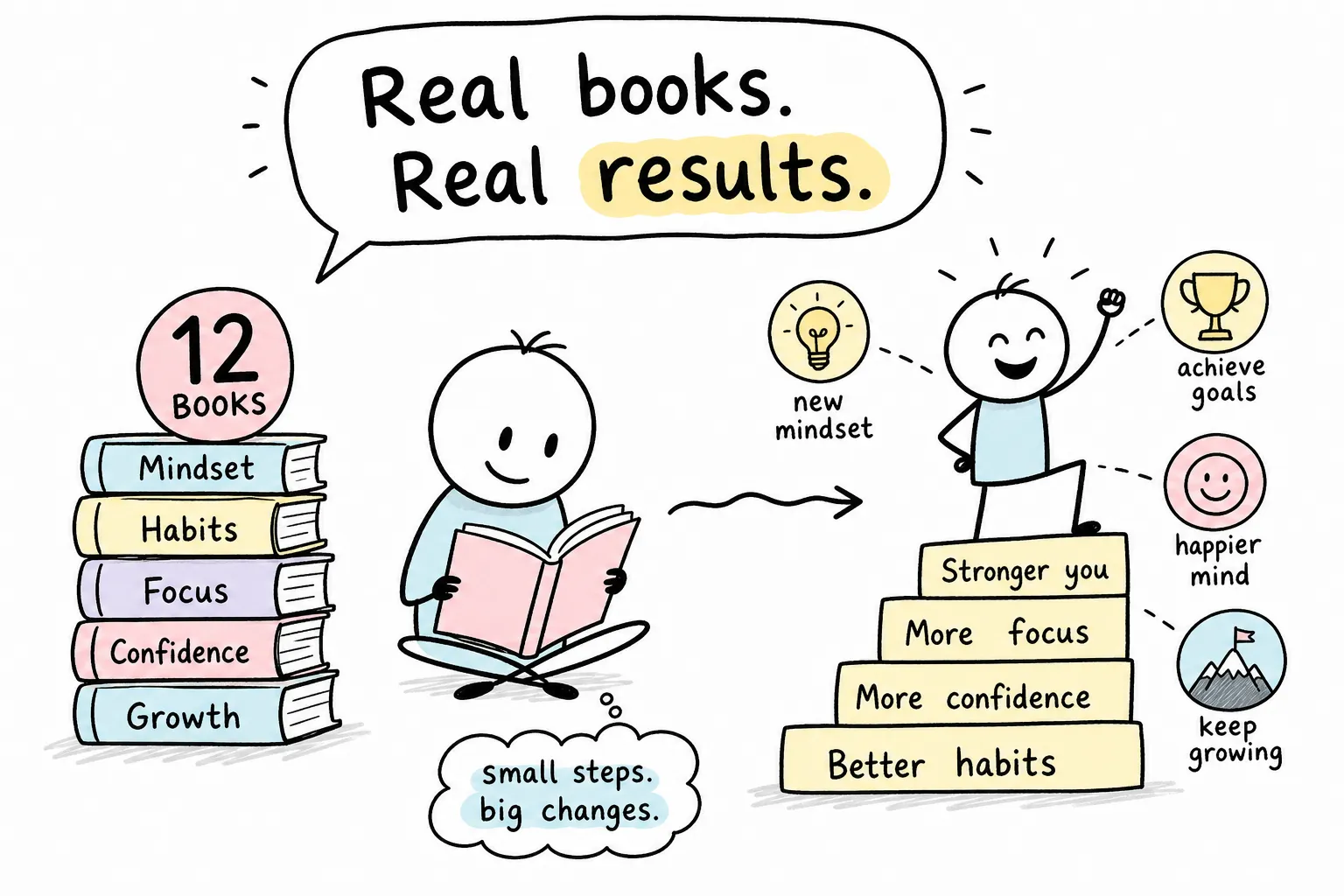
If you've ever wondered what are the best self improvement books that have proven results for readers, you already know the problem with most answers: they're popularity contests, not evidence reviews. Most self-improvement books get abandoned by chapter three. That's not a criticism of readers; it's a design problem. Books that promise transformation without giving you a repeatable system are easy to start and easier to quit. The real question isn't which books are trending on social media this week. It's which ones produce documented, measurable changes in the people who actually finish and apply them.
At The Growth Engine, the whole premise is that real personal growth requires moving from inspiration to action. This list is built around that exact standard: 12 evidence-based self-improvement books organized into four categories, matched to different goals, and followed by a short implementation guide so you don't just read them. You apply them.
What separates a self-improvement book that works from one you forget
Most self-help is not written by researchers. It's written by practitioners summarizing research, or by marketers packaging inspiration into chapters. That gap between popular claim and clinical evidence matters when you're deciding what to spend six hours of your life reading.
The evidence standard this list uses
Every book here passes three checks. First, the core method maps to peer-reviewed research in psychology, behavioral science, or cognitive therapy. Second, the book has sustained commercial relevance over multiple years, not just a strong launch week driven by marketing. Third, reader ratings are high across verified purchasers with substantial review volume. "Evidence-based" in this context means the underlying mechanism is research-supported, not that the book itself is a randomized clinical trial. The distinction matters, and you deserve to know it upfront.
Why sales longevity matters as a trust signal
A book selling millions of copies over 10 to 20 years tells you something that first-week launch numbers never can. It means readers kept buying it after the marketing spend ran out, kept recommending it to friends, and kept returning to it when life got hard. That sustained demand is a meaningful proxy for real-world utility. Books that coast on advertising spend crater after six months. Books that solve real problems compound. The 12 titles below have all passed that test.
What are the best self improvement books that have proven results for readers, 12 evidence-backed picks
The four categories below cover habit formation, cognitive reframing, productivity, and long-term character development. Each book is assessed on its research grounding, reader-reported outcomes, and a concrete first exercise so you can start applying it immediately.
Habit and behavior-change books with the strongest scientific backing
Habit formation research has one of the deepest evidence bases in behavioral science. Context-dependent behavior, automaticity development, and cue-driven action are well-established constructs in academic literature. The books below don't just tell you to build habits; they give you systems grounded in how habits actually form in the brain. These are the proven habit books readers return to again and again.
1. Atomic Habits by James Clear
The core method combines habit stacking, environment design, and the two-minute rule for tiny behavior anchors. These recommendations align with peer-reviewed research on automaticity and context-dependent habit formation. James Clear's email list surpassed 10 million subscribers, the book spent over four years on the New York Times bestseller list, and more than 30 million copies have been sold worldwide as of 2026. Those are not vanity metrics; they're evidence of wide practical adoption. Start here if your primary goal is any kind of behavioral change. Your first exercise: map one current habit to the four-step habit loop and redesign one environmental trigger this week.
2. The Power of Habit by Charles Duhigg
Duhigg's cue-routine-reward habit loop draws directly on MIT behavioral neuroscience research. The framing is a simplification of a broader research base, which is actually what makes it useful: it gives you a workable mental model rather than a literature review. The book's sustained commercial success and adoption in corporate training programs indicate real-world traction beyond airport-bookstore impulse buys. Your key exercise: identify the specific cue driving one unwanted habit and replace only the routine while keeping the cue and reward intact.
3. No Excuses! The Power of Self-Discipline by Brian Tracy
Tracy's approach centers on daily goal-setting and completing your A-1 task, your single most important task, before anything else each morning. Reader-reported outcomes cluster around structured morning planning and improved task-completion consistency. The method is less research-derived than the other two in this category, but its results are practical and trackable. Run a 30-day trial of daily priority planning before evaluating whether it changes your output.
Mindset and cognitive reframing books rooted in clinical research
This category has the most direct link to clinical psychology. Cognitive behavioral therapy has one of the strongest evidence bases in mental health research, and several of the best self improvement books are structured applications of CBT tools. One important caveat: these books support mental wellness and cognitive flexibility, but they are not substitutes for professional care when clinical symptoms are present.
4. Feeling Good by David D. Burns
This is the most clinically grounded title on the list. The book maps almost directly onto CBT thought records and cognitive restructuring techniques, which have extensive meta-analytic support for depression and anxiety. A randomized primary-care trial found that patients prescribed Feeling Good as bibliotherapy showed statistically significant decreases in depression symptoms and increases in quality of life. Over five million copies sold and decades of bibliotherapy use in clinical settings back that up. The triple-column technique, identify automatic thoughts, name the cognitive distortion, and write a rational response, is the core exercise. Practice it daily for six to eight weeks before judging its impact on your internal self-talk.
5. Mindset by Carol Dweck
Dweck's growth mindset construct is one of the most cited ideas in modern education and psychology. The peer-reviewed research behind it shows real effects, though the full picture is more layered than the popular summary: meta-analyses report an average effect size for adults of around d = 0.08 on academic achievement outcomes, which is small. Effects appear larger for well-being and social functioning outcomes. The book's adoption across U.S. education systems and more than 3 million copies sold indicate that readers find the framework useful, even when the effect is context-dependent. Apply it to a specific skill you're building, not as a general philosophy.
6. Chatter by Ethan Kross
Kross is a University of Michigan researcher who built his lab around self-distancing and emotion regulation, and this book draws directly from that work. The distanced self-talk technique, referring to yourself by name or using second-person language during internal monologue, has peer-reviewed support for reducing rumination and improving stress responses. Reader-reported outcomes cluster around reduced anxiety loops and clearer thinking during high-pressure situations. This is a short, dense, immediately applicable read that rewards re-reading after you've tried the exercises.
Productivity and focus books tied to output you can measure
Productivity books are the category most likely to overpromise and underdeliver. The best ones are built on attention research, task-switching costs, and deliberate practice principles that have genuine experimental support. The three below earn their place because their core recommendations align with what cognitive science says about sustained focus. These are research-backed personal development titles, not motivation packages dressed up as systems.
7. Deep Work by Cal Newport
Newport's central argument: the ability to focus without distraction on cognitively demanding tasks is increasingly rare and simultaneously increasing in value. His recommendations align with research on attention and the significant productivity costs of task-switching. Reader-reported outcomes are mostly qualitative but consistent, structured deep-work blocks scheduled daily for four to six weeks regularly produce output gains for knowledge workers. One widely cited reader formulation distills the book's core idea to "high-quality work produced equals time spent multiplied by intensity of focus," which is a useful operational definition. Schedule two 90-minute deep-work blocks daily and track your output for four weeks.
8. The 5 AM Club by Robin Sharma
The 20/20/20 formula is the core implementation: 20 minutes of exercise, 20 minutes of reflection or meditation, and 20 minutes of learning in the first hour of the day. This structure maps to morning cortisol rhythms and habit-stacking principles from behavioral science. Reader reports are clear that this requires a minimum of 30 to 60 days of daily consistency before stable energy and focus improvements appear. If you try it for two weeks and quit, you haven't tested the book; you've tested your patience. Give it a full month before evaluating.
9. Thinking, Fast and Slow by Daniel Kahneman
This is the only book on the list written by the researcher whose work the book summarizes. Kahneman is a Nobel laureate, and the book draws directly from decades of his peer-reviewed judgment-and-decision-making research on cognitive biases and dual-process thinking. The reader outcomes are different from the other books in this category: the primary change is better decision-making and bias recognition rather than productivity in the conventional sense. Track your decisions in a structured journal for six weeks and note where System 1 thinking led you astray. That's the exercise.
Influence and character books that have outlasted every publishing trend
A book selling for 80 years is not luck. It means the advice works across different generations, cultural contexts, and economic conditions. These three titles are the longest-tenured on the list, and their staying power is itself a meaningful form of evidence. They are, in the truest sense, books that actually work.
10. How to Win Friends and Influence People by Dale Carnegie
Published in 1936 and still selling. Carnegie's core principles, genuine interest in others and specific rapport-building behaviors, overlap with modern social psychology findings on liking and persuasion. Reader-reported outcomes consistently center on improved professional relationships and reduced interpersonal conflict. The book's principles align broadly with interpersonal communication research, even if Carnegie himself never framed it that way. The most useful exercise is simple: before every significant conversation this week, write down one genuine question you're curious about regarding the other person.
11. The 7 Habits of Highly Effective People by Stephen Covey
Over 40 million copies sold globally and translated into more than 40 languages. The "begin with the end in mind" and "put first things first" habits map directly to implementation intention research and goal-setting principles from behavioral science. Covey's framework is broadly consistent with well-supported self-regulation research, even without a tight link to a single peer-reviewed method. The most actionable starting point is the weekly planning session: schedule 30 minutes every Sunday to review your roles, goals, and top three priorities for the coming week. Do this for eight consecutive weeks before evaluating its effect on your focus and follow-through.
12. Grit by Angela Duckworth
Duckworth defines grit as sustained effort combined with passion toward long-term goals. The peer-reviewed support exists in correlational and longitudinal studies, with the honest criticism that grit's predictive power overlaps significantly with conscientiousness. That overlap doesn't make the book less useful for most readers; it means the real value is in the deliberate practice framework rather than the grit construct itself. Pair this book with a specific skill you're developing over the next six months and use the deliberate practice structure to track your progress. Without a concrete skill goal attached to it, the book's impact is mostly motivational.
How to move from reading to real change (the implementation gap)
Reading a book is not the same as applying it. Behavior change from self-help reading requires active exercise completion, spaced repetition of the core practice, and a timeline long enough to build automaticity. Most readers who report "not getting results" quit after two weeks, well before the four-to-eight-week threshold where consistent habit application begins to show measurable outcomes. Research on automaticity suggests the minimum is around six weeks for exercise-based behaviors, with broader habit formation averaging 66 days across behaviors and individuals.
The one-book-at-a-time rule and the 8-week practice window
Reading multiple self-help books simultaneously dilutes implementation. When you split your focus across three frameworks, you apply none of them deeply enough to see results. The recommendation is straightforward: commit to one book for at least four to eight weeks, complete the exercises, and track one behavioral metric before picking the next book. Habit-based books need four to six weeks of daily practice. Cognitive reframing tools like those in Feeling Good or Chatter need six to eight weeks to produce noticeable shifts in self-talk patterns. The timeline is not optional; it's the method.
Where The Growth Engine comes in
This is the gap most readers fall into: they finish a genuinely good book, feel energized, and then have no system for applying what they just read. The inspiration fades within a week. The Growth Engine exists specifically to close that gap. The platform's resources, including habit-tracking templates built around the cue-routine-reward loop, a weekly priority-planning worksheet aligned with Covey's framework, and personal development guides for each category above, are designed for readers who have the inspiration but need the system. The content connects mindset, productivity, and daily practice into one implementation-ready resource, so you're not left with highlighted pages and no action plan. Check out the habit and productivity sections for templates you can start using this week.
How to match the right book to your specific goal
Not every book works for every reader, and the wrong book for your current goal wastes time even if it's an excellent book. A simple matching framework cuts through the choice paralysis.
A simple goal-to-book matching framework
Use this to choose your first read from the list:
- Building or breaking a specific habit: Start with Atomic Habits.
- Reducing anxiety, negative self-talk, or rumination: Start with Feeling Good or Chatter.
- Sharper focus and measurable output as a knowledge worker: Start with Deep Work.
- A comprehensive character and productivity system across all life areas: Start with The 7 Habits.
- Daily self-discipline and execution specifically: Start with No Excuses!
One book, one goal, one eight-week window.
Using reader ratings and sales data to vet a new pick
Before buying a self-improvement book not on this list, run it through the same filter used here. Look for sustained sales rank over multiple years, not just a launch-week chart position. Look for a high average rating from verified purchasers with at least 10,000 reviews, a 4.8-star average from 200 reviewers tells you very little. And look for at least one peer-reviewed mechanism mentioned in credible reviews or the author's own references. These three checks won't guarantee a book works for you, but they eliminate most of the noise.
What to track to know if a book is actually working for you
A book that produces no measurable change after four to eight weeks of honest application is either the wrong book for your goal or being read without the exercises. The antidote is a short measurement system you run in parallel with the reading.
Three metrics worth tracking across any self-improvement book
Track these three data points throughout your eight-week commitment:
- Behavior frequency: How often per week are you completing the book's core exercise?
- Target outcome metric: A specific, goal-tied measure, daily focus hours tracked, savings rate recorded, or sleep consistency logged.
- Weekly subjective check-in: Rate your energy, clarity, or mood on a 1-to-10 scale every Sunday morning.
Six to eight weeks of these three data points gives you a real signal rather than a feeling. You'll know whether the book is working or whether it's time to adjust.
Red flags that a book isn't the right fit
Common signs a book isn't working for you: the exercises feel impossible to start because they require a life context you don't have; the author's core worldview conflicts with your values so deeply that you resist every recommendation; or the book was designed for a specific situation, such as a structured nine-to-five job, when your reality is freelance or shift work. Even the best research-backed books don't produce results for every reader in every context. Knowing when to stop is as valuable as knowing how to start, and switching books after an honest eight-week trial is not failure. It's good data.
Start with one book, not a reading list
The best self improvement books with proven reader results aren't the ones with the loudest marketing or the most viral TikTok summaries. They're the books that actually work, grounded in behavioral science, tested across millions of readers over years, and paired with a real implementation plan. Every title on this list earned its place through sustained results, not launch-week hype.
Your move is simple. Pick one book that matches your current goal. Block four to eight weeks to complete its exercises. Track one metric that tells you whether anything is actually changing. That's the entire system. You don't need to read all 12; you need to apply one deeply enough that it becomes part of how you operate.
Still asking what are the best self improvement books that have proven results for readers? The answer is already in front of you. Choose the title that maps to your goal, commit to the eight-week window, and use The Growth Engine's habit and productivity resources to bridge the gap between a finished book and a practiced system. Choose your book, commit to the timeline, and build the habits that make the reading matter.
#SelfImprovementBooks #EvidenceBased #HabitBuilding #PersonalGrowth #SmartMoney #MindsetShift #ProductivityHacks #ReadToSucceed


Comments
Post a Comment